AI + CRM: The Future of Business Automation
In today’s fast-moving digital world, businesses are always searching for smarter ways to improve customer relationships, save time, and increase productivity. This is where AI and CRM together are creating a huge transformation. Companies are no longer depending only on manual processes and traditional customer management methods. Instead, they are using Artificial Intelligence (AI) combined with Customer Relationship Management (CRM) systems to automate tasks, improve customer experience, and grow faster.
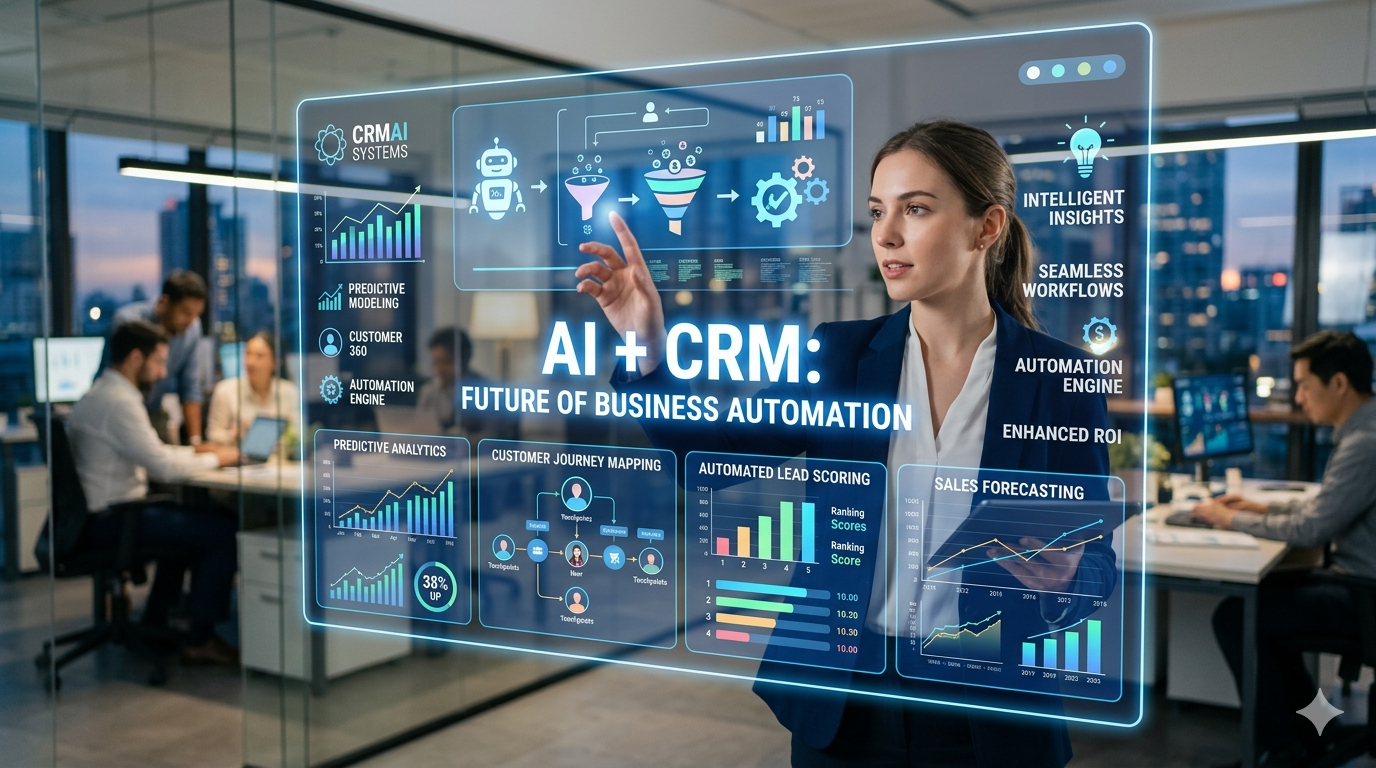
The combination of AI and CRM is becoming the future of business automation. From sales and marketing to customer support and analytics, AI-powered CRM systems are helping businesses work smarter than ever before.
Many training institutes and IT learning platforms are also focusing on these technologies because the demand for skilled professionals is increasing rapidly. Platforms like Cloud Data Technologies are helping students and working professionals learn modern CRM and automation technologies through practical training and real-time projects.
In this blog, we will explore how AI and CRM are changing modern businesses, the benefits of business automation, real-world use cases, and why companies should adopt AI-powered CRM solutions.
Salesforce and other CRM platforms help businesses manage customer data, sales activities, communication, and support services in one place.
CRM stands for Customer Relationship Management. It is software that helps companies:
Store customer information
Track sales activities
Manage leads and opportunities
Improve customer service
Automate workflows
Analyze customer behavior
Popular CRM platforms used by businesses include:
Salesforce
Microsoft Dynamics 365
HubSpot
Zoho CRM
CRM systems have already changed how businesses operate. But when AI is added to CRM, the possibilities become much more powerful.
Artificial Intelligence in CRM means using smart technologies like machine learning, predictive analytics, automation, and chatbots inside CRM systems.
AI helps CRM software:
Understand customer behavior
Predict future sales
Automate repetitive tasks
Provide personalized recommendations
Improve customer communication
Analyze large amounts of data quickly
Instead of employees spending hours on manual work, AI-powered CRM systems can handle many tasks automatically.
This helps businesses save time, reduce errors, and focus more on customer satisfaction.
Businesses today handle massive amounts of customer data daily. Managing everything manually is difficult and time-consuming.
AI-powered CRM systems make business automation faster and smarter by:
Reducing manual work
Improving decision-making
Increasing productivity
Enhancing customer experience
Delivering real-time insights
Companies that adopt AI in CRM can respond to customer needs more efficiently and stay ahead of competitors.
This is one of the reasons many learners are now choosing CRM and AI-related courses to build future-ready careers. Training providers like Cloud Data Technologies are seeing increasing interest in Salesforce, automation, data visualization, and CRM technologies from students and working professionals.
Sales teams often spend a lot of time identifying quality leads. AI can analyze customer behavior and automatically identify the best leads for sales teams.
AI-powered CRM systems can:
Score leads automatically
Predict customer interest
Recommend follow-up actions
Prioritize high-converting leads
This helps sales representatives focus on leads that are more likely to become customers.
Customer support is becoming faster and more efficient with AI chatbots and virtual assistants.
AI-based CRM systems can:
Answer customer questions instantly
Provide 24/7 support
Route tickets automatically
Analyze customer sentiment
This improves customer satisfaction while reducing workload for support teams.
For example, many businesses use AI chatbots to handle basic support requests before connecting customers to human agents.
One of the biggest advantages of AI in CRM is predictive analytics.
AI can study customer data and predict:
Future buying behavior
Sales trends
Customer churn risks
Revenue growth opportunities
Businesses can use these insights to make better decisions and improve business strategies.
AI-powered CRM systems automate many sales-related tasks.
These include:
Sending follow-up emails
Scheduling meetings
Updating customer records
Tracking customer interactions
Creating reminders
Sales teams can spend more time closing deals instead of doing repetitive administrative work.
Modern customers expect personalized experiences. AI helps businesses deliver targeted marketing campaigns based on customer interests and behavior.
AI can:
Recommend products
Send personalized emails
Segment customers automatically
Analyze campaign performance
This improves engagement and increases conversion rates.
Businesses often have repetitive daily tasks that consume time and resources.
AI + CRM automation helps businesses:
Approve requests automatically
Trigger notifications
Update records instantly
Generate reports automatically
Workflow automation improves efficiency and reduces operational delays.
Employees can focus on important business activities while AI handles repetitive tasks.
AI helps businesses respond quickly and provide personalized services.
Real-time insights and predictive analytics help management make smarter business decisions.
AI improves lead management and customer targeting, resulting in higher sales opportunities.
Automation reduces manual work, saving time and labor costs.
AI helps businesses understand customer needs and improve long-term relationships.
Online shopping companies use AI-powered CRM systems to:
Recommend products
Analyze customer preferences
Automate marketing campaigns
Improve customer support
This helps improve customer engagement and sales.
Healthcare Industry
Hospitals and healthcare providers use AI-based CRM systems to:
Manage patient records
Schedule appointments
Send automated reminders
Improve patient communication
This increases efficiency and improves patient care.
Banks use AI in CRM for:
Fraud detection
Customer support automation
Personalized financial recommendations
Risk analysis
AI helps financial institutions improve security and customer service.
Educational institutions use CRM automation for:
Student admissions
Attendance tracking
Course management
Student communication
AI helps streamline administrative operations and improve student experiences.
Many IT training institutes are also adopting CRM tools to manage student inquiries, admissions, and learning support. Organizations like Cloud Data Technologies are increasingly focusing on practical CRM learning because companies now prefer candidates with real-time automation skills.
Many modern CRM platforms already include AI features.
Salesforce Einstein is an AI-powered feature inside Salesforce that provides:
Predictive analytics
Smart recommendations
Automated insights
AI-powered forecasting
Microsoft Dynamics 365 uses AI for:
Customer insights
Sales predictions
Intelligent automation
Customer service optimization
HubSpot offers AI-based features for:
Email writing
Chat automation
Marketing optimization
Reporting
Although AI-powered CRM systems offer many benefits, businesses may also face some challenges.
AI systems depend heavily on accurate data. Poor-quality data can produce incorrect insights.
Employees need proper training to use AI-powered CRM tools effectively.
Businesses may face challenges while integrating AI with existing systems.
Advanced CRM and AI solutions may require significant investment initially.
However, long-term benefits usually outweigh the implementation costs.
The future of AI and CRM looks extremely promising. Businesses are expected to adopt even more advanced automation technologies.
Some future trends include:
Voice assistants will help users interact with CRM systems using voice commands.
AI will provide highly personalized customer experiences based on real-time behavior.
Future AI systems will offer even more accurate sales and customer predictions.
Businesses will rely more on AI-generated insights for strategic planning.
Future CRM platforms may automate most customer management tasks with minimal human involvement.
Businesses that delay digital transformation may struggle to compete in the future.
AI-powered CRM systems help companies:
Improve efficiency
Deliver better customer experiences
Increase profitability
Stay competitive
Scale operations faster
Companies that invest in AI and CRM today will be better prepared for future business challenges.
As AI-powered CRM adoption grows, demand for skilled professionals is also increasing.
Popular career opportunities include:
Salesforce Administrator
CRM Consultant
AI Business Analyst
CRM Developer
Data Analyst
Automation Specialist
Important skills for these careers include:
CRM administration
Business automation
Data analytics
AI fundamentals
Workflow automation
Reporting and dashboards
Many beginners are now enrolling in practical CRM and automation training programs to improve their career opportunities. Learning platforms such as Cloud Data Technologies provide hands-on exposure to technologies like Salesforce, Tableau, Power BI, and Dynamics 365, which are highly valuable in today’s job market.
AI and CRM together are transforming the future of business automation. Businesses no longer want slow manual processes and disconnected systems. They need smart solutions that improve productivity, automate workflows, and provide better customer experiences.
AI-powered CRM systems are helping businesses automate sales, customer support, marketing, analytics, and operations more efficiently than ever before. From predictive analytics to intelligent chatbots and workflow automation, AI is making CRM systems smarter and more valuable.
As technology continues to evolve, AI + CRM will become an essential part of every modern business. Companies that adopt these technologies early will gain a strong competitive advantage in the digital marketplace.
For students, freshers, and working professionals, learning AI-powered CRM technologies like Salesforce and Dynamics 365 can open the door to exciting and high-paying career opportunities in the future.
Businesses that embrace AI and CRM today are not just improving operations — they are preparing for the future of intelligent business automation.
 admin
admin