Artificial Intelligence (AI) is changing the way people work with data. From automating repetitive tasks to helping businesses make smarter decisions, AI has become an important part of modern technology. One area where AI is making a significant impact is SQL query writing.
SQL (Structured Query Language) is the standard language used to interact with databases. Developers, data analysts, and database administrators use SQL to retrieve, update, and manage data. However, writing SQL queries can be challenging for beginners. Complex joins, nested queries, and optimization techniques often require experience and practice.
Today, AI SQL Query Writing tools are simplifying this process. These tools help users generate, optimize, and troubleshoot SQL queries quickly and accurately. For freshers entering the world of databases and data analytics, AI is making SQL learning easier than ever before.
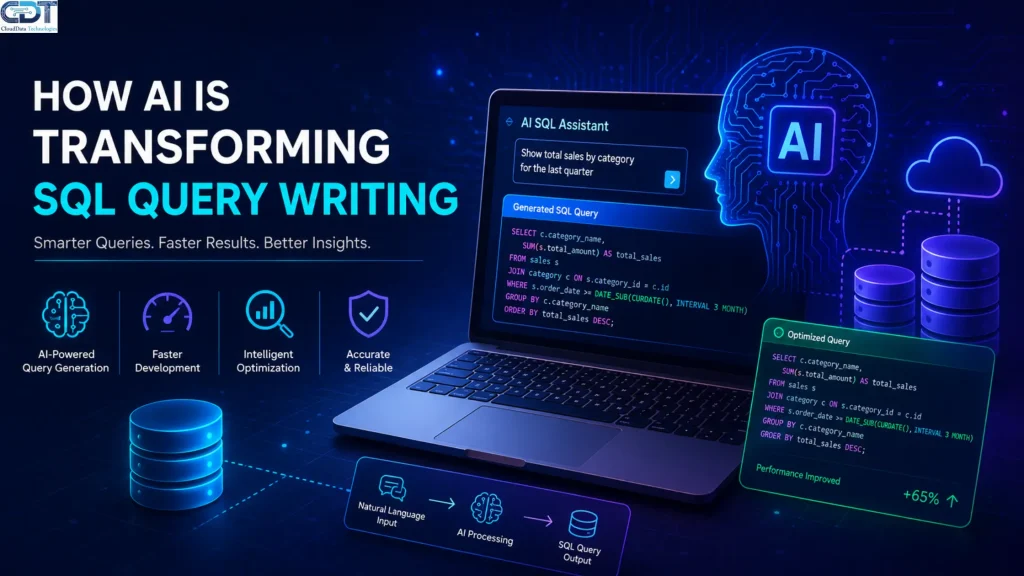
AI SQL Query Writing refers to the use of artificial intelligence and machine learning technologies to generate SQL queries from natural language instructions. Instead of manually writing complex SQL commands, users can simply describe what they need, and AI generates the appropriate query.
For example, a user can type:
“Show all customers who made purchases above $500 in the last three months.”
An AI-powered SQL tool can convert this request into a properly structured SQL query within seconds.
This technology combines natural language processing (NLP), machine learning, and database intelligence to bridge the gap between human language and database operations.
Many beginners struggle with SQL because it requires understanding several concepts, including:
Database structures
Tables and relationships
SQL syntax
Joins and subqueries
Aggregate functions
Query optimization
Even a small syntax error can cause a query to fail. Freshers often spend hours debugging simple mistakes.
As databases become larger and more complex, writing efficient queries becomes even more challenging. This is where AI-powered SQL tools provide valuable assistance.
One of the biggest innovations in AI SQL Query Writing is natural language processing.
Instead of learning complex SQL syntax immediately, users can type requests in plain English. AI interprets the request and generates the correct SQL statement.
This feature helps beginners:
Freshers can focus on understanding database concepts rather than memorizing every SQL command.
Writing SQL queries manually can take time, especially for beginners.
AI-powered SQL tools generate queries instantly. Users simply describe their requirements, and the system creates the necessary code.
This capability saves valuable time when:
Developers and analysts can spend more time interpreting data instead of writing code.
A query may work correctly but still perform poorly.
AI tools can analyze SQL statements and suggest improvements. They identify inefficient operations and recommend better alternatives.
Common optimization suggestions include:
This helps databases perform faster while reducing resource consumption.
SQL errors are common among beginners.
AI-powered platforms can detect syntax mistakes, logical errors, and performance issues before execution.
For example, AI can identify:
Instead of searching through documentation for hours, users receive immediate guidance.
AI is becoming an excellent learning assistant for SQL beginners.
Modern AI tools explain:
Freshers can learn SQL concepts more effectively through real-time feedback and practical examples.
This interactive learning process accelerates skill development and boosts confidence.
AI reduces the complexity of learning SQL by providing guidance throughout the learning process.
Users can generate queries quickly and complete tasks faster.
AI minimizes syntax and logical mistakes, improving accuracy.
AI-generated explanations help beginners understand database relationships and query logic.
As AI tools become common in workplaces, learning AI-assisted SQL development prepares freshers for future job opportunities.
AI SQL Query Writing is useful across multiple industries and job roles.
Data analysts use AI to generate reports, analyze trends, and extract insights from large datasets.
Organizations use AI-powered SQL tools to build dashboards and support decision-making.
Developers use AI to create database queries more efficiently during application development.
Database administrators use AI for query optimization, monitoring, and troubleshooting.
Students and freshers use AI tools to learn SQL concepts and practice database operations.
Although AI SQL Query Writing offers many advantages, it is not perfect.
Some challenges include:
AI may occasionally misunderstand user requests and generate incorrect queries.
Different database systems use slightly different SQL syntax. AI-generated queries may require adjustments.
Organizations must review AI-generated queries carefully to avoid security risks or unintended database modifications.
Freshers should avoid relying entirely on AI. Understanding SQL fundamentals remains essential for long-term career growth.
The future of AI SQL Query Writing looks promising.
As AI technology advances, we can expect:
Businesses increasingly rely on data-driven decision-making. As a result, professionals who understand both SQL and AI technologies will be highly valuable in the job market.
Freshers who learn these skills today will gain a competitive advantage in future careers.
AI is transforming SQL query writing by making database interactions faster, smarter, and more accessible. Through natural language processing, automated query generation, intelligent optimization, and error detection, AI is helping users work with databases more efficiently than ever before.
For freshers, AI SQL Query Writing provides an excellent opportunity to learn database concepts while improving productivity. However, AI should be viewed as a learning companion rather than a replacement for SQL knowledge.
By combining strong SQL fundamentals with modern AI-powered tools, aspiring developers and data professionals can build successful careers in today’s data-driven world. As AI continues to evolve, the role of SQL will remain important, and those who embrace both technologies will be well-positioned for future success.