Driving Scalable Efficiency: The Ultimate Guide to Enterprise Multi-Agent Orchestration & Use Cases
Remember the days when a simple AI chatbot answering customer FAQs felt like pure magic? Those days are officially behind us. Monolithic, single-prompt AI models served us well as basic productivity tools, but they frequently hit a hard wall when faced with complex, long-horizon enterprise operations. They easily lose track of context, suffer from hallucination cascades, and cannot reliably run multi-step workflows that require distinct corporate skill sets.
Today, forward-thinking businesses are shifting away from standalone AI tools toward a much more powerful paradigm: digital workforces. This sea change is entirely driven by Enterprise Multi-Agent Orchestration & Use Cases.
Instead of asking one massive AI model to handle everything, modern enterprise architecture deploys specialized networks of autonomous AI agents. These individual agents act like focused department experts—such as data analysts, compliance officers, and copywriters—working under a centralized control plane to achieve shared, high-value business goals.
Let’s break down exactly what this means, how it works, and how you can deploy it to unlock massive ROI for your business.
To understand how Enterprise Multi-Agent Orchestration & Use Cases function in the real world, think of it like a digital symphony. One musician playing a solo can sound beautiful, but you need an entire coordinated orchestra to play a complex, multi-layered symphony.
In this setup, the “orchestration layer” acts as the conductor. It centralizes the responsibility for timing, sequencing, task assignment, and global state management. Rather than embedding messy coordination logic inside individual agents, the conductor seamlessly routes information, tracks goals, manages dependencies, and steps in with error-handling mechanisms when things don’t go as planned.
                       +---------------------------+
                       |    Orchestration Layer    |
                       |       (The Conductor)     |
                       +-------------+-------------+
                                     |
         +---------------------------+---------------------------+
         |                           |                           |
         v                           v                           v
+-----------------+         +-----------------+         +-----------------+
|  Data Agent A   | <-----> | Compliance B    | <-----> |   Writer Agent C|
| (Queries Logs)  |         | (Checks Rules)  |         | (Drafts Report) |
+-----------------+         +-----------------+         +-----------------+
When you scale this concept to an enterprise level, these agentic networks don’t just talk to each other; they interface directly with your live APIs, databases, CRMs, and enterprise tools. This changes AI from a passive assistant into an active, governed operational layer that can execute work autonomously at scale.
Building a reliable multi-agent network requires choosing the right communication structure. Enterprises generally rely on a few core design patterns depending on the complexity of the workflow:
Orchestrator-Worker (Centralized): A single master agent interprets the user’s intent, breaks it down into individual tasks, assigns them to specialized worker agents, collects the results, and delivers the final output. This pattern provides incredible control and predictability.
Hierarchical Teams: This architecture mimics a traditional corporate org chart. You might have a “VP Agent” coordinating several “Manager Agents,” each running their own localized squad of execution agents. It is perfect for sprawling enterprise operations.
Sequential Pipelines: Tasks flow linearly from one agent to the next. For example, Agent A extracts data, Agent B cleans it, and Agent C formats it.
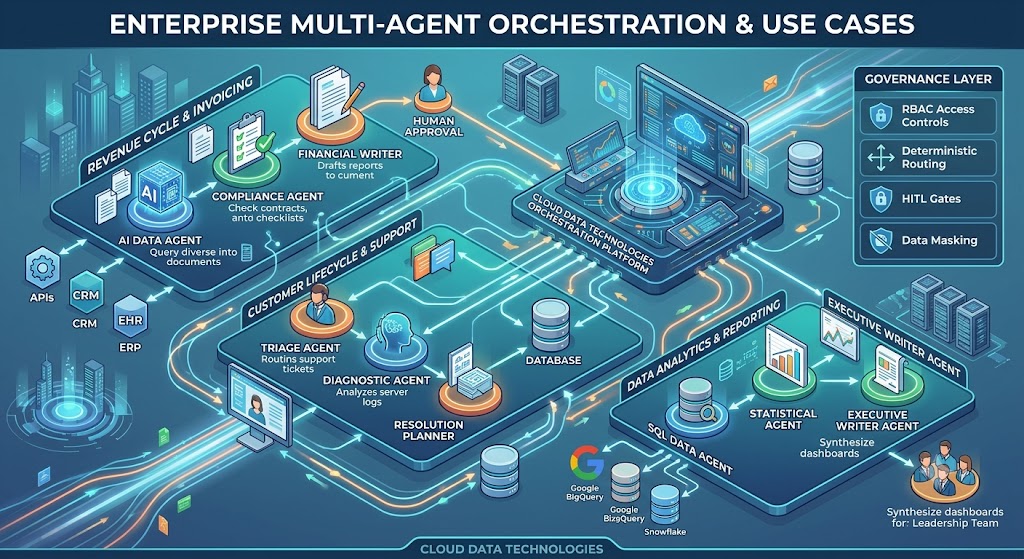
Enterprise Multi-Agent Orchestration & AI Use Cases
Peer-to-Peer (Swarms): Agents collaborate dynamically in a decentralized network, passing context back and forth to solve a problem collectively. While highly flexible, it requires strong guardrails to keep token costs and runtime loops under control.
Seeing this technology in action is the best way to understand its power. Let’s explore how structured networks of autonomous agents radically transform standard back-office and front-office operations.
Managing complex corporate billing, matching purchase orders, and resolving invoice discrepancies usually requires hours of manual oversight. Multi-agent networks completely revolutionize this pipeline.
Agent A (The Extraction Expert): Scans incoming invoices, purchase orders, and unstructured billing PDFs across multi-format documents using advanced OCR and LLM parsing.
Agent B (The Cross-Reference Specialist): Securely calls enterprise database APIs to cross-check line items, pricing books, and historical contract terms to catch deviations.
Agent C (The Compliance & Dispute Drafter): Flags any missing data or financial anomalies, cross-references internal tax rules, and drafts highly precise dispute or approval notices.
The Orchestrator: Assembles the entire validated packet and routes it directly to a Human-in-the-Loop (HITL) manager dashboard for a final, one-click sign-off before triggering the payment API.
Business Impact: Organizations see up to an 80% reduction in billing processing times, removing data-entry leakage while maintaining tight human oversight.
Traditional customer support relies on rigid, frustrating decision trees. When a tier-3 technical issue hits a support queue, it typically bounces between multiple human silos before resolution. An agentic network changes the entire experience.
Agent A (The Triage & Sentiment Guide): Analyzes incoming customer tickets, evaluates emotional sentiment, extracts immediate intent, and checks historical customer records.
Agent B (The Deep System Diagnostic Agent): Interacts securely with system logs, internal knowledge bases, and API monitoring tools to safely isolate the exact technical root cause.
Agent C (The Resolution Architect): Drafts a personalized, step-by-step resolution blueprint for the user and automatically updates the client profile inside your CRM.
Business Impact: Drastically drops your Mean Time to Resolution (MTTR) by 30% to 40%, keeping your expensive tier-3 engineering human resources focused on building product infrastructure rather than hunting down log bugs.
In modern business, data is everywhere, but insights are hard to extract. Teams frequently spend days pulling data from different systems just to compile a single weekly briefing.
Agent A (The SQL/Data Retrieval Pro): Dynamically constructs and executes highly secure queries across your distributed data warehouses, whether you use Snowflake, BigQuery, or Microsoft Fabric.
Agent B (The Statistical Analyst): Processes the raw datasets to isolate anomalies, historical shifts in operational KPIs, and emerging market trends.
Agent C (The Executive Copywriter): Synthesizes those dense analytical discoveries into a beautifully polished report, automatically creating corresponding visualization layout instructions.
Business Impact: Shifts your business intelligence team away from manual data aggregation and empowers them to act as strategic editors who audit, refine, and act on instantly generated insights.
While the benefits are massive, deploying multi-agent systems at scale introduces unique challenges around predictability, security, and computing costs. If you leave agents to communicate entirely on their own, you run the risk of cascading API loops, accidental data exposure, or astronomical token bills.
To deploy these systems safely, enterprise-grade orchestration platforms implement strict operational frameworks:
+--------------------------------------------------------------+
|                   ENTERPRISE GOVERNANCE LAYER                |
+--------------------------------------------------------------+
|  [RBAC Access Controls]   --> Only authorized data calls     |
|  [Deterministic Routing]  --> Strict limits on agent loops   |
|  [HITL Review Gates]      --> Humans approve high-stake actions|
|  [Data Masking / Trust]   --> PII is redacted before LLM processing|
+--------------------------------------------------------------+
By separating your core business logic from the agentic reasoning layer, you guarantee that every single agent operates within predefined regulatory and compliance rails.
Building a robust digital workforce requires leveraging mature developer frameworks and open integration protocols. Modern architectures are moving toward flexible, framework-agnostic systems that prevent vendor lock-in.
| Framework / Protocol | Core Strength & Use Case | Production Advantage |
| LangGraph | Advanced cyclic graph orchestration with state state-machine control. | Offers maximum control and time-travel debugging for complex branching logic. |
| CrewAI Enterprise | Role-based agent networks that are easy to prototype and deploy. | Rapid setup for collaborative agent teams with SOC2/HIPAA compliance rails. |
| Microsoft AutoGen (AG2) | Event-driven, asynchronous conversational agent architectures. | Exceptional built-in sandboxed code execution environments. |
| Model Context Protocol (MCP) | Open-standard protocol developed to connect frontier models to tools. | Provides secure, modular tool integration across multiple distinct LLM providers. |
By combining these frameworks with robust observability platforms, engineering teams can trace every step an agent takes, measure latency, and optimize token costs transparently.
Moving from experimental chatbots to production-ready agentic systems requires deep architectural expertise, robust data pipelines, and a clear understanding of enterprise security.
At CloudData Technologies, we help organizations move past simple prompt engineering to build high-performance, secure, and compliant multi-agent networks tailored to their specific operational workflows. Whether you want to comprehensively upskill your internal development teams through our advanced training masterclasses, or require end-to-end strategic consulting to architect a custom autonomous workforce, our experts deliver production-ready velocity.
Stop treating AI like a static text tool. Reach out to our team today, and let’s design a dynamic, resilient multi-agent orchestration architecture that transforms your complex enterprise data into a scalable, high-yielding operational advantage.