Choosing the right database is one of the most important decisions in software development. Whether you are building a mobile app, a business application, or a high-traffic website, your database directly affects performance, scalability, and security.
Among the most popular relational database management systems (RDBMS), SQLite and MySQL are widely used by developers worldwide. Although both store and manage structured data efficiently, they serve different purposes.
In this guide, we compare SQLite vs MySQL in detail, including their architecture, performance, security, scalability, advantages, disadvantages, and ideal use cases. By the end of this article, you will understand which database is the better choice for your project.
SQLite is a lightweight, serverless, self-contained relational database management system. Unlike traditional databases, SQLite does not require a dedicated server. Instead, the entire database is stored in a single file on the local system.
Because of its simplicity and portability, SQLite is commonly used in:
SQLite is built directly into many operating systems and programming languages, making deployment incredibly simple.
MySQL is one of the world’s most popular open-source relational database management systems. Unlike SQLite, MySQL uses a client-server architecture where multiple users can access the same database simultaneously.
Large organizations, startups, and enterprises use MySQL for handling massive datasets and high-volume applications.
Common applications include:
MySQL offers advanced security, scalability, and performance features for production-level environments.
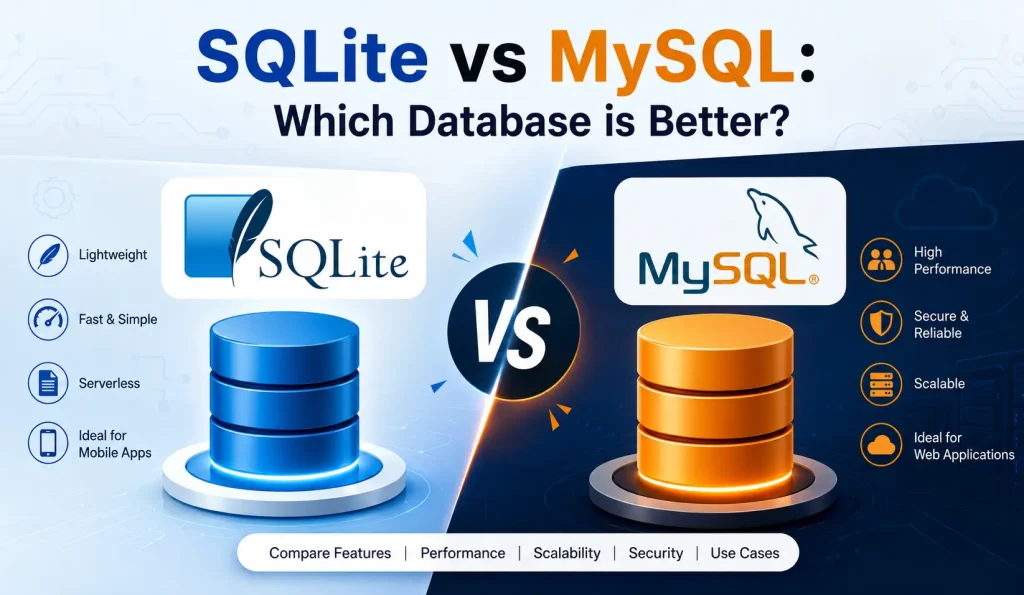
| Feature | SQLite | MySQL |
| Architecture | Serverless | Client-Server |
| Installation | Very Easy | Moderate |
| Database Size | Small to Medium | Medium to Very Large |
| Multi-user Support | Limited | Excellent |
| Performance | Fast for Local Access | Excellent for Concurrent Users |
| Security | Basic | Advanced |
| Scalability | Limited | Highly Scalable |
| Transactions | ACID | ACID |
| Best For | Mobile & Embedded Apps | Enterprise & Web Applications |
Performance depends largely on your application requirements.
SQLite performs exceptionally well when a single user accesses the database. Since there is no communication between the application and a separate database server, read operations are extremely fast.
However, SQLite struggles when multiple users attempt to write data simultaneously because it locks the entire database during write operations.
MySQL handles concurrent users much more efficiently. It supports multiple read and write operations at the same time, making it ideal for busy websites and enterprise applications
Scalability becomes important as your application grows.
SQLite works perfectly for small projects but becomes less efficient as database size and user traffic increase.
MySQL is designed for scalability. It supports:
If your application expects future growth, MySQL offers a much better long-term solution.
Security is critical for modern applications.
SQLite provides basic database security because the database exists as a single file. Protection mainly depends on operating system permissions.
MySQL offers enterprise-grade security features such as:
Organizations handling customer or financial data typically choose MySQL for its advanced security capabilities.
SQLite stores everything inside one database file.
Advantages include:
MySQL stores data across multiple files managed by the database server.
This allows:
Concurrency refers to multiple users accessing the database simultaneously.
SQLite allows multiple readers but only one writer at a time.
This limitation makes SQLite unsuitable for applications where many users frequently update data.
MySQL supports hundreds or even thousands of concurrent users through sophisticated locking mechanisms.
Therefore, websites receiving heavy traffic usually rely on MySQL.
SQLite is incredibly easy to use.
There is:
Developers can simply create a database file and begin storing data immediately.
MySQL requires:
Although installation takes more effort, it provides significantly more functionality.
SQLite offers several benefits for developers.
Simple Setup
SQLite works immediately without installing additional software.
Lightweight
Its small footprint makes it perfect for mobile and embedded devices.
Portable
Moving a database is as easy as copying a single file.
Cost Effective
SQLite is completely free and open source.
Fast Local Performance
Applications experience minimal latency because there is no database server communication.
MySQL provides enterprise-level capabilities.
High Performance
It handles large datasets efficiently.
Multi-user Support
Many users can work simultaneously without affecting performance.
Strong Security
MySQL includes advanced authentication and encryption features.
High Availability
Replication and clustering improve system reliability.
Extensive Community Support
Millions of developers actively contribute tutorials, plugins, and documentation.
SQLite is the better choice when you need:
Examples include:
MySQL is the better option for:
Examples include:
There is no universal winner because each database solves different problems.
Choose SQLite if you need:
Choose MySQL if you require:
For modern web applications, MySQL is generally the preferred choice due to its reliability, scalability, and extensive feature set.
However, for mobile apps, embedded systems, and local desktop applications, SQLite remains one of the fastest and easiest database solutions available.
Understanding the differences between SQLite and MySQL helps developers choose the right database based on project requirements rather than popularity. SQLite excels in simplicity, portability, and local performance, while MySQL stands out with superior scalability, security, and multi-user capabilities.
If you are starting a small application that stores data locally, SQLite is an excellent option. On the other hand, if you plan to build a dynamic website, enterprise application, or cloud-based platform with thousands of users, MySQL is the better investment.
Learning both databases is highly valuable because each serves a unique purpose in modern software development. Mastering SQLite and MySQL also strengthens your SQL skills and prepares you to work on a wide variety of real-world projects.
At Cloud Data Technologies, we provide practical SQL training with real-world database projects that cover SQLite, MySQL, SQL Server, PostgreSQL, and advanced SQL concepts. Our hands-on approach helps students, freshers, and working professionals gain the skills needed for database development, data analysis, and software engineering careers.