
If you are getting ready for an AI job interview, you have probably noticed one thing already. Every second job posting now mentions “Agentic AI” somewhere in the description. So, if you want to walk into that interview room with confidence, you need more than just a basic idea of what Agentic AI means. You need real, practical answers ready to go.
That is exactly why we, at CloudData Technologies, put together this guide. In this article, we cover the most common Agentic AI interview questions and answers, explained in plain and simple language. Whether you are a fresher trying to break into AI, or a working professional switching careers, this guide will help you prepare properly and walk in ready.
Let’s get started.
Before jumping into the questions, let’s quickly understand why this topic has become such a big deal.
Agentic AI is no longer just a research buzzword. Companies across industries are moving from simple chatbots to full-on autonomous systems that can plan, decide, and act on their own. Because of this shift, hiring managers are actively searching for people who understand how these systems work under the hood, not just people who know how to use ChatGPT.
As a result, interviewers today ask much deeper questions than before. They want to know if you can actually design an agent, debug one when it fails, and explain your reasoning clearly. So, if you are preparing for an AI role, brushing up on Agentic AI interview questions is one of the smartest things you can do right now.
This is exactly the gap that CloudData Technologies aims to close through its hands-on Agentic AI training program. Instead of just covering theory, the course walks you through real frameworks, live projects, and practical scenarios, so you are not just memorizing answers but actually understanding how these systems work.
Almost every interview starts with this one. So, let’s nail it first.
Question: What is Agentic AI, and how is it different from a regular AI chatbot?
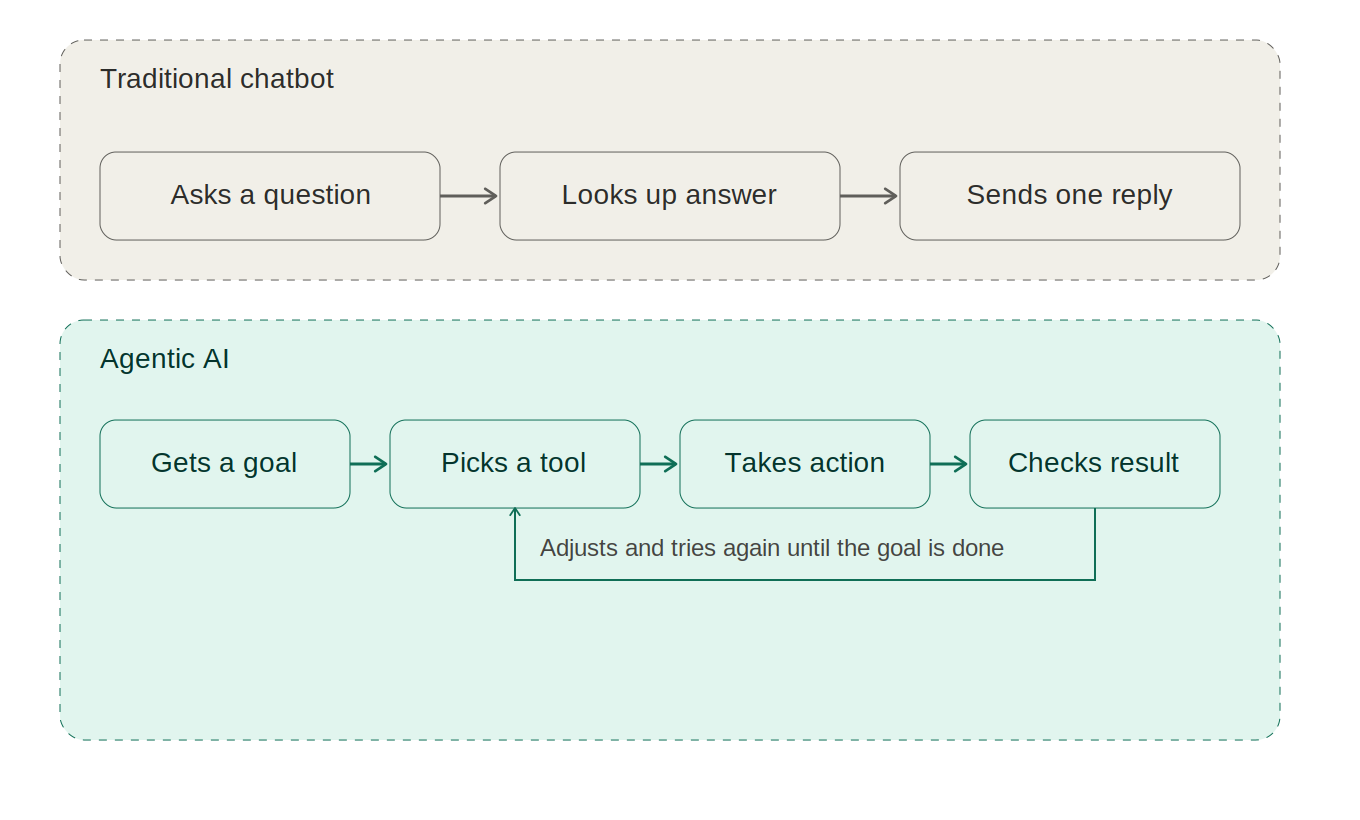
Here’s a simple way to answer it. A regular chatbot follows a fixed pattern. You ask a question, it searches for an answer, and it replies. That’s it. The process ends there.
Agentic AI, on the other hand, works very differently. Instead of just answering once, an AI agent can break down a big task into smaller steps, decide which tool or resource to use for each step, and keep working until the task is fully done. For example, if you ask a chatbot “book me a flight,” it usually cannot do it. But an AI agent can search flights, compare prices, check your calendar, and even complete the booking, all without you guiding every single step.
In short, a chatbot reacts. An agent plans, acts, and adapts. That difference is the whole foundation of Agentic AI, so make sure you can explain it clearly and confidently.
These questions test your basic understanding. Interviewers usually start here to see how well you grasp the fundamentals before moving to harder topics.
1. What are the core components of an AI agent? Every working AI agent generally needs a few basic building blocks. These include a reasoning engine (usually a large language model), a memory system to remember past actions, a set of tools it can call (like search engines or APIs), and a planning or orchestration layer that decides what to do next. Without these pieces working together, an agent cannot function properly.
2. What is the difference between automation and agentic behavior? Traditional automation follows fixed rules. If X happens, do Y, every single time. Agentic behavior is different because the system actually evaluates the situation first, then decides what steps make sense, and adjusts its plan along the way. So, automation is rigid, while agentic systems are flexible and adaptive.
3. Can you explain what “tool calling” means in Agentic AI? Tool calling simply means giving an AI agent access to external tools, like a calculator, a search engine, or a company database, so it can complete tasks that a language model alone cannot handle. Instead of guessing an answer, the agent decides when to call a tool, uses it, and then continues its reasoning with the new information.
Agentic AI Interview Questions
4. What is memory in the context of AI agents, and why does it matter? Memory allows an agent to remember earlier steps in a task or previous conversations. Without memory, an agent would forget everything after every single response, making it impossible to handle multi-step tasks. Short-term memory helps during one session, while long-term memory helps the agent improve over repeated interactions.
Once you clear the basics, interviewers usually move on to questions that test how well you understand real workflows, especially around enterprise multi-agent AI systems where multiple agents work together instead of just one.
5. What is Agentic RAG, and how is it different from traditional RAG? Traditional RAG (Retrieval-Augmented Generation) works in a simple, one-way flow. The system searches a database, pulls relevant information, and passes it to the model to generate an answer. There is no decision-making involved.
Agentic RAG works differently. Instead of just pulling information once, the agent treats retrieval as a tool it can use strategically. It can ask follow-up questions, decide which data source to search, perform multiple searches if needed, and judge whether the information it found is actually good enough. Because of this, Agentic RAG feels much more like a researcher working through a problem, rather than a simple lookup system. You will see this same principle at work in agentic analytics, where an agent does not just pull a report but actively investigates the data to find the “why” behind the numbers.
6. How would you design an agent for a real-time system where speed matters? This question checks your practical thinking. A good answer should mention using low-latency architectures, streaming data pipelines, and optimized workflows to cut down delays. You can also mention techniques like caching frequent results and limiting unnecessary reasoning steps, since these help the agent respond quickly without losing accuracy.
7. What does “adaptive workflow optimization” mean? This simply refers to an agent’s ability to improve its own process over time. Instead of repeating the same steps blindly, the agent learns from feedback and past results, then adjusts its approach to become more efficient. Over time, this leads to fewer errors and better decision-making.
8. How do you handle errors or failures in an agent’s workflow? A solid answer here should mention building in checkpoints, fallback options, and human-in-the-loop review for critical decisions. Since agents can sometimes make mistakes or get stuck, having a safety net in place, such as pausing for human approval before high-risk actions, keeps the system reliable.
These are the questions that separate candidates who have simply read about Agentic AI from those who have actually worked with it.
9. LangGraph vs CrewAI vs AutoGen — how do you choose between frameworks? Interviewers do not just want you to name-drop a framework. Instead, they want to see if you understand the trade-offs. For example, some frameworks use a state graph model, which works well for complex, branching workflows, while others rely more on a simple message-passing structure, which can be easier to set up but less flexible for advanced use cases. A strong answer explains why you would pick one approach over another based on the actual project needs, not just popularity.
10. How do you evaluate whether an AI agent is actually working well? This is where many candidates struggle. It is not enough to just check if the final answer looks correct. You also need to evaluate the agent’s entire trajectory, meaning every step it took to reach that answer. Did it use the right tools? Did it waste steps? Did it recover well from a mistake? Good evaluation looks at the whole journey, not just the destination.
11. How would you handle a task with a very long time horizon, like researching an entire company’s history? For long, complex tasks, agents can easily lose track of what they are doing. A good approach involves breaking the task into smaller milestones, saving progress at each stage, and periodically reviewing whether the agent is still on the right track. This prevents the agent from wandering off course or repeating work unnecessarily.
12. What are the minimum components a production-ready Agentic AI system needs? At a minimum, you need a reliable reasoning model, a tool registry, a working memory layer, an orchestration loop to manage steps, and a safety or guardrail system to prevent harmful actions. On top of that, observability (tracking what the agent is doing) and a fallback-to-human option are essential once the system goes live in production.
Before we wrap up, here are a few quick tips that can genuinely make a difference:
Agentic AI is moving fast, and so are the expectations around it. However, you do not need to know everything to succeed in your interview. What matters most is having a clear, solid understanding of the fundamentals, backed by the ability to explain your thinking simply and confidently.
So, take your time going through these Agentic AI interview questions and answers, practice them out loud, and build a small project if you can. That combination alone will put you ahead of most candidates walking into the same interview room.
If you would rather learn all of this with proper guidance instead of figuring it out alone, CloudData Technologies, a leading Agentic AI development company in Chennai, offers a complete Agentic AI training program with live projects, hands-on framework practice, and placement support. It is a practical way to move from just reading about Agentic AI to actually building with it, and to walk into your interview with real, demonstrable experience.
Good luck, and go get that offer.