Data has become the foundation of modern business decisions. Every organization, from startups to multinational corporations, relies on data to improve operations, understand customer behavior, and increase profitability. As a result, business intelligence (BI) tools have become more important than ever. Among these tools, Tableau continues to be one of the most trusted platforms for data visualization and analytics.
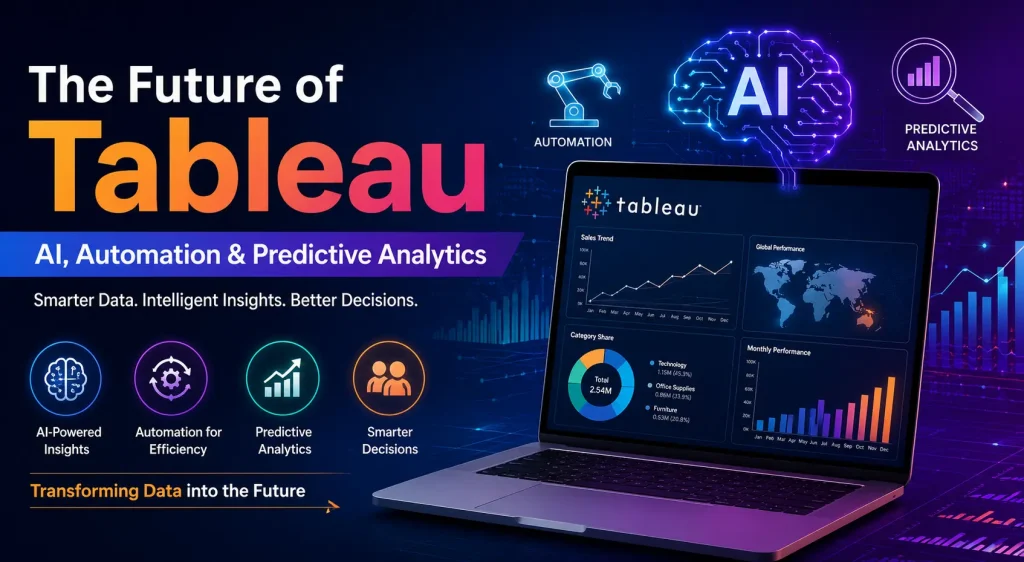
However, the Future of Tableau is no longer limited to creating charts and dashboards. In 2026, Tableau is evolving with Artificial Intelligence (AI), automation, and predictive analytics, making it smarter, faster, and easier to use. These innovations are changing how businesses analyze data while creating exciting career opportunities for freshers entering the data analytics industry.
In this article, you will discover how Tableau is evolving, why it remains relevant, and what skills beginners should develop to build a successful career.
Although several BI platforms are available today, Tableau remains a preferred choice because of its simplicity, flexibility, and powerful visualization capabilities. Businesses can easily transform complex datasets into interactive dashboards that support faster decision-making.
Furthermore, Tableau integrates with cloud platforms, databases, spreadsheets, and enterprise applications, making it suitable for organizations of all sizes.
Some major reasons behind Tableau’s continued success include:
Therefore, learning Tableau is still one of the smartest career investments for aspiring data analysts.
Artificial Intelligence is becoming a core feature of business intelligence platforms. Instead of manually searching for insights, users can now ask questions in natural language and receive meaningful answers instantly.
For example, a sales manager can simply ask:
“Which product generated the highest revenue this quarter?”
Rather than writing calculations manually, Tableau automatically analyzes the data and presents visual insights.
This AI-powered approach significantly reduces analysis time while improving accuracy.
Some AI capabilities expected in Tableau during 2026 include:
Consequently, users spend less time creating reports and more time making business decisions.
Automation is another major trend shaping the Future of Tableau.
Previously, analysts spent hours preparing data, cleaning datasets, refreshing dashboards, and generating reports. Today, many of these repetitive tasks can be automated.
Automation helps organizations by:
As a result, business teams receive updated insights without waiting for analysts to prepare reports manually.
For freshers, this means learning automation features can make them more productive from the very beginning of their careers.
Traditional dashboards explain what has already happened.
However, predictive analytics helps organizations understand what is likely to happen next.
This is one of the biggest changes in modern business intelligence.
Using historical data together with machine learning algorithms, Tableau can help businesses predict:
For example, an e-commerce company can forecast holiday sales and prepare inventory before demand increases.
Similarly, hospitals can predict patient admissions, while banks can identify potential financial risks.
Because predictive analytics supports proactive decision-making, it is becoming one of Tableau’s most valuable capabilities.
Cloud technology continues to reshape business intelligence.
Instead of installing software locally, organizations increasingly prefer cloud-based analytics because they are flexible, secure, and accessible from anywhere.
Tableau Cloud offers several advantages:
Consequently, remote teams can collaborate on the same dashboards regardless of their location.
As hybrid work continues to grow, cloud analytics will become even more important.
Creating dashboards is only one part of data analysis.
The real objective is communicating insights clearly.
Modern Tableau dashboards increasingly include AI-generated summaries that explain trends in simple language.
Instead of interpreting dozens of charts, business leaders receive concise explanations highlighting:
This makes data easier to understand for non-technical users.
Therefore, Tableau is evolving from a visualization tool into a complete decision-support platform.
The Future of Tableau requires more than dashboard development.
Freshers should combine technical knowledge with analytical thinking.
Important skills include:
Tableau Fundamentals
Understand dashboards, worksheets, filters, parameters, calculated fields, and visualizations.
SQL
Most Tableau projects involve databases. SQL helps retrieve and manage data efficiently.
Excel
Many organizations still store data in Excel before moving it into Tableau.
Data Cleaning
High-quality dashboards depend on clean, accurate data.
Business Intelligence Concepts
Learn KPIs, metrics, dimensions, measures, and reporting best practices.
Basic Python
Python supports automation, machine learning, and advanced analytics.
AI Fundamentals
Understanding machine learning and AI concepts will help you use Tableau’s latest intelligent features effectively.
Developing these skills together will significantly improve employability.
Tableau is expanding across nearly every industry.
Some of the fastest-growing sectors include:
Since every industry generates massive amounts of data, skilled Tableau professionals remain in high demand.
The demand for Tableau professionals continues to increase as organizations invest more in data-driven decision-making.
Freshers can begin their careers in roles such as:
Moreover, professionals who combine Tableau with SQL, Power BI, Python, and cloud technologies often receive better career opportunities and higher salaries.
Several technology trends indicate that Tableau will remain highly relevant in the coming years.
Businesses need faster reporting.
Executives require real-time dashboards.
AI is simplifying analytics.
Automation is reducing manual work.
Predictive analytics is improving business planning.
Cloud technology is making collaboration easier.
Because Tableau combines all these capabilities within one platform, it continues to be one of the leading business intelligence solutions worldwide.
For freshers, learning Tableau today means preparing for tomorrow’s analytics jobs.
The Future of Tableau is driven by innovation. Artificial Intelligence, automation, cloud analytics, and predictive analytics are transforming the way businesses work with data. Instead of simply creating dashboards, Tableau now enables organizations to discover insights faster, automate repetitive tasks, and make accurate predictions that improve business performance.
For freshers, this is an excellent time to start learning Tableau. By building a strong foundation in Tableau, SQL, Excel, AI concepts, and data visualization, you can prepare yourself for a rewarding career in business intelligence and analytics.
As companies continue their digital transformation journeys, professionals with Tableau expertise will remain valuable assets. Investing your time in learning Tableau today can open doors to exciting job opportunities, career growth, and long-term success in the rapidly evolving world of data analytics.