
Generative AI is changing the way businesses create content, develop software, analyze information, and interact with customers. From generating text and images to writing code and building intelligent chatbots, Generative AI has quickly become an important technology across industries.
For freshers, this growth creates exciting career opportunities. However, simply knowing how to use an AI chatbot is not enough to build a successful career. Employers increasingly value candidates who understand Generative AI skills, AI tools, programming fundamentals, prompt engineering, large language models, and practical AI applications.
Therefore, students and recent graduates should focus on developing a combination of technical knowledge and practical skills. With the right learning path, freshers can build projects, strengthen their resumes, and prepare themselves for emerging AI-related roles.
Generative AI refers to artificial intelligence systems that can create new content based on instructions or prompts. These systems can generate text, images, code, audio, videos, summaries, and other forms of digital content.
Unlike traditional AI systems that mainly analyze existing information or make predictions, Generative AI can produce new outputs based on patterns learned from large datasets.
For example, businesses can use Generative AI to create marketing content, summarize documents, generate software code, answer customer questions, and automate repetitive tasks.
As a result, organizations are looking for professionals who can understand these technologies and apply them responsibly to real-world business problems.
The demand for AI-enabled solutions continues to influence different technology roles. Consequently, learning Generative AI can give freshers an additional skill set when they enter the job market.
Freshers who combine Generative AI knowledge with programming, data, cloud, or business skills can create stronger career profiles.
Moreover, Generative AI skills can help beginners:
However, freshers should avoid learning tools randomly. Instead, they should follow a structured learning path that starts with fundamentals and gradually moves toward practical applications.
Before working with advanced Generative AI tools, freshers should understand basic artificial intelligence and machine learning concepts.
You do not necessarily need to become a machine learning researcher. However, understanding concepts such as datasets, models, training, inference, classification, neural networks, and model evaluation can help you understand how AI systems work.
These fundamentals also make it easier to understand large language models and other generative models.
Therefore, beginners should first build a solid foundation before moving into advanced Generative AI applications.
Python is one of the most useful programming languages for AI and machine learning. It is beginner-friendly and widely used for automation, data processing, machine learning, and AI application development.
For freshers, Python can become an important foundation for developing Generative AI projects.
You should learn:
Once you understand these concepts, you can start connecting Python applications with AI models and APIs.
CloudData Technologies also positions Python alongside its Gen AI training, helping learners build complementary technical skills.
Prompt engineering has become one of the most practical Generative AI skills for beginners.
A prompt is the instruction you provide to an AI model. The quality and structure of the prompt can significantly influence the usefulness of the output.
Freshers should learn how to create clear and specific prompts that provide context, define the expected output, and establish appropriate constraints.
Important prompt engineering concepts include:
For example, instead of asking an AI model to “write a blog,” a better prompt can specify the target audience, topic, tone, structure, word count, keywords, and desired output format.
Consequently, prompt engineering can help freshers use AI more effectively in development, marketing, research, customer service, and other professional areas.
Large Language Models, commonly called LLMs, form the foundation of many modern Generative AI applications.
Freshers should understand how LLMs work at a conceptual level and learn about important concepts such as:
Understanding these concepts allows beginners to move beyond simply using AI tools and start developing applications around them.
Learning how to connect AI models to applications is another valuable skill.
Freshers can use APIs to integrate AI capabilities into websites, applications, internal business tools, and automation workflows.
For example, a beginner could create an application that:
Learning API requests, authentication, JSON, error handling, and basic backend development can therefore help freshers transform AI concepts into working applications.
Retrieval-Augmented Generation, or RAG, is an important concept for modern AI applications.
Instead of relying only on the information contained within a model, a RAG application can retrieve relevant information from an external knowledge source and use that information when generating a response.
For example, a company could build an internal chatbot that answers questions using company documents.
Freshers should understand concepts such as:
Learning RAG can help beginners build more practical AI projects instead of limiting themselves to basic chatbot demonstrations.
AI-powered chatbots are among the most visible applications of Generative AI.
Freshers can learn how to build chatbots that answer questions, retrieve information, assist users, or automate basic customer-service tasks.
A chatbot project can also become an excellent portfolio project because it demonstrates multiple skills at once, including Python, APIs, prompt engineering, LLMs, and application development.
For example, a fresher could build a college admission chatbot that answers questions about courses, eligibility, fees, and admission procedures using a predefined knowledge base.
Generative AI becomes even more valuable when combined with automation.
Freshers can explore how AI can automate repetitive tasks such as:
Learning automation helps beginners understand how organizations can use AI to save time and improve productivity.
Technical skills alone are not enough. Freshers should also understand responsible AI practices.
Generative AI systems can produce incorrect, biased, or misleading information. Therefore, professionals need to understand issues such as privacy, security, bias, copyright, data protection, and responsible AI usage.
Freshers who understand both the capabilities and limitations of AI can make better technical decisions.
Finally, freshers should focus on building practical projects.
Projects demonstrate that you can apply your knowledge rather than simply list skills on your resume.
Some beginner-friendly Generative AI project ideas include:
While building these projects, document the problem, technology stack, development process, and final result.
As freshers develop their Generative AI skills, they can explore several technology and AI-related career paths.
Potential roles include:
The exact requirements vary by organization and job role. Therefore, freshers should carefully study job descriptions and identify the technical skills employers repeatedly request.
Additionally, combining AI knowledge with another specialization can make a fresher’s profile more useful. For example, Python + Generative AI, Data Analytics + AI, Cloud + AI, or Salesforce + AI can create valuable combinations.
Learning Generative AI does not happen overnight. Instead, beginners should follow a step-by-step approach.
Start with basic AI, machine learning, and programming concepts. Build your foundation before moving into complex AI applications.
Practice Python regularly and use small exercises to improve your programming confidence.
Learn how large language models work and explore important concepts such as tokens, context, embeddings, and inference.
Experiment with different prompts. Compare results and improve your instructions based on the output.
Learn how to connect AI models to simple Python applications.
Create practical applications that solve real problems. Start with simple projects and gradually increase their complexity.
Upload suitable projects to a professional portfolio or GitHub repository. Explain the problem, solution, technologies, and results clearly.
Practice explaining your projects and understand the concepts behind every technology you use.
Freshers often face one major challenge: they understand theoretical concepts but struggle to demonstrate practical experience.
Therefore, project-based learning can make a significant difference.
CloudData Technologies describes its Generative AI training as a structured program covering Python, machine learning basics, LLMs, prompt engineering, text and image generation, code generation, chatbots, and AI integrations. The institute also emphasizes practical, job-oriented learning for students and freshers.
Practical training allows learners to move from understanding concepts to actually building applications. As a result, students can develop confidence and create projects that demonstrate their skills to potential employers.
Generative AI is not simply another technology trend. It is becoming part of how organizations develop software, communicate with customers, analyze information, and automate business processes.
For freshers, this creates both an opportunity and a challenge.
The opportunity is clear: beginners can learn modern AI technologies and build skills that complement traditional IT knowledge.
The challenge is that AI tools evolve quickly. Therefore, freshers must develop a habit of continuous learning.
Instead of focusing on one AI tool, learn the underlying concepts. Understand how LLMs work, practice prompt engineering, learn Python, explore APIs, build RAG applications, experiment with automation, and create practical projects.
Generative AI skills can give freshers a strong foundation for entering the rapidly evolving AI and technology industry. However, successful candidates need more than basic knowledge of AI tools.
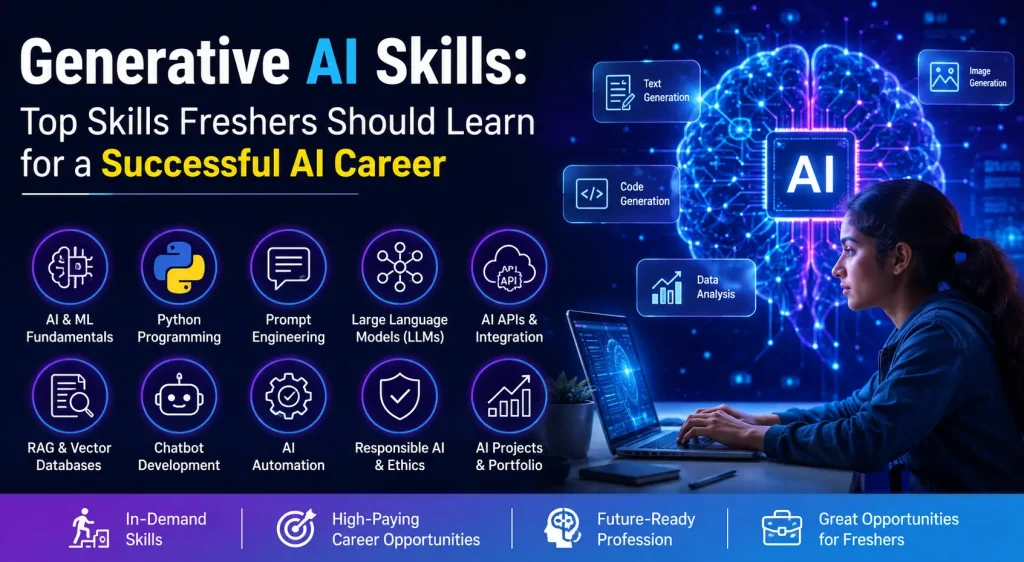
They should develop a combination of Python programming, AI fundamentals, prompt engineering, LLM knowledge, API integration, RAG, chatbot development, automation, responsible AI, and project-building skills.
Most importantly, freshers should focus on practical learning. Build projects, solve real problems, document your work, and continuously improve your technical knowledge.
If you are a fresher planning to start your AI career, learning Generative AI alongside strong programming and application-development fundamentals can help you prepare for the changing technology landscape.
CloudData Technologies offers Generative AI training in Chennai with a focus on structured learning and real-world AI applications. Explore the program and start building the skills needed for your next career opportunity.