If you are a fresher planning to start a career in software development, learning Python can be a strong first step. Python has a simple syntax, a large ecosystem, and applications across web development, automation, data analytics, artificial intelligence, and machine learning. However, simply learning Python syntax is not enough to become job-ready. You need a structured learning path that combines programming fundamentals, databases, frameworks, development tools, projects, and problem-solving skills.
This Python Developer Roadmap 2026 is designed especially for freshers who want to progress from Python basics to practical development skills. By following the roadmap step by step, you can build the technical foundation and project experience required for entry-level Python developer opportunities.
CloudData Technologies also focuses on practical Python learning, including fundamentals, object-oriented programming, database connections, web development, data analysis, automation, and real-time projects.
Python continues to be widely used in software development, automation, data-related applications, and AI. Its beginner-friendly syntax makes it easier for students and non-IT learners to start programming.
More importantly, Python can lead to different career paths. Depending on your interests, you can move toward:
Therefore, learning Python gives freshers flexibility when choosing a specialization.
However, avoid trying to master every Python-related technology at the same time. First build a strong foundation, then choose a career direction and develop deeper skills in that area.
A successful Python learning journey should follow a logical sequence. Instead of jumping directly into advanced frameworks, start with programming fundamentals and gradually move toward professional development.
The first stage of the Python Developer Roadmap 2026 is mastering Python fundamentals.
Start with:
At this stage, focus on understanding how Python works rather than memorizing code.
For example, practice writing small programs such as calculators, number guessing games, expense trackers, student grade systems, and file-processing scripts.
As a fresher, consistent practice is more valuable than simply watching tutorials.
Once you understand Python basics, improve your logical thinking.
A Python developer needs to break a problem into smaller steps and convert those steps into working code. Therefore, practice programming problems regularly.
Focus on:
You do not need to begin with extremely difficult coding challenges. Instead, start with beginner and intermediate problems and gradually increase the difficulty.
This approach will also help you prepare for coding assessments and technical interviews.
Object-Oriented Programming, or OOP, is an important skill for Python developers.
Learn concepts such as:
Understanding OOP helps you write organized and reusable applications.
For instance, instead of putting an entire application into one large Python file, you can divide the functionality into classes and modules. This makes your code easier to maintain and extend.
Real-world applications need to handle unexpected situations. Therefore, learn Python exception handling properly.
Important concepts include:
You should also learn how to work with files and common data formats such as JSON and CSV.
These skills are useful when building automation scripts, data-processing applications, and backend systems.
As your projects become larger, you will use multiple Python files and external libraries.
Learn how to:
pipVirtual environments are especially useful because they allow individual projects to maintain their own dependencies.
This is an important step toward professional Python development.
Python alone is not enough for most software development roles. You should also understand databases.
Learn SQL fundamentals, including:
You can start with databases such as MySQL or PostgreSQL.
Then learn how Python applications communicate with databases. Understanding Python and SQL together can significantly strengthen your profile as a fresher.
Modern software development involves collaboration, version control, and code management. Therefore, Git should be part of your Python Developer Roadmap 2026.
Learn:
You should also create a GitHub profile and upload your projects.
A well-organized GitHub profile can demonstrate your practical skills to recruiters and interviewers.
If your goal is to become a Python backend or web developer, learn a Python web framework.
Popular options include:
CloudData Technologies’ Python training also covers web development using Flask or Django as part of its practical learning approach.
Start by understanding how web applications work. Then learn routing, request handling, templates, authentication, databases, and APIs.
For beginners, it is better to learn one framework properly rather than trying to master several frameworks simultaneously.
APIs are an important part of modern application development.
As a Python developer, you should understand how applications communicate with each other through APIs.
Learn:
You can use Python frameworks such as Flask, Django REST Framework, or FastAPI to create APIs.
Building a small REST API project can also give you valuable portfolio experience.
A job-ready Python developer should know how to identify and fix errors.
Learn how to:
Python’s testing ecosystem includes tools such as pytest and the built-in unittest framework.
Testing improves code reliability and helps you develop professional programming habits.
Python is also widely used in data analytics, machine learning, and AI applications.
Once you have strong Python fundamentals, you can explore:
If you are interested in AI, you can later explore machine learning frameworks and modern AI development tools.
However, freshers should first learn Python programming and data-handling fundamentals before jumping into advanced AI concepts.
Python is particularly useful for automation.
You can create scripts to automate repetitive tasks such as:
Automation projects are excellent choices for beginners because they allow you to solve practical problems with relatively small programs.
Projects are one of the most important parts of the Python Developer Roadmap 2026.
Instead of completing dozens of tutorials without creating anything, build projects that demonstrate what you have learned.
Start with:
Next, build:
After gaining confidence, create:
CloudData Technologies highlights hands-on projects such as web applications, dashboards, automation scripts, and small AI models as part of its Python learning approach.
The goal is not to create the largest project. Instead, create projects that clearly demonstrate your ability to solve problems.
After building projects, organize them into a professional portfolio.
Your portfolio should include:
For example, if you build an employee management application, explain how Python, SQL, APIs, and your selected framework work together.
This gives recruiters a practical view of your abilities instead of relying only on certificates.
Technical preparation should happen alongside project development.
Prepare questions related to:
Also practice explaining your own code.
During an interview, recruiters may ask why you selected a particular approach, how you solved a problem, or how you would improve your application.
Therefore, do not build projects only by copying tutorials. Understand every important part of your code.
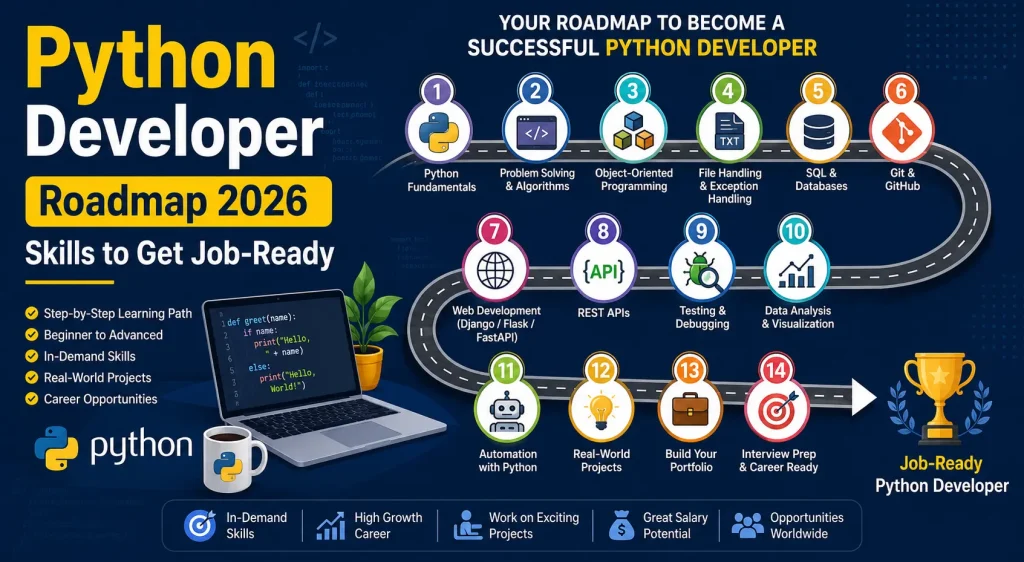
A simple learning sequence for freshers can look like this:
Stage 1: Python fundamentals
Stage 2: Problem-solving and data structures
Stage 3: OOP and advanced Python concepts
Stage 4: SQL and databases
Stage 5: Git and GitHub
Stage 6: Django, Flask, or FastAPI
Stage 7: REST APIs
Stage 8: Testing and debugging
Stage 9: Real-world projects
Stage 10: Portfolio and interview preparation
This sequence provides a practical foundation without overwhelming beginners.
Many beginners spend months collecting courses but build very few projects. Avoid this mistake.
Here are some common problems:
Watching Python tutorials is useful, but coding yourself is essential. Write programs regularly.
Trying to Learn Everything
Do not learn Django, Flask, FastAPI, AI, data science, cloud, and DevOps simultaneously. Build fundamentals first and then specialize.
Ignoring SQL
If you want a development career, database knowledge can be extremely useful. Include SQL in your learning plan.
Not Using GitHub
A GitHub profile can provide evidence of your practical work. Upload clean, documented projects.
Copying Projects
Tutorial projects are useful for learning, but recruiters want to see whether you can solve problems independently. After following a tutorial, modify the project or build a similar application from scratch.
Ignoring Communication Skills
Technical skills are important, but freshers should also practice explaining their projects, solutions, and technical decisions clearly.
The timeline depends on your existing knowledge, learning schedule, and practice consistency.
A fresher who studies consistently can begin with Python fundamentals and gradually progress to projects and interview preparation. Instead of focusing only on completing a course quickly, focus on whether you can independently write code, debug applications, work with databases, use Git, build projects, and explain your work.
The best indicator of progress is not the number of tutorials completed. It is what you can build without following step-by-step instructions.
After completing your Python learning roadmap, you can explore several entry-level career paths.
Depending on your skills, you can target roles such as:
Your career direction should determine the additional technologies you learn.
For example, aspiring backend developers can focus on Django, Flask, FastAPI, SQL, APIs, and deployment. Data-focused learners can move toward Pandas, NumPy, visualization, statistics, and machine learning.
The Python Developer Roadmap 2026 is not about learning every Python technology available. Instead, it is about learning the right skills in the right order.
Start with Python fundamentals, strengthen your problem-solving abilities, learn OOP and SQL, understand Git, choose a web framework, build APIs, and create real-world projects. Then, build a portfolio and prepare specifically for Python developer interviews.
For freshers, consistency is more important than speed. Practice coding every day, build projects, learn from errors, and gradually move toward advanced technologies.
If you are looking for structured, practical Python training, CloudData Technologies offers Python training in Chennai with hands-on learning, real-time projects, flexible batches, and placement-oriented guidance.
Start your Python journey today, build practical skills, and work toward becoming a job-ready Python developer in 2026.