
Artificial intelligence has officially moved past the stage of simple experimentation and novelty. Today, organizations across every imaginable industry are actively searching for practical, scalable ways to integrate smart technologies into their daily operational routines. If you have been wondering how artificial intelligence can genuinely help your business expand and thrive, you are definitely in the right place. In this comprehensive guide, we will break down the top generative ai use cases in meticulous detail and show you exactly how modern enterprises leverage these tools to save valuable time, drastically reduce operational overhead, and boost customer satisfaction rates.
Before we dive straight into specific industry applications, let us take a close look at what this technology actually accomplishes. Unlike traditional software solutions that strictly follow rigid, pre-written rules and predictable logic trees, generative tools possess the unique capability to create entirely new, original content. Whether you need text, computer code, high-resolution images, or audio assets, these advanced models analyze massive historical patterns and synthesize fresh outputs in a matter of seconds.
For business owners, founders, and operations leaders, this fundamental shift means you no longer have to stare at a blank page every single time you need to draft an urgent client email, build a quarterly performance report, or troubleshoot a complex software bug. Instead, you can rely on smart automation to handle repetitive manual tasks while your human team focuses entirely on high-level strategy, empathy-driven communication, and creative problem-solving.
One of the most widespread and impactful generative ai use cases involves completely transforming front-line customer service operations. Historically, traditional rule-based chatbots were notoriously frustrating for users because they could only comprehend a handful of rigid keywords or exact phrases. If a customer typed something unexpected or nuanced, the bot would immediately break, leaving the user stranded and forced to wait hours for a human agent.
Modern conversational AI agents and intelligent chat widgets change this dynamic completely. These sophisticated systems understand natural human language, emotional context, underlying intent, and conversational flow.
Round-the-Clock Availability: Your customers can receive accurate, polite, and immediate answers to their questions at any hour of the day or night, ensuring zero downtime for your support desk.
Frictionless Lead Qualification: Smart conversational workflows automatically capture vital visitor information—such as names, contact numbers, geographical locations, and email addresses—naturally within the chat interface without making the user fill out a tedious, long form.
Seamless Human Handoffs: If a customer inquiry becomes too emotionally complex or technically advanced, the system smoothly transfers the entire chat history to a human team member along with a concise, automated summary of the issue.
By handling routine inquiries automatically and gracefully, growing businesses can dramatically cut down response times, eliminate customer churn, and keep clients consistently happy. Furthermore, integrating smart voice and chat agents bridges communication gaps across global time zones, ensuring that no prospective customer or inbound lead ever slips through the cracks. When visitors land on your website looking for immediate assistance, these intelligent routing tools greet them instantly, answer product questions accurately, and collect valuable lead data before an internal team member even steps in.
Producing fresh, high-quality marketing content on a consistent schedule is a monumental challenge for growing companies. Between writing engaging social media updates, drafting educational website articles, designing promotional banners, and crafting email newsletters, marketing teams frequently find themselves stretched painfully thin.
Leveraging generative tools for content creation allows marketing departments to scale their output effortlessly without sacrificing quality.
Drafting First Iterations: Content writers and copywriters use AI to generate detailed structural outlines, brainstorm fresh campaign angles, and write initial drafts for blogs, whitepapers, or newsletters in minutes.
Social Media Scaling: Companies can easily repurpose long-form guides and webinars into snappy social media posts, catchy captions, and targeted ad copy optimized for various platforms.
Hyper-Personalized Campaigns: Businesses can tailor promotional messaging, subject lines, and product descriptions to match specific audience segments and buyer personas, driving significantly higher engagement rates.
When combined with human editorial oversight, this balanced approach ensures your brand maintains a vibrant online presence without burning out your creative staff. Additionally, modern digital marketing relies heavily on search engine visibility and keyword optimization. Generative text models help marketing teams analyze competitor content structures, discover latent semantic indexing keywords, and restructure web copy to meet evolving search engine algorithms smoothly. This systematic approach saves countless hours of manual keyword research while maximizing organic reach across competitive search engine results pages.
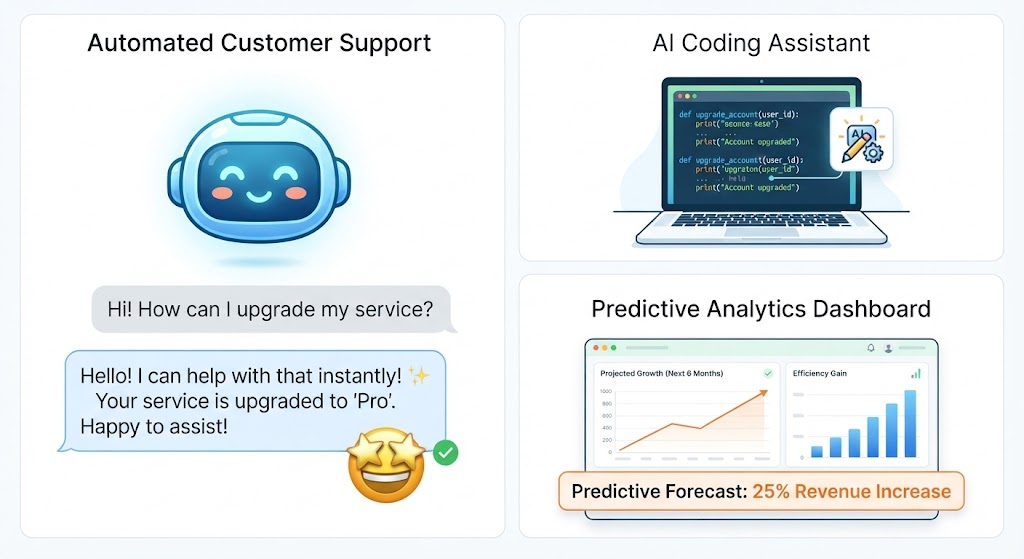
Generative AI Use Cases
Writing, testing, and debugging computer code traditionally consumes a massive portion of an engineering team’s daily schedule. Another major area where modern enterprises see incredible value is software development acceleration and infrastructure automation.
Developers utilize smart coding assistants to speed up their development lifecycles significantly. These tools can automatically write standard boilerplate code, suggest precise fixes for syntax bugs, and translate legacy scripts from one programming language to another.
Rapid Prototyping: Development teams can build, test, and validate functional software prototypes in a fraction of the usual timeline, getting products to market faster.
Proactive Code Quality Checks: Smart algorithms scan active codebases in real-time to spot security vulnerabilities, memory leaks, and performance bottlenecks before code ever reaches production.
Reduced Training Curves: Junior developers and interns can learn syntax rules and architectural best practices much faster by receiving contextual explanations and suggestions directly from their coding assistants.
Beyond writing code, development teams utilize generative models to draft comprehensive technical documentation, API guides, and system architecture manuals automatically. Keeping documentation updated is notoriously tedious for busy developers, but automated generation ensures that team wikis and developer portals remain accurate and accessible at all times, minimizing onboarding friction for new hires.
Data is only truly valuable if your leadership team can interpret it quickly and make smart, proactive decisions based on those insights. Unfortunately, many organizations sit on massive digital piles of unprocessed customer and operational data simply because they lack enough data analysts to review everything manually.
Smart analytics platforms powered by generative models make it remarkably easy to turn raw numbers into clear, conversational, and actionable business insights.
Natural Language Database Queries: Instead of requiring team members to write complex SQL database queries, staff can simply ask questions in plain English—such as “What were our top-selling training courses or products last month?”—and receive instant visual summaries.
Predictive Market Forecasting: Advanced algorithms analyze historical sales trends and external market indicators to help management accurately predict future customer demand and resource allocation needs.
Automated Executive Reporting: Systems generate clean, comprehensive performance dashboards and textual summaries for stakeholders automatically, saving hundreds of hours of manual spreadsheet manipulation.
Moreover, combining predictive analytics with automated workflows empowers organizations to anticipate market shifts before they happen. Management teams no longer have to wait for monthly manual audits to notice performance dips or emerging opportunities; instead, smart alerts notify leadership immediately when key performance indicators deviate from projected benchmarks.
Beyond customer-facing departments, internal human resources and corporate training programs benefit immensely from artificial intelligence integration. Onboarding new employees typically requires a heavy investment of time from senior managers who must repeatedly explain company policies, software tools, and workflow procedures.
By deploying internal AI assistants, companies create an interactive knowledge base that answers employee questions instantly.
Instant Policy Access: Staff can ask questions regarding health benefits, remote work guidelines, or expense reporting policies and receive immediate, accurate citations from company handbooks.
Personalized Learning Paths: Training modules can dynamically adapt to an employee’s learning speed and skill gaps, providing custom quizzes and explanations to ensure complete comprehension.
Streamlined Candidate Screening: HR departments utilize smart tools to review resumes against job descriptions objectively, highlighting top-tier talent and scheduling initial introductory touchpoints automatically.
This internal automation drastically reduces administrative overhead for human resources professionals, allowing them to focus on high-touch employee engagement, culture building, and professional development programs rather than drowning in paperwork.
Jumping blindly into artificial intelligence adoption without a cohesive, well-thought-out strategy often leads to frustrated employees, wasted financial resources, and fragmented customer experiences. If you want to achieve the absolute best results from these powerful technologies, keep a few core strategic guidelines in mind.
Start with Small Pilot Projects: Choose one specific, high-friction area of your business—such as front-line customer support or social media content drafting—and thoroughly test an AI tool there before rolling it out across the entire organization.
Always Maintain a Human Touch: Review AI-generated content, code commits, and customer interactions regularly to ensure they strictly match your unique brand voice, ethical standards, and quality requirements.
Focus Heavily on Internal Training: Ensure your team members feel comfortable using these new tools through structured workshops and clear guidelines. Providing proper education helps everyone embrace new workflows with confidence rather than anxiety.
Furthermore, establish clear internal governance policies regarding data privacy, model transparency, and output accountability. Ensuring that all deployed models comply with regional data protection regulations protects your brand reputation and builds lasting trust with your clientele.
Embracing advanced technology and automation is no longer just an optional luxury if you want to remain competitive in today’s fast-moving digital economy. By carefully exploring and implementing these practical generative ai use cases, you can drastically streamline your daily operations, engage your target audience much more effectively, and position your business for sustainable, long-term success. Whether you intend to upgrade your customer service chat widgets, speed up your marketing campaigns, or optimize your internal tech infrastructure, integrating smart solutions will ultimately help your organization work smarter, scale faster, and achieve its ultimate growth potential in an increasingly digital world.