Generative AI is rapidly changing how businesses create content, analyze information, support customers, develop software, and automate everyday tasks. In 2026, organizations across healthcare, finance, education, retail, manufacturing, marketing, and technology are moving beyond simple AI experiments and exploring practical Generative AI use cases that can improve productivity and customer experiences.
For freshers, understanding these applications is especially valuable. Generative AI skills can help you understand how modern companies use large language models (LLMs), prompt engineering, automation, and AI-powered applications to solve real business problems.
According to Cloud Data Technologies, its Generative AI training covers Python, machine learning foundations, LLMs, prompt engineering, and practical applications such as text, image, and code generation. The training is designed for students, freshers, and working professionals who want practical AI skills.
Generative AI is a branch of artificial intelligence that can create new content based on user instructions or prompts. Unlike traditional software that follows predefined rules, generative AI models can produce text, images, code, summaries, ideas, and other outputs.
Large Language Models, commonly called LLMs, form an important part of many generative AI applications. These models understand natural language and generate responses based on patterns learned from large datasets.
For example, a user can ask an AI model to summarize a report, create product descriptions, generate programming code, or prepare an email. As a result, businesses can automate repetitive knowledge-based tasks while employees focus on more strategic work.
Businesses generate enormous amounts of information every day. Employees need to read documents, respond to customers, create reports, analyze data, write content, and complete repetitive administrative tasks.
Generative AI can support these activities by producing useful first drafts, summarizing information, finding relevant knowledge, and assisting employees. For example, financial organizations are using generative AI for document search, customer assistance, content generation, and personalized communication.
Therefore, learning Generative AI use cases in 2026 can give freshers a practical understanding of where AI skills fit into modern careers.
Healthcare is one of the major areas where generative AI applications are developing quickly. Hospitals and healthcare organizations manage clinical notes, reports, patient communications, insurance documents, and research information.
Generative AI can help with:
For example, AI can summarize large amounts of information so healthcare professionals can review relevant details more efficiently. However, healthcare applications require strong privacy controls, validation, and human oversight because inaccurate AI-generated information can create serious risks. Recent 2026 industry research highlights documentation, hospital operations, payer workflows, research, and patient engagement among healthcare generative AI applications.
Finance involves large volumes of documents, transactions, reports, regulations, and customer interactions. Consequently, financial institutions are exploring many Generative AI use cases.
Common applications include:
For instance, generative AI can help financial employees search through lengthy policies and documents and create concise summaries. It can also assist employees in preparing reports and customer communications.
Financial organizations are increasingly deploying AI at scale, although security, compliance, governance, and human review remain important considerations.
Education is another sector where generative AI can support both students and educators.
Some important Generative AI applications in education include:
For freshers, AI-powered learning tools can provide explanations based on their skill level. For example, a student learning Python can ask an AI assistant to explain a programming concept, generate practice questions, or identify errors in code.
However, students should use AI as a learning assistant rather than depending on it completely. Building foundational knowledge remains essential.
Marketing teams create content continuously. They need advertisements, social media posts, email campaigns, product descriptions, blogs, and campaign ideas.
Therefore, marketing has become one of the most visible areas for generative AI.
Businesses can use AI for:
Generative AI can help marketers produce initial drafts quickly. Nevertheless, marketers still need to review AI-generated content for accuracy, brand consistency, originality, and search engine quality.
Software development is another important area for Generative AI use cases. Developers can use AI assistants to accelerate repetitive coding activities.
Common applications include:
For example, a developer can describe a function in natural language and ask an AI coding assistant to create an initial implementation. The developer can then review, test, modify, and integrate the code.
This does not mean developers become unnecessary. Instead, developers need stronger problem-solving, system-design, testing, security, and code-review skills.
Retail businesses interact with customers through websites, mobile applications, email, social media, and customer service channels.
Generative AI can improve these experiences through:
For example, an AI shopping assistant can understand a customer’s natural-language request and help identify suitable products. As a result, customers can receive more conversational and personalized shopping experiences.
Manufacturing companies generate technical documentation, maintenance records, production reports, safety information, and operational data.
Generative AI can support:
AI assistants can help employees find information faster. However, manufacturers should validate AI-generated instructions before applying them to machinery or safety-critical processes.
Customer service is one of the most practical Generative AI industry use cases. Businesses receive thousands of customer questions about products, services, billing, delivery, troubleshooting, and policies.
Generative AI can:
Instead of replacing every support employee, companies can use AI as an assistant. The AI can handle routine questions while human agents manage complex or sensitive cases.
HR teams manage job descriptions, resumes, employee communications, training materials, policies, and interview processes.
Potential applications include:
However, companies should apply careful governance when AI processes employee or candidate information. Human review is particularly important when AI supports hiring-related activities.
Generative AI is also changing how people interact with data. Instead of writing every query manually, users can describe what they want in natural language.
For example, a business user might ask:
“Show me the sales performance by region for the last six months.”
An AI-powered analytics system can potentially translate that request into an appropriate query or visualization workflow.
Important applications include:
For freshers, combining Generative AI with SQL, Python, Power BI, or Tableau can create a valuable technical skill set.
Generative AI has transformed the way creators produce digital content. AI models can generate text, images, audio, video concepts, and creative variations.
Businesses and creators can use AI for:
Nevertheless, creators should review AI-generated content carefully and consider copyright, originality, disclosure, and brand requirements.
IT teams can use generative AI to analyze technical information and support troubleshooting.
Potential use cases include:
AI can help professionals process large volumes of technical information. However, cybersecurity teams should not blindly follow AI recommendations. Security professionals must validate outputs and maintain strong access controls.
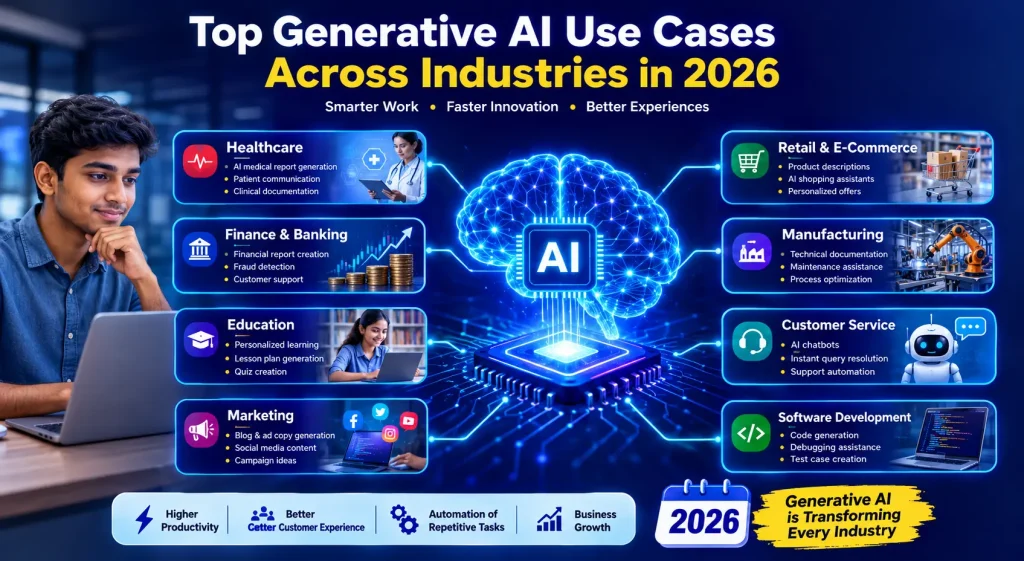
Across these industries, several benefits appear repeatedly.
Faster Productivity
AI can automate repetitive content and knowledge-based tasks. Therefore, employees can spend more time on high-value activities.
Better Customer Experiences
AI assistants can provide faster responses and personalized interactions.
Reduced Manual Work
Organizations can automate tasks such as summarization, drafting, classification, and document processing.
Faster Content Creation
Marketing and business teams can generate initial drafts quickly and refine them with human expertise.
Improved Access to Knowledge
Employees can interact with large knowledge bases using natural language rather than searching through hundreds of documents manually.
Support for Innovation
Generative AI allows teams to prototype ideas and applications faster. Consequently, businesses can experiment with new products and workflows.
If you are a fresher planning a career in AI, start with the fundamentals instead of learning tools randomly.
A practical learning path includes:
Cloud Data Technologies’ Generative AI course includes Python, machine learning basics, LLMs, prompt engineering, and practical applications involving text, image, and code generation. It also covers chatbot development and AI integration into web or business workflows.
Furthermore, the institute offers training in related technologies such as Python, SQL, Power BI, Tableau, and Salesforce. This can help freshers build complementary technical skills alongside Generative AI.
Learning theory alone is not enough. Instead, build small projects that demonstrate practical skills.
For example, you can create:
Next, publish your projects on GitHub and explain how each application works. Also, create a portfolio that demonstrates your ability to use prompts, APIs, Python, data, and LLMs.
Possible career paths include Generative AI Developer, Prompt Engineer, NLP Engineer, AI/ML Engineer, and related AI application roles. Cloud Data Technologies also identifies these roles as potential career directions after its Generative AI training.
The next stage of Generative AI will focus increasingly on practical business workflows rather than simple content generation. AI systems are becoming more useful when they connect with company data, applications, and business processes.
At the same time, responsible AI will become increasingly important. Businesses need to address accuracy, privacy, security, bias, intellectual property, and human oversight.
For freshers, this creates an important opportunity. Instead of learning only how to use an AI chatbot, learn how AI systems work and how to build useful applications around them.
Generative AI use cases are expanding across healthcare, finance, education, marketing, software development, retail, manufacturing, customer service, HR, analytics, and many other industries. In 2026, businesses are using generative AI to create content, summarize information, assist employees, improve customer experiences, automate workflows, and accelerate software development.
For freshers, this technology creates new opportunities to develop practical and career-focused skills. By learning Python, machine learning fundamentals, LLMs, prompt engineering, APIs, and real-world AI applications, you can build a strong foundation for an AI career.
Most importantly, focus on solving problems rather than simply learning AI tools. Build projects, understand the technology, evaluate AI outputs, and keep improving your skills. That approach can help you prepare for the growing demand for Generative AI professionals.
Ready to start learning Generative AI? Explore the Generative AI training offered by Cloud Data Technologies and develop practical skills in LLMs, prompt engineering, Python, and real-world AI applications.