Generative AI is changing the way developers write code, test applications, fix bugs, document projects, and build software products. In 2026, developers can use AI-powered tools to complete repetitive programming tasks faster and spend more time solving complex problems. For freshers, this shift creates new opportunities to learn modern development skills and become job-ready.
The rise of Generative AI in software development does not mean that developers are becoming unnecessary. Instead, AI is becoming a powerful development assistant. Developers still need programming knowledge, logical thinking, problem-solving skills, security awareness, and the ability to review AI-generated code.
For students and freshers starting their IT careers, understanding AI-assisted coding can provide an important advantage. CloudData Technologies, for example, offers Gen AI, Python, SQL, Power BI, Tableau, and Salesforce training designed around practical, career-focused learning.
Generative AI in software development refers to the use of artificial intelligence models to generate, modify, explain, test, and improve software-related content.
Instead of writing every line manually, developers can describe what they want in natural language. An AI coding tool can then suggest code, explain programming concepts, generate test cases, or identify potential errors.
For example, a fresher could ask an AI assistant to:
However, developers must review the output before using it. AI can generate incorrect, inefficient, insecure, or outdated code. Therefore, programming fundamentals remain essential.
Software development involves many repetitive activities. Developers often spend significant time writing boilerplate code, preparing documentation, creating test cases, searching for errors, and understanding unfamiliar code.
Generative AI can assist with many of these activities. As a result, developers can focus more on architecture, business requirements, user experience, security, and complex problem-solving.
The biggest change is therefore not simply AI generating code. It is the broader shift toward AI-powered software development, where developers and AI systems work together throughout the development lifecycle.
For freshers, this means learning only one programming language may not be enough. Instead, students should combine programming fundamentals with AI tools and practical project experience.
One of the most visible applications of Generative AI is code generation.
A developer can provide a prompt describing a requirement, and an AI coding assistant can suggest an implementation. For instance, a fresher working with Python could request a function that reads a CSV file, cleans missing values, and produces a summary.
The AI may generate an initial solution within seconds.
However, the developer still needs to check:
Therefore, generative AI coding works best as an assistant rather than a replacement for programming knowledge.
Debugging can be challenging for beginners. A small syntax error or incorrect condition can prevent an application from working correctly.
AI tools can analyze error messages and code snippets and explain possible causes. They can also suggest fixes and provide alternative implementations.
For freshers, this can make the learning process more interactive.
Instead of simply copying a solution, students should ask questions such as:
“Why did this error occur?”
“Explain this solution step by step.”
“What happens if the input is empty?”
This approach helps learners understand programming concepts instead of depending entirely on AI.
Testing is another area where AI can save developers time.
Developers can use AI to generate:
For example, after creating a Python function, a developer can ask an AI assistant to identify different input conditions that should be tested.
Nevertheless, human review remains important. AI-generated tests may miss business-specific requirements or unusual production scenarios.
Therefore, developers should combine AI-assisted testing with proper testing strategies and manual validation.
Freshers often struggle when they join a project containing thousands of lines of unfamiliar code.
Generative AI can help explain functions, classes, APIs, and programming logic in simpler language.
A developer can provide a code section and ask:
Explain what this function does and identify potential problems.
This can reduce the time required to understand unfamiliar code.
Furthermore, AI can help developers create documentation for existing functions and APIs. As a result, teams can maintain clearer technical documentation.
Developer productivity is one of the major benefits of AI software development.
AI can assist with small repetitive tasks while developers concentrate on more important work.
For example, AI can help generate:
This does not automatically make every developer more productive. Developers must know how to communicate requirements clearly and evaluate AI output accurately.
Consequently, prompt skills, programming skills, and critical thinking are becoming valuable together.
The role of a junior developer is also evolving.
Previously, beginners often started by completing simple coding tasks. Today, AI tools can handle many basic programming activities quickly.
Therefore, freshers need to develop skills beyond basic code writing.
A strong beginner profile should include:
This combination helps freshers become developers who can understand, review, modify, and improve AI-generated solutions.
Python remains an important skill for students entering AI and software development.
Python’s relatively simple syntax makes it accessible to beginners, while its ecosystem supports automation, data analysis, machine learning, APIs, and AI applications.
CloudData Technologies positions its Python training for beginners as well as learners who want to progress toward advanced topics, with practical projects such as automation scripts and AI-related applications.
For a fresher, learning Python alongside Generative AI can create a strong foundation.
You can start with:
Python basics → Functions → OOP → APIs → Data handling → AI APIs → Generative AI applications
This step-by-step approach is more effective than trying to learn advanced AI tools without understanding programming fundamentals.
Generative AI is also influencing database development.
Developers and analysts can use AI to generate SQL queries from natural-language requirements. For example, instead of manually writing a complex query, a learner can describe the required result and ask AI to suggest an SQL query.
However, the learner should understand:
CloudData Technologies’ SQL training includes practical query writing, database concepts, advanced SQL, and real-time project practice.
Therefore, AI should accelerate SQL learning rather than replace SQL knowledge.
The impact of Generative AI goes beyond writing code.
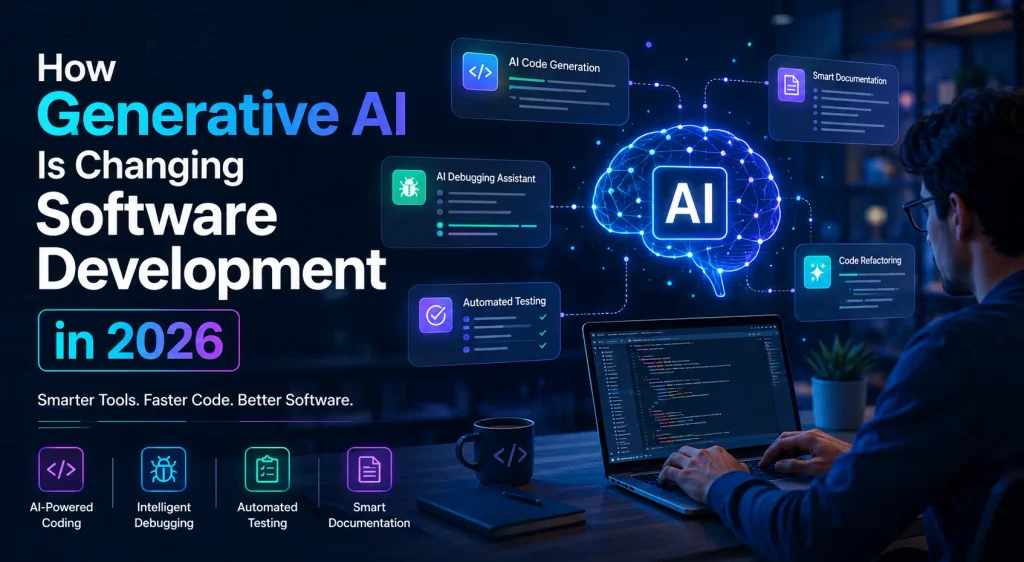
AI can support different stages of software development, including:
Planning: Developers can use AI to brainstorm requirements and project structures.
Development: AI can suggest and generate code.
Testing: AI can help create test cases and identify potential edge cases.
Debugging: AI can analyze errors and suggest possible solutions.
Documentation: AI can create initial technical documentation.
Maintenance: AI can help developers understand existing code and identify areas that may need improvement.
This makes Generative AI in software development relevant across the entire development lifecycle.
Although AI has become increasingly capable, developers should not depend on it blindly.
AI-generated code can contain:
For this reason, developers need strong judgment.
A successful AI-assisted developer should ask:
Is this code correct?
Is it secure?
Can it scale?
Does it solve the actual business problem?
Can I explain how it works?
If a developer cannot answer these questions, they should not rely on the generated code.
If you are a fresher planning a career in software development, follow a structured learning path.
Start With Programming
Choose Python, Java, JavaScript, or another suitable language. Learn variables, conditions, loops, functions, data structures, error handling, and object-oriented programming.
Learn Databases
SQL remains an important development skill. Learn how applications store, retrieve, and manipulate data.
Understand APIs
Learn how applications communicate through APIs. Practice creating API requests and connecting applications to external services.
Learn Git
Understand repositories, commits, branches, pull requests, and collaborative development.
Explore AI Coding Tools
Once you understand programming fundamentals, experiment with AI-assisted coding tools. Learn how to write clear prompts and verify generated solutions.
Build Projects
Projects demonstrate that you can apply your knowledge.
For example, a fresher could build:
These projects can strengthen your portfolio and provide useful discussion points during interviews.
The best strategy is to become AI-enabled, not AI-dependent.
Start by learning programming fundamentals. Then use Generative AI to accelerate your learning and development process.
For example, when you build a project:
1: Define the requirement.
2: Design the solution yourself.
3: Write the initial code.
4: Use AI to improve or review it.
5: Test the application.
6: Fix problems manually.
7: Document the project.
8: Add the project to your portfolio.
This process develops both technical knowledge and practical AI skills.
The future of software development will likely involve closer collaboration between developers and AI systems.
Developers will increasingly focus on defining problems, designing solutions, reviewing AI-generated output, managing architecture, ensuring security, and delivering business value.
At the same time, AI will continue assisting with repetitive implementation tasks.
For freshers, this creates an important opportunity. Instead of competing with AI, developers can learn how to use it effectively.
Students who combine software development fundamentals, Generative AI, Python, SQL, APIs, testing, and project experience can build a stronger foundation for modern technology careers.
Generative AI in software development is changing how developers create, test, debug, document, and maintain applications in 2026. AI-powered development tools can increase productivity and reduce repetitive work. However, successful developers still need programming knowledge, logical reasoning, security awareness, and strong problem-solving skills.
For freshers, the right approach is simple: learn the fundamentals first, use AI as a development assistant, and build real projects.
CloudData Technologies offers industry-focused training across Gen AI, Python, SQL, Power BI, Tableau, and Salesforce, with practical learning and project-oriented programs.
If you are starting your IT career, now is a good time to learn how AI and software development work together. The developers who understand both technology fundamentals and AI-assisted workflows can position themselves for the changing software industry.