Generative AI is changing how people work, learn, communicate, and solve business problems. From writing emails and creating presentations to generating code and analyzing information, AI tools are becoming part of everyday workplace activities.
For freshers, this change creates both opportunities and challenges. The question is no longer simply “Will AI replace jobs?” A better question is “Which jobs will change first, and what skills will help freshers stay competitive?”
The impact of Generative AI in the workplace will not be the same across every profession. Jobs that involve repetitive digital tasks may experience faster changes, while roles that require human judgment, creativity, communication, leadership, and complex decision-making will continue to evolve alongside AI.
For students and fresh graduates starting their IT careers, understanding this transformation early can provide a major advantage.
Generative AI refers to artificial intelligence systems that can create new content based on user instructions. These systems can generate text, images, computer code, summaries, ideas, reports, and other forms of digital content.
In the workplace, companies can use Generative AI to automate routine activities and support employees with tasks such as:
CloudData Technologies describes Generative AI as a practical technology that can be used to create text, images, code, and business solutions from prompts. Its training approach covers Python, machine learning fundamentals, LLMs, prompt engineering, and practical AI applications.
Therefore, freshers should think of AI as more than just a chatbot. It is becoming a workplace productivity technology.
Generative AI can perform many tasks that previously required considerable human time. As a result, companies can automate portions of existing workflows and allow employees to focus on higher-value responsibilities.
For example, a marketing employee might previously spend several hours creating initial content ideas. With an AI assistant, the employee can generate multiple ideas quickly and then spend more time reviewing, improving, and strategizing.
Similarly, a software developer can use AI to generate code suggestions, explain errors, create test cases, or document existing code.
This means AI automation in the workplace often changes individual tasks before it completely changes an entire profession.
That distinction is important for freshers.
Instead of asking whether a particular job will disappear, consider which responsibilities within that job can be automated and which responsibilities still require human expertise.
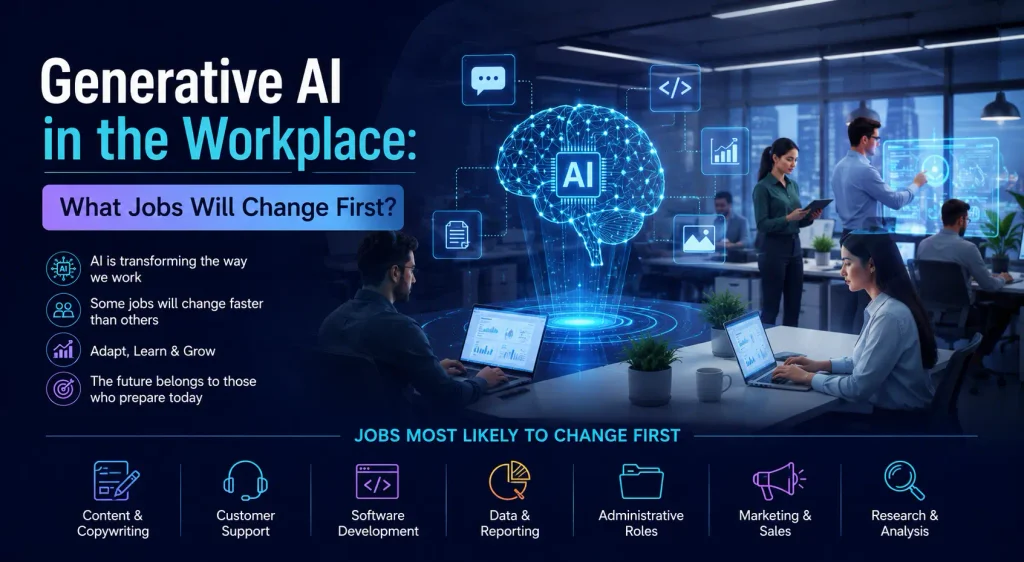
Some jobs are likely to experience faster transformation because they involve repetitive, predictable, and highly digital tasks.
Content creation is one of the most visible areas affected by Generative AI.
AI tools can help create:
However, human writers still play an important role in strategy, fact-checking, brand voice, storytelling, editing, and audience understanding.
For freshers interested in digital marketing or content, learning how to use AI for content creation can therefore become more valuable than competing against AI.
Customer support is another area where AI is changing workflows.
AI-powered assistants can answer frequently asked questions, summarize conversations, classify customer requests, and provide suggested responses.
However, complex customer problems may still require human intervention.
Therefore, customer service professionals who understand AI tools, communication, problem-solving, and customer relationship management can remain valuable.
Software development is experiencing significant AI-assisted transformation.
Generative AI can help developers:
This does not mean freshers should stop learning programming.
Instead, programming fundamentals become even more important because developers need to understand whether AI-generated code is correct, secure, efficient, and appropriate for the application.
For this reason, learning Python and Generative AI can be a strong combination for beginners entering technology careers.
CloudData Technologies’ Python training emphasizes fundamentals, practical projects, automation, data analysis, and application development, providing a useful foundation for learners who want to move toward AI-related roles.
Generative AI can also change how employees work with data.
Traditional reporting activities may involve collecting information, preparing summaries, creating charts, and explaining basic trends.
AI can accelerate several of these activities. However, businesses still need professionals who understand data quality, business requirements, analytics, and decision-making.
This creates opportunities for freshers who combine AI skills with data analytics skills.
For example, learning SQL, Python, Power BI, and AI can help a fresher understand both the technical and business sides of data.
CloudData Technologies’ Power BI program focuses on data modeling, Power Query, DAX, dashboards, multiple data sources, and practical projects.
Administrative work contains many repetitive digital tasks.
AI can assist with:
As a result, administrative professionals may spend less time on manual tasks and more time coordinating people, managing exceptions, and making decisions.
Freshers who develop digital productivity and AI automation skills can position themselves for this changing environment.
Marketing and sales teams can use Generative AI to research customers, create campaign ideas, draft emails, analyze conversations, and personalize communication.
However, successful marketing still requires creativity, customer understanding, positioning, and strategic thinking.
Similarly, sales professionals need relationship-building and negotiation skills that AI cannot completely replace.
The future therefore belongs increasingly to professionals who know how to combine human skills with AI tools.
Research-heavy entry-level positions may also change.
AI can quickly summarize large amounts of information, compare documents, generate research questions, and organize findings.
Nevertheless, AI-generated information must be reviewed carefully.
Freshers who learn research methodology, critical thinking, fact-checking, data interpretation, and AI-assisted research can become more productive without depending blindly on AI.
This is one of the biggest concerns among students.
The answer is more complicated than simply saying yes or no.
Generative AI may reduce the need for people to perform certain repetitive entry-level tasks. At the same time, AI adoption can create new responsibilities involving AI implementation, testing, monitoring, prompt design, automation, data preparation, and AI-assisted workflows.
The World Economic Forum has also highlighted that the AI transition should be viewed in terms of changing livelihoods and skills rather than simply replacing individual job titles.
Therefore, freshers should focus on becoming AI-enabled professionals rather than trying to compete with AI on repetitive tasks.
The best strategy is to develop a combination of technical and human skills.
Learn how Generative AI works and how businesses use it.
Important areas include:
CloudData Technologies’ Generative AI course covers LLMs, prompt engineering, Python, machine learning fundamentals, and practical applications such as chatbots and AI-powered workflows.
Python is widely used in automation, data analysis, machine learning, and AI development.
A fresher does not necessarily need to become an advanced programmer immediately. Start with Python fundamentals and gradually move toward automation and AI projects.
AI depends heavily on data.
Therefore, freshers can strengthen their profiles by learning:
Knowing how to communicate effectively with AI systems is becoming a useful workplace skill.
Good prompts can provide clearer instructions, better context, constraints, and desired output formats.
However, prompt engineering should not be treated as the only AI skill. Combine it with programming, data, business knowledge, and critical thinking.
AI can generate content, but professionals still need to communicate with colleagues, customers, managers, and stakeholders.
Strong communication can differentiate a fresher from another candidate with similar technical skills.
Never assume that AI-generated information is automatically correct.
Professionals need to verify facts, identify errors, evaluate outputs, and make informed decisions.
This is especially important when AI generates code, business recommendations, reports, or technical information.
First, start learning AI before your first job rather than waiting for your employer to teach you.
Second, build projects instead of collecting only certificates.
For example, a fresher can create:
Projects demonstrate that you can apply technology to solve problems.
Third, combine AI with another career skill. For example:
Python + Generative AI
Power BI + Generative AI
Salesforce + AI
SQL + Data Analytics + AI
This approach can make your profile more specialized.
CloudData Technologies offers training across Generative AI, Python, Power BI, SQL, Salesforce, Tableau, and other technology areas, allowing learners to build complementary technical skills.
As companies adopt AI, new and evolving roles are emerging around AI implementation and business applications.
Depending on your skills and experience, possible career paths include:
CloudData Technologies’ Generative AI program specifically identifies career paths such as Generative AI Developer, Prompt Engineer, NLP Engineer, and AI/ML Engineer.
For a fresher, the goal should not be to master every AI technology. Instead, build a strong foundation and gradually specialize.
The workplace of the future will probably not be divided into people versus AI.
Instead, many organizations will combine human expertise with AI-powered tools.
Employees will use AI to complete repetitive tasks faster, analyze information, generate ideas, and automate workflows. Humans will continue to provide judgment, creativity, leadership, accountability, communication, and strategic thinking.
Therefore, Generative AI in the workplace should be viewed as a career transformation opportunity.
For freshers, this transformation can be particularly valuable because they can develop AI skills from the beginning of their careers.
Generative AI is changing jobs by changing the tasks people perform. Content creation, customer support, software development, data reporting, administration, marketing, and research are among the areas where AI can significantly transform everyday work.
However, AI does not eliminate the need for skilled professionals. Instead, it increases the importance of people who know how to use technology effectively.
If you are a fresher preparing for an IT career, start with the fundamentals. Learn Generative AI, Python, data analytics, SQL, automation, and communication skills. Then build real-world projects that demonstrate what you can do.
The future of work will reward professionals who can adapt.
Don’t wait for AI to change your career. Learn how to use AI to build it.
If you are a fresher looking to develop practical Generative AI skills, CloudData Technologies offers a structured Generative AI Course in Chennai covering Python, machine learning fundamentals, LLMs, prompt engineering, and practical AI applications. The program is designed for students, freshers, and working professionals with a focus on practical learning and job-oriented skills.
Explore Generative AI training, build practical projects, and prepare for the AI-powered workplace.