Starting a career in software development can feel overwhelming, especially when you are a fresher and do not know which technologies to learn first. The good news is that Python Full Stack for Freshers offers a practical path into modern web development. By learning Python, backend frameworks, frontend technologies, databases, APIs, and deployment, beginners can develop the skills needed to build complete web applications.
Python remains a popular choice for beginners because of its readable syntax and wide range of applications. It is used in web development, automation, data science, artificial intelligence, and software development. The official Python documentation continues to provide tutorials and resources for learning the language from the fundamentals.
For freshers, however, learning only Python syntax is not enough. A successful Python Full Stack Developer should understand how the frontend, backend, database, APIs, and deployment layers work together. This guide provides a practical Python Full Stack Developer roadmap for 2026, including the skills, projects, tools, and career preparation you should focus on.
Python Full Stack Development means building both the frontend and backend parts of a web application.
The frontend is the part users interact with in their browsers. It commonly includes:
The backend handles application logic, authentication, APIs, data processing, and communication with databases. Python frameworks such as Django, Flask, and FastAPI can be used for backend development.
A typical Python full stack application can follow this structure:
React/HTML/CSS → REST API → Python/Django → PostgreSQL/MySQL → Cloud Deployment
Therefore, freshers who learn the complete development process can move beyond writing small Python programs and start building practical applications.
There are several reasons why Python Full Stack for Freshers is a valuable learning path.
First, Python is relatively beginner-friendly. Its straightforward syntax allows new programmers to concentrate on programming concepts instead of dealing with complicated syntax.
Second, Python has applications across multiple technology areas. A fresher can begin with web development and later explore automation, data analytics, artificial intelligence, or machine learning.
Third, modern web applications require developers who understand multiple layers of development. Learning Python together with frontend technologies gives you a broader technical foundation.
In addition, AI is becoming increasingly connected with software applications. Python is widely used across AI and machine learning ecosystems, which makes Python knowledge useful for developers who want to explore AI-powered applications later.
If you are starting from zero, avoid trying to learn everything simultaneously. Instead, follow a structured roadmap.
The first stage is to build a strong Python foundation.
Start with:
Next, practice writing small programs. For example, create a calculator, student management program, expense tracker, or simple inventory application.
Cloud Data Technologies’ Python training approach similarly begins with fundamentals such as variables, loops, functions, and conditional statements before moving into advanced concepts and practical applications.
The goal is not simply to memorize Python syntax. Instead, understand how to solve problems using Python.
After learning Python basics, move to Object-Oriented Programming (OOP).
Important concepts include:
OOP is important because professional applications often contain many reusable components. Understanding these concepts helps you write organized and maintainable code.
At this stage, create small projects using classes and objects. For example, you can develop a library management system or employee management application.
Python handles the backend, but a full stack developer must also understand the frontend.
Start with HTML to create the structure of web pages.
Then learn CSS for:
After that, learn JavaScript fundamentals.
Focus on:
This foundation will make it easier to learn React.
Once you understand Python and basic web technologies, learn Django.
Django is a Python web framework designed to help developers build web applications efficiently. Its official documentation provides beginner tutorials covering requests and responses, models, views, templates, forms, testing, and other core concepts.
Freshers should learn:
Start by creating a simple blog application. Then move to more advanced projects.
Django’s official getting-started material recommends beginners build applications step by step, making it suitable for learners who are new to web development.
Modern applications frequently separate the frontend and backend. This makes API development an essential skill for a Python Full Stack Developer.
Learn:
After understanding these concepts, learn Django REST Framework (DRF).
For example, you could create a REST API for an e-commerce application where users can:
This type of project demonstrates much more than basic programming knowledge.
To become a complete full stack developer, you should understand a modern frontend library such as React.
Start with:
Then connect your React frontend with your Python backend using REST APIs.
This is where your learning becomes truly full stack development. Instead of creating separate frontend and backend exercises, you start building one complete application.
A web application needs somewhere to store its data.
Therefore, database knowledge is essential for Python Full Stack for Freshers.
Start with SQL concepts such as:
You can then learn databases such as PostgreSQL or MySQL.
Django also provides an ORM that allows developers to work with database models through Python.
Do not completely depend on an ORM, however. Understanding SQL will help you troubleshoot queries and perform better in technical interviews.
Technical skills are important, but freshers also need to demonstrate their work.
Learn Git basics:
Create a GitHub profile and upload your projects.
For every project, include:
A well-organized GitHub portfolio can help recruiters understand what you can actually build.
After developing applications locally, learn how to deploy them.
Start with basic concepts such as:
You can also gradually learn Docker and CI/CD concepts.
For a fresher, you do not need to become a DevOps expert immediately. However, understanding how to move an application from development to production will make your profile stronger.
In 2026, freshers can strengthen their Python development skills by understanding how AI features integrate with applications.
You can learn:
For example, you could build a customer-support application using React, Django, PostgreSQL, and an AI API.
This approach combines traditional web development with modern AI capabilities.
Cloud Data Technologies also connects Python learning with AI and modern technology training, while its Gen AI program covers Python for AI, machine learning fundamentals, LLMs, prompt engineering, and practical AI applications.
Projects are one of the most important parts of your learning journey.
Instead of building only basic calculator or to-do applications, gradually create projects that demonstrate multiple skills.
Use:
Include student registration, authentication, courses, marks, and admin functionality.
Build:
Use React for the frontend and Django REST Framework for the backend.
Create a platform where employers can post jobs and candidates can apply.
Add:
This is an excellent portfolio project because it demonstrates real-world business logic.
After learning the fundamentals, create an application that integrates an AI feature.
For example:
These projects can demonstrate your ability to combine Python, web development, APIs, and AI.
Before applying for jobs, make sure you are comfortable with the following:
Programming: Python, OOP, data structures and problem solving
Frontend: HTML, CSS, JavaScript, React
Backend: Django, Django REST Framework
Database: SQL, PostgreSQL or MySQL
API: REST API, JSON, authentication
Tools: Git, GitHub, VS Code, Postman
Deployment: Basic cloud deployment and environment configuration
Professional Skills: Communication, debugging, teamwork, problem solving and interview preparation
You do not need to master every technology before applying for your first role. Instead, build strong fundamentals and demonstrate your ability through projects.
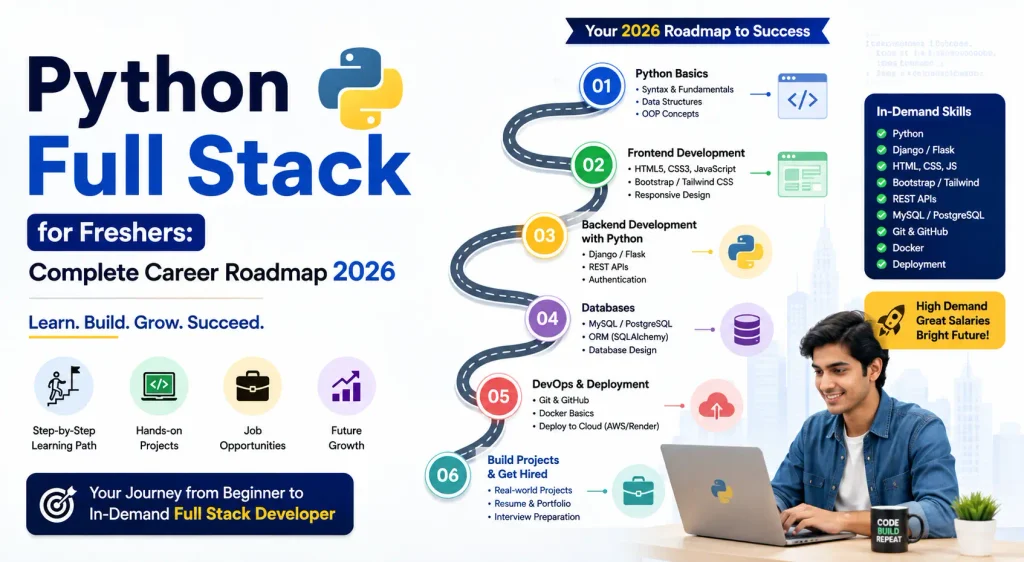
A fresher can organize learning into six stages:
1: Python fundamentals, OOP and problem solving.
2: HTML, CSS, JavaScript and SQL.
3: Django, databases, authentication and project development.
4: Django REST Framework, REST APIs and API testing.
5: React and frontend-backend integration.
6: Projects, GitHub portfolio, deployment, resume preparation and mock interviews.
The exact timeline depends on your existing knowledge and the number of hours you practice each day. Consistent hands-on practice is more important than completing a roadmap quickly.
After developing the required skills, freshers can explore roles such as:
Your first job title may vary from company to company. Therefore, focus on the skills listed in job descriptions rather than targeting only one job title.
Many beginners struggle because they learn programming concepts without applying them.
Practical training can help bridge this gap by combining theory, coding exercises, projects, and career preparation.
Cloud Data Technologies states that its Python training includes hands-on learning, real-time projects, flexible batches, and placement support. Its Python program progresses from fundamentals to application development, automation, and data-related applications.
For freshers, this type of project-based learning can provide a structured environment for building confidence and creating a portfolio.
Follow these habits throughout your learning journey:
Practice Coding Every Day
Even 60–90 minutes of consistent practice can help you improve. Write programs instead of only watching tutorials.
Build Projects While Learning
Do not wait until you finish the entire syllabus. Build a small project after every major topic.
Understand Your Code
During interviews, recruiters may ask why you selected a particular approach. Therefore, understand the logic behind your projects instead of copying code.
Maintain a GitHub Portfolio
Upload projects regularly and keep your repositories organized.
Practice Technical Interviews
Prepare Python, OOP, SQL, Django, REST API, JavaScript and basic React interview questions.
Improve Communication Skills
Technical knowledge matters, but you also need to explain your projects clearly. Practice describing the problem, your solution, technologies used, challenges, and results.
Python Full Stack for Freshers provides a structured path for beginners who want to enter software development in 2026. However, becoming job-ready requires more than learning Python alone.
Start with Python fundamentals and OOP. Then move to HTML, CSS, JavaScript, SQL, Django, REST APIs and React. After that, build complete projects, learn Git, deploy your applications, and gradually explore AI integration.
Most importantly, focus on practical experience. A fresher with a strong foundation, several meaningful projects, a professional GitHub portfolio, and good interview preparation can present a much stronger profile to potential employers.
If you are looking for structured Python training in Chennai, Cloud Data Technologies offers Python learning with practical projects, flexible learning options, and placement support. The institute’s Python curriculum is designed to take learners from fundamentals toward practical application development.
Start small, practice consistently, build real applications, and keep improving. Your journey from Python beginner to Full Stack Developer becomes much easier when you follow a clear roadmap and focus on skills that you can demonstrate.
Ready to start your Python journey? Explore the Python learning options at Cloud Data Technologies and build the practical skills needed for your next step in technology.