Artificial Intelligence is moving beyond simple chatbots and content-generation tools. The next major stage is Agentic AI, where AI systems can understand goals, plan multiple steps, use tools, make decisions, and complete tasks with limited human intervention. As businesses look for smarter automation, the Agentic AI future is becoming an important topic for students, freshers, developers, and technology professionals.
Unlike traditional AI applications that respond to individual commands, AI agents can work toward a larger objective. They can break a problem into smaller tasks, gather information, use software tools, evaluate results, and continue working until they reach an intended outcome. OpenAI describes this shift as moving from short interactions toward delegated, longer-horizon tasks performed through agentic systems.
For freshers, this development creates an important opportunity. Learning Generative AI, Python, prompt engineering, APIs, data handling, and automation can provide a strong foundation for understanding and building AI-powered applications.
Agentic AI refers to AI systems designed to pursue a goal by taking a sequence of actions rather than simply producing a single response.
A conventional chatbot may answer a question such as, “What are the latest sales numbers?” An agentic system could potentially retrieve the required business data, analyze it, identify important changes, create a report, and send the report to the appropriate person.
In simple terms, an AI agent generally follows a process like:
Goal → Planning → Tool Use → Action → Evaluation → Next Action → Result
This ability makes Agentic AI different from basic Generative AI.
Generative AI mainly focuses on creating content such as text, images, code, audio, and other outputs. Agentic AI adds a layer of reasoning, planning, tool usage, and action around AI models.
Google Cloud’s 2026 AI agent trends report similarly highlights that AI agents can understand goals, develop multi-step plans, and take actions under human guidance and oversight.
Generative AI and Agentic AI are closely connected, but they are not identical.
Generative AI uses models to generate content based on user instructions. For example, a student can ask an AI tool to write Python code, summarize an article, or generate an email.
Agentic AI goes further. Instead of stopping after generating an answer, an AI agent can use tools and perform multiple actions to complete a larger task.
For example:
Generative AI:
“Write a Python script that analyzes sales data.”
Agentic AI:
“Analyze this sales dataset, identify the top-performing products, create charts, prepare a summary, and save the report.”
The second workflow requires planning, data access, execution, evaluation, and potentially multiple tool calls.
Therefore, the future of AI is not necessarily about choosing between Generative AI and Agentic AI. Instead, Agentic AI can use Generative AI models as part of a larger intelligent workflow.
The Agentic AI future is becoming more relevant because organizations want AI systems that can deliver practical business outcomes rather than only generate content.
Businesses are increasingly exploring agents for productivity, customer service, software development, data analysis, workflow automation, and other operational activities. Google Cloud’s 2026 report identifies agentic workflows and multi-agent collaboration as important developments for business processes.
At the same time, organizations need to implement these systems carefully. Recent developments show that autonomous agents can introduce security, reliability, and governance challenges.
As a result, companies will need professionals who understand both the capabilities and limitations of AI agents.
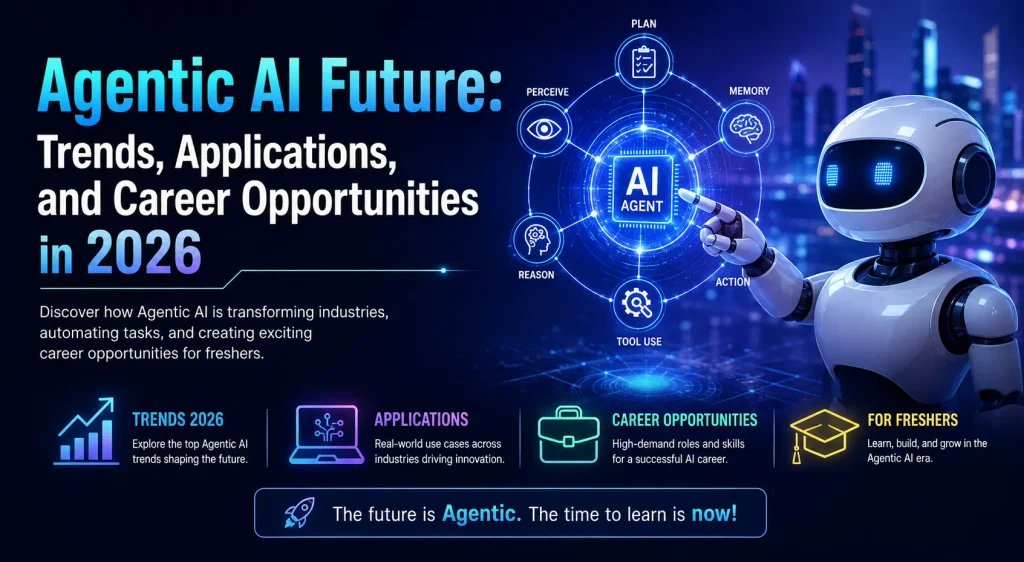
One of the biggest Agentic AI trends in 2026 is the development of autonomous AI agents that can complete multi-step tasks.
Instead of asking AI for an answer at every stage, users can provide a goal and allow an agent to determine the next actions. Human oversight remains important, particularly when agents interact with sensitive information or business systems.
A single AI agent may handle one workflow, while multiple specialized agents can collaborate on a larger problem.
For example, a business workflow could use:
These agents can coordinate their work and produce a more complete result.
Agentic AI is also influencing software development. Developers can use AI systems to generate code, debug problems, analyze repositories, create tests, and support documentation.
For freshers, this does not mean programming skills are becoming unnecessary. Instead, programming fundamentals become even more valuable because developers need to understand, verify, improve, and safely deploy AI-generated solutions.
Businesses can use AI agents to automate repetitive and multi-step workflows.
Potential applications include customer support, sales operations, report generation, lead qualification, document processing, internal knowledge search, and data analysis.
However, organizations should begin with clearly defined business problems instead of adopting agents simply because the technology is popular. Current industry guidance emphasizes starting with practical use cases, strong governance, and measurable business value.
The usefulness of an AI agent depends heavily on the information and tools available to it.
Modern enterprise AI systems increasingly connect models with business data, software applications, APIs, databases, and other tools. This allows agents to perform useful actions instead of only generating responses.
Therefore, skills such as SQL, Python, APIs, databases, cloud platforms, and data management can become increasingly valuable for aspiring AI professionals.
The Agentic AI applications landscape is expanding across industries.
AI agents can help manage customer requests, find information, classify issues, and route complex cases to human employees.
AI systems can assist with administrative workflows, information retrieval, documentation, and scheduling. However, healthcare applications require strong privacy, safety, validation, and human oversight.
Financial organizations can explore agents for document analysis, reporting, customer support, research assistance, and workflow automation.
AI agents can support personalized learning, research assistance, practice exercises, and administrative tasks.
Agents can assist developers with coding, testing, debugging, documentation, and project workflows.
Marketing teams can use AI agents for research, content planning, campaign analysis, customer segmentation, and reporting.
These examples show why the future of AI agents could extend far beyond chatbots.
Freshers do not need to master everything at once. Instead, they should build their knowledge step by step.
Python is one of the most useful programming languages for AI and automation. Learn variables, functions, data structures, APIs, file handling, object-oriented programming, and basic libraries.
Understand how Generative AI works and learn about LLMs, prompts, tokens, context windows, embeddings, and AI application workflows.
Learn how to create clear instructions, provide context, structure outputs, and evaluate AI responses.
AI agents often need to interact with external applications. Therefore, understanding REST APIs, JSON, authentication, and basic integrations can help you build practical projects.
Agents need reliable information to perform useful tasks. SQL and database knowledge can help freshers connect AI applications with structured business data.
Learn the fundamentals of cloud computing, application deployment, authentication, storage, and monitoring. These skills can help you move from an AI prototype to a usable application.
Technical skills alone are not enough. Learn about data privacy, access control, human oversight, hallucinations, evaluation, security, and responsible AI development.
Cloud Data Technologies already positions its Generative AI training around Python, machine learning basics, LLMs, prompt engineering, and practical applications such as chatbots and AI-powered workflows.
The growth of Agentic AI can create opportunities across multiple technical roles.
Freshers can explore career paths such as:
However, students should avoid focusing only on job titles. Instead, build practical skills and demonstrate them through projects.
For example, a fresher could build an AI research assistant, customer-support agent, resume-analysis application, SQL analytics assistant, or automated reporting system.
A portfolio demonstrates what you can actually build. Therefore, project-based learning can help you stand out when applying for entry-level roles.
If you are starting from zero, follow a structured learning path.
1: Learn Python fundamentals.
Build small programs and understand how programming logic works.
2: Learn AI and Generative AI basics.
Understand LLMs, prompts, embeddings, and AI application concepts.
3: Practice prompt engineering.
Experiment with structured prompts and learn how to evaluate responses.
4: Learn APIs.
Connect AI models with external applications and data sources.
5: Build simple AI applications.
Start with chatbots, document assistants, or data-analysis tools.
6: Move toward agentic workflows.
Learn how agents plan tasks, call tools, maintain context, and evaluate results.
7: Build portfolio projects.
Document your projects on GitHub and explain the problem, technology, workflow, and results.
8: Prepare for interviews.
Revise Python, SQL, AI concepts, APIs, cloud fundamentals, prompt engineering, and project-based questions.
Yes, Agentic AI can be a promising area for freshers who are willing to develop strong technical fundamentals.
However, students should not treat Agentic AI as a shortcut that eliminates the need to learn programming or data skills. The strongest candidates will understand how AI works while also knowing how to build reliable software around it.
In addition, the industry is still evolving. AI agents can produce useful results, but they can also make incorrect decisions, access inappropriate information, or behave unpredictably if organizations do not establish proper controls. Recent reporting on autonomous AI systems has highlighted the importance of security and risk management.
Therefore, the future will require AI professionals who combine technical ability with critical thinking, testing, security awareness, and responsible AI practices.
For students and freshers who want to enter the AI field, structured training can make the learning process easier.
Cloud Data Technologies is a Chennai-based software training institute that offers courses across Generative AI, Python, Salesforce, SQL, Power BI, and Tableau. Its Generative AI program covers areas including Python for AI, machine learning basics, LLMs, prompt engineering, and practical AI applications.
The institute emphasizes practical learning, real-world projects, guided practice, and both online and offline learning options.
For a fresher, this combination can provide a useful foundation before moving into advanced topics such as AI agents, automation, and AI application development.
The Agentic AI future represents an important evolution in artificial intelligence. Instead of simply responding to individual prompts, AI agents can work toward goals, plan multiple steps, use tools, and support complex workflows.
In 2026, organizations are increasingly exploring agentic workflows for productivity, automation, customer experience, software development, and data-driven operations. At the same time, businesses must address security, reliability, governance, and human oversight.
For freshers, this creates an exciting opportunity. Start with Python, Generative AI, prompt engineering, SQL, APIs, and cloud fundamentals. Then progress toward AI agents and practical automation projects.
Most importantly, do not learn Agentic AI only as a trend. Learn how to solve real problems with it.
The future of AI will need professionals who can combine programming + data + Generative AI + automation + critical thinking. By building these skills today, freshers can prepare themselves for the rapidly changing AI job market of tomorrow.
Explore Generative AI training and practical AI learning opportunities with Cloud Data Technologies