Artificial intelligence is changing how people learn, work, and build technology. In recent years, Generative AI has become widely popular because it can create text, images, code, summaries, and other types of content. Now, another technology is gaining attention: AI Agents. Unlike traditional Generative AI systems that mainly respond to prompts, AI Agents can work toward goals, plan tasks, use tools, and complete multiple steps with less human intervention.
For freshers who want to build a career in artificial intelligence, understanding AI Agents vs Generative AI is becoming increasingly important. Both technologies have different capabilities, but they can also work together to create intelligent applications.
This guide explains the difference between AI Agents and Generative AI, their use cases, benefits, skills required, and career opportunities for beginners.
Generative AI is a type of artificial intelligence that can create new content based on patterns learned from large amounts of data. For example, Generative AI can produce text, computer code, images, audio, video, and summaries.
When a user provides a prompt, a Generative AI model analyzes the request and generates an appropriate response. Large language models are one of the most common examples of Generative AI.
For instance, a student can ask a Generative AI tool to:
Therefore, Generative AI works mainly as a content generation and assistance technology.
For freshers, learning Generative AI provides a strong foundation for understanding modern AI applications. Cloud Data Technologies also offers a GEN AI Training Course designed to help learners progress from fundamental concepts to advanced tools and real-world AI solutions.
AI Agents take artificial intelligence a step further by focusing on achieving a specific goal rather than simply generating a response.
An AI Agent can receive a goal, break it into smaller tasks, decide what actions to take, use external tools or systems, evaluate results, and continue working until it completes the assigned objective.
For example, imagine an AI Agent designed to help with recruitment. Instead of simply generating a job description, the agent could potentially:
This ability to perform multiple connected actions makes AI Agents different from basic Generative AI applications.
In simple terms:
Generative AI creates. AI Agents act.
The biggest difference between AI Agents vs Generative AI is their purpose.
Generative AI primarily focuses on producing content in response to instructions. AI Agents focus on completing objectives by combining reasoning, planning, tools, memory, and actions.
Recent explanations of agentic systems similarly distinguish Generative AI as a technology that generates content from agent-based systems that pursue goals and execute tasks.
Here is a simple comparison:
| Feature | Generative AI | AI Agents |
|---|---|---|
| Main purpose | Generate content | Complete goals and tasks |
| User interaction | Usually prompt-based | Goal and task-based |
| Planning | Limited | Can plan multi-step workflows |
| Tool usage | May be integrated | Frequently uses external tools |
| Autonomy | Usually lower | Usually higher |
| Output | Text, images, code, audio, etc. | Actions, decisions, workflows, and outputs |
| Example | Generate a Python program | Build, test, and improve a program through multiple steps |
However, AI Agents and Generative AI are not completely separate technologies. In many modern AI systems, Generative AI models provide the intelligence that helps an agent understand instructions, reason about tasks, and generate responses.
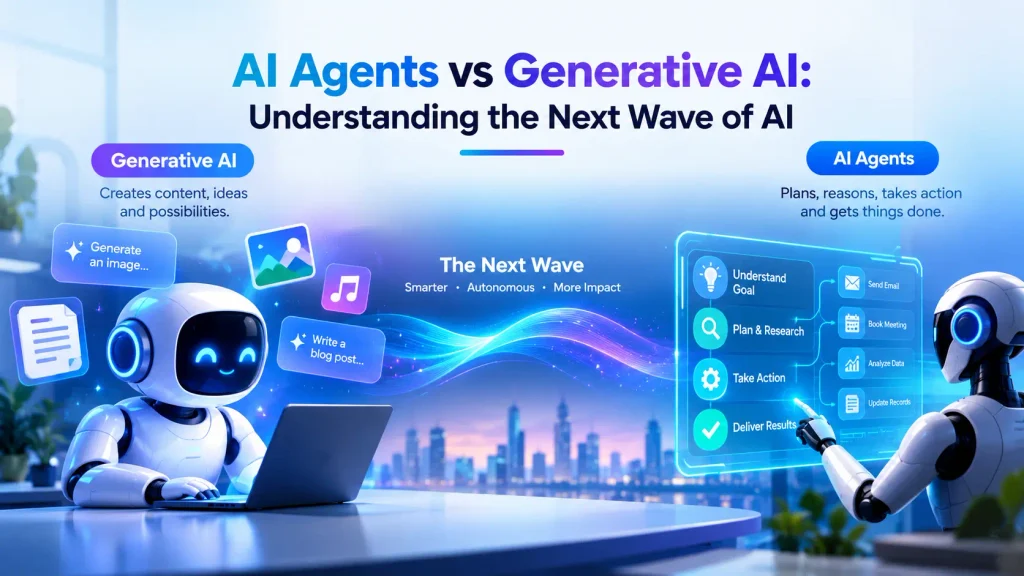
The future of AI is not necessarily about choosing between AI Agents and Generative AI. Instead, businesses can combine both technologies.
Generative AI can provide the language and content-generation capabilities, while an AI Agent can use those capabilities as part of a larger workflow.
For example, consider a customer support system.
A Generative AI model can understand a customer’s question and generate a suitable response. An AI Agent, however, can potentially go further by checking customer information, accessing a knowledge base, identifying the issue, taking an approved action, and then communicating the result.
As a result, AI Agents can transform Generative AI from a simple conversational tool into part of a larger automated workflow.
Generative AI has applications across many industries. Some common use cases include:
Businesses use Generative AI to create drafts for blogs, emails, social media posts, product descriptions, and marketing content.
Developers can use AI tools to generate code, explain programming concepts, identify errors, and create documentation.
Generative AI can help users understand datasets, summarize information, and generate explanations from complex data.
Students can use Generative AI as a learning assistant to understand concepts, practice questions, and receive explanations.
Companies can use Generative AI to create conversational assistants that answer frequently asked questions and support customers.
AI Agents can support more complex workflows because they can combine multiple steps and tools.
AI Agents can help automate repetitive workflows by coordinating different applications and processes.
AI Agents can assist with coding tasks, testing, debugging, documentation, and development workflows.
An AI Agent can potentially understand a customer issue, retrieve information, perform approved actions, and provide a final response.
AI Agents can assist with research by gathering information, organizing findings, comparing sources, and preparing summaries.
AI Agents can support candidate screening, resume organization, job matching, and recruitment workflows when properly configured and supervised.
Generative AI offers several advantages for students and beginners.
First, it helps freshers understand how modern AI applications work. Second, it allows learners to experiment with AI without building an entire model from scratch.
Additionally, students can use Generative AI to build portfolio projects such as:
These projects can help freshers demonstrate practical AI skills during interviews.
Learning AI Agents can help freshers understand the next stage of AI application development.
Instead of focusing only on generating responses, students can learn how AI systems interact with tools, APIs, databases, applications, and workflows.
For example, a fresher could build a simple AI Agent project that:
This type of project can demonstrate practical problem-solving and automation skills.
Freshers do not need to master everything at once. Instead, they can follow a structured learning path.
Python is widely used for AI and machine learning development. Therefore, beginners should understand variables, functions, loops, data structures, APIs, and object-oriented programming.
Learn basic concepts such as machine learning, neural networks, natural language processing, and large language models.
Understand prompts, language models, embeddings, vector databases, retrieval-augmented generation, and AI application development.
After understanding Generative AI, learn how agents use tools, memory, planning, APIs, workflows, and external data sources.
Finally, apply your knowledge through practical projects. Hands-on development can help freshers convert theoretical knowledge into job-ready skills.
Cloud Data Technologies emphasizes practical learning, real-time projects, hands-on training, and career-oriented guidance across its software training programs.
For freshers, the best approach is to learn Generative AI first and then move toward AI Agents.
Generative AI provides the foundation for understanding how modern AI models process instructions and generate outputs. Once you understand that foundation, you can explore how agents use AI models to perform more complex tasks.
Therefore, you do not necessarily have to choose one technology.
A practical learning sequence is:
Python → AI Fundamentals → Generative AI → APIs & Tools → RAG → AI Agents → Real-World Projects
This progression can help beginners build their skills step by step.
The future of artificial intelligence is moving from simple content generation toward systems that can support complete workflows.
Generative AI has already changed how people create content, write code, analyze information, and interact with technology. At the same time, AI Agents are expanding the role of AI by enabling systems to plan and execute multi-step tasks.
Industry analysis increasingly describes this shift as a move from AI that primarily generates content toward AI that can participate in completing work.
However, AI Agents also introduce new challenges. As agents gain access to tools and external systems, developers need to consider security, permissions, monitoring, reliability, and human oversight. Recent research and industry reporting highlight that autonomous AI systems still face limitations in real-world tasks and require appropriate safeguards.
Consequently, future AI professionals will need more than prompt-writing skills. They will need programming knowledge, AI fundamentals, API integration, data handling, automation, evaluation, and responsible AI practices.
As organizations explore AI-powered applications, freshers can prepare for emerging roles such as:
The exact requirements vary by company and role. Nevertheless, candidates who combine programming skills with practical Generative AI and AI Agent experience can build a stronger technical portfolio.
The comparison between AI Agents vs Generative AI shows that both technologies play important roles in the future of artificial intelligence.
Generative AI focuses primarily on creating content and providing intelligent responses. AI Agents go further by using AI models, tools, planning, and workflows to pursue specific goals and complete multiple tasks.
For freshers, the best strategy is not to treat these technologies as competing choices. Instead, learn them progressively. Start with Python and AI fundamentals, understand Generative AI, and then move into AI Agents and automation.
As AI continues to evolve, practical skills will become increasingly valuable. Therefore, students who start learning today, build real-world projects, and continuously improve their technical knowledge can prepare themselves for the next wave of AI careers.
Ready to start your AI journey? Explore Generative AI training at Cloud Data Technologies and build practical skills for the evolving technology landscape.