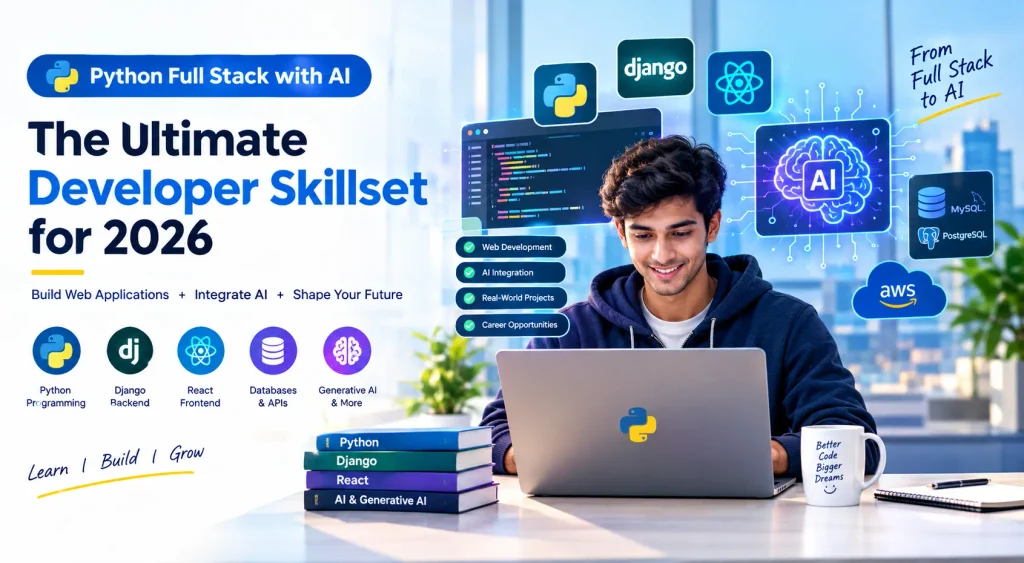
The software development industry is changing rapidly. Today, companies are not only looking for developers who can build websites and applications. They increasingly need developers who can create intelligent, scalable, and user-friendly digital products. As a result, Python Full Stack with AI is emerging as a powerful skill combination for aspiring developers in 2026.
For freshers, learning Python Full Stack Development along with Artificial Intelligence can open the door to a wider range of technology careers. Instead of focusing only on frontend or backend development, beginners can learn how different technologies work together and how AI can make applications smarter.
A modern Python Full Stack Developer can work with Python, Django, React, databases, REST APIs, cloud technologies, and AI-powered features. Furthermore, knowledge of Generative AI can help developers build applications such as intelligent chatbots, recommendation systems, document assistants, automation tools, and AI-enabled business applications.
Python Full Stack with AI combines traditional full stack web development with Artificial Intelligence and Generative AI capabilities.
A Python Full Stack Developer generally works on both the frontend and backend of an application. Python is commonly used for backend development, while technologies such as React can be used to create interactive user interfaces. Databases store application data, and APIs allow different systems to communicate.
When AI is added to this stack, developers can create applications that understand data, generate content, automate tasks, answer questions, and support intelligent decision-making.
A typical Python Full Stack with AI skillset may include:
Therefore, this combination gives freshers a broader understanding of modern software development.
The demand for software is moving beyond traditional websites and basic business applications. Businesses increasingly want applications that can automate repetitive work and provide intelligent experiences.
For example, an e-commerce application can use AI to provide personalized recommendations. A customer service platform can use an AI chatbot to answer common questions. Similarly, a document management application can use Generative AI to summarize documents and answer questions about their contents.
Because Python has a large ecosystem for web development, automation, data processing, and AI, it provides a strong foundation for developers who want to work across multiple areas.
Moreover, developers who understand both application development and AI integration can participate in projects from the initial frontend design to backend development and intelligent feature implementation.
Starting a technology career can be challenging for fresh graduates. Many beginners learn individual programming languages but struggle to understand how those skills are used in real applications.
Python Full Stack with AI provides a practical learning path.
First, freshers can learn programming fundamentals using Python. Next, they can understand backend development with frameworks such as Django or Flask. After that, they can learn frontend development using HTML, CSS, JavaScript, and React.
Once these fundamentals are clear, they can move toward APIs, databases, authentication, deployment, and cloud concepts.
Finally, they can integrate AI into their applications.
This progression helps freshers understand the complete development lifecycle instead of learning isolated technologies.
Becoming a Python Full Stack Developer requires more than knowing Python syntax. Developers need to understand how different technologies work together.
Python should be the foundation of the learning journey. Freshers should understand variables, data types, functions, object-oriented programming, exception handling, modules, packages, file handling, and common Python libraries.
Strong Python fundamentals make it easier to learn backend development and AI technologies later.
Django and Flask are popular Python frameworks for backend development.
Provides many built-in features for developing structured web applications, while Flask provides a lightweight approach that gives developers greater flexibility.
Freshers should learn routing, authentication, database integration, forms, middleware, APIs, and application architecture.
A full stack developer must also understand how users interact with an application.
Therefore, beginners should learn:
React combined with Python backend technologies can help developers create modern, interactive web applications.
Every real-world application works with data. Consequently, database knowledge is an important part of Python Full Stack Development.
Freshers should learn relational databases such as MySQL or PostgreSQL. They should understand tables, relationships, SQL queries, joins, indexing, transactions, and database design.
Basic knowledge of NoSQL databases can also be useful for certain modern applications.
APIs connect different parts of an application.
For example, a React frontend may communicate with a Python backend through REST APIs. Similarly, an AI service can be integrated into an application through an API.
Therefore, freshers should understand HTTP methods, JSON, authentication, API endpoints, error handling, and API testing.
Artificial Intelligence adds another layer of capability to traditional applications.
Consider a basic customer support website. Traditionally, the website may allow users to submit questions through a form. With AI integration, the same application can include an intelligent assistant that understands questions and generates relevant responses.
Similarly, a Python Full Stack Developer can add AI features to:
As a result, developers can move from building simple applications to creating AI-powered web applications.
Generative AI is one of the most important areas for developers entering the technology industry.
Generative AI systems can create text, code, summaries, responses, and other forms of content. For developers, the opportunity is not only to use AI tools but also to integrate AI capabilities into real applications.
A Python Full Stack Developer can learn how to connect applications with AI models and build features such as:
Furthermore, concepts such as Large Language Models (LLMs), prompt engineering, embeddings, vector databases, and Retrieval-Augmented Generation (RAG) can help developers build more useful AI applications.
Retrieval-Augmented Generation, commonly known as RAG, is an approach that allows an AI application to retrieve relevant information from a knowledge source before generating a response.
For example, imagine a company has hundreds of internal documents. Instead of asking an AI model to answer questions without access to those documents, a RAG application can retrieve relevant information from the company’s knowledge base and provide it to the model.
A fresher learning Python Full Stack with AI can build a simple RAG project using Python, a web framework, an embedding model, a vector database, and an LLM.
This type of project can also demonstrate practical development skills during interviews.
Projects are extremely important when starting a software development career. Instead of building only basic calculator or to-do applications, freshers can create projects that demonstrate multiple skills.
Here are some project ideas:
Build a web application where users upload a resume and receive an AI-generated summary, skill analysis, and improvement suggestions.
This project can combine Python, Django, React, APIs, document processing, and Generative AI.
Create a chatbot that answers customer questions and connects with a knowledge base.
This project can demonstrate frontend development, backend APIs, databases, and AI integration.
Develop an online learning application that uses AI to generate quizzes, summarize lessons, and provide personalized learning suggestions.
Create a RAG-based application that allows users to upload documents and ask questions about their content.
These projects demonstrate how Python Full Stack Development and AI can work together in practical scenarios.
After developing the right technical foundation, freshers can explore several career paths.
Possible roles include:
The exact role depends on the candidate’s skills, projects, technical knowledge, and company requirements.
Importantly, freshers should not focus only on collecting certificates. They should also develop problem-solving abilities and demonstrate their knowledge through practical projects.
A structured roadmap can make the learning process easier.
Start with Python fundamentals and gradually move into object-oriented programming and practical coding.
Learn HTML, CSS, JavaScript, and responsive web development.
Choose Django or Flask and understand how to build backend applications and APIs.
Understand components, state, routing, forms, and API integration.
Practice SQL and learn how applications store, retrieve, and manage information.
Use Git and GitHub for version control. Then understand basic deployment and cloud concepts.
Understand Artificial Intelligence, Machine Learning basics, Generative AI, LLMs, and AI APIs.
Finally, combine your full stack and AI knowledge to build real-world applications.
This step-by-step approach can help freshers become more confident and job-ready.
For students and freshers interested in software development, Python Full Stack with AI can be a valuable skill combination.
However, technology careers require continuous learning. Tools and frameworks will continue to evolve. Therefore, developers should focus on strong fundamentals rather than depending entirely on a particular tool.
Python programming, web development, databases, APIs, software engineering practices, and problem-solving skills will remain important foundations. At the same time, AI development skills can help developers adapt to the changing technology landscape.
The strongest approach is to become a developer who can build applications and intelligently integrate AI where it creates genuine value.
Freshers can start by choosing a structured Python Full Stack Course that covers both development fundamentals and modern AI concepts.
A practical learning program should include Python, frontend development, Django or Flask, databases, REST APIs, Git, real-world projects, and AI integration.
At CloudData Technologies, learners can explore technology-focused training designed around practical development skills. For freshers, hands-on learning can help connect classroom concepts with real-world application development.
Instead of learning every technology at once, build your skills progressively. Start with Python, develop strong programming fundamentals, learn full stack development, and then move into AI-powered application development.
Python Full Stack with AI represents a powerful combination for aspiring developers in 2026. It brings together Python programming, backend development, frontend technologies, databases, APIs, cloud concepts, and Artificial Intelligence.
For freshers, the biggest advantage is the opportunity to develop a broad and practical technical skillset. Rather than becoming familiar with only one programming language, learners can understand how complete applications are designed, developed, connected, and enhanced with AI.
Most importantly, focus on practical skills. Build projects, solve coding problems, understand application architecture, learn how APIs work, and experiment with AI integration.
The future of software development will not simply be about writing more code. It will increasingly involve building smarter applications and using technology to solve real business problems.
If you are a fresher planning to enter software development, Python Full Stack with AI can be a strong starting point for building the skills needed for modern web and AI application development.