Python continues to play an important role in software development, artificial intelligence, machine learning, data science, automation, backend development, and many other technology areas. In fact, Python’s adoption increased significantly in the 2025 Stack Overflow Developer Survey, with a 7-percentage-point increase compared with 2024. The survey also highlights Python’s strong position in AI, data science, and backend development.
For freshers, this makes Python an attractive programming language to learn. However, simply knowing Python syntax is not enough. You need practical skills, projects, problem-solving ability, and knowledge of related technologies to build a successful career.
So, let’s explore the Python career scope 2026, future job opportunities, required skills, and why Python remains valuable for freshers.
Python has remained popular because it is relatively easy to learn and can be used across many technology domains.
For example, developers use Python to:
Furthermore, Python has a large ecosystem of libraries and frameworks. Developers can use tools such as Django, Flask, FastAPI, Pandas, NumPy, and many AI and machine learning libraries.
The 2025 Stack Overflow Developer Survey reported that Python’s adoption accelerated significantly and specifically connected its growth with AI, data science, and backend development. FastAPI also recorded notable growth among web technologies.
Therefore, Python is not simply a beginner programming language. It has become a practical technology for several modern IT careers.
Yes, Python can be a strong starting point for freshers.
One major advantage is its relatively simple and readable syntax. Because of this, beginners can focus more on programming logic and problem-solving instead of spending too much time understanding complicated syntax.
However, freshers should avoid one common mistake: learning Python only through theoretical tutorials.
Instead, learn Python step by step and apply every concept through coding practice.
For example, start with:
This approach helps you build confidence and prepares you for technical interviews.
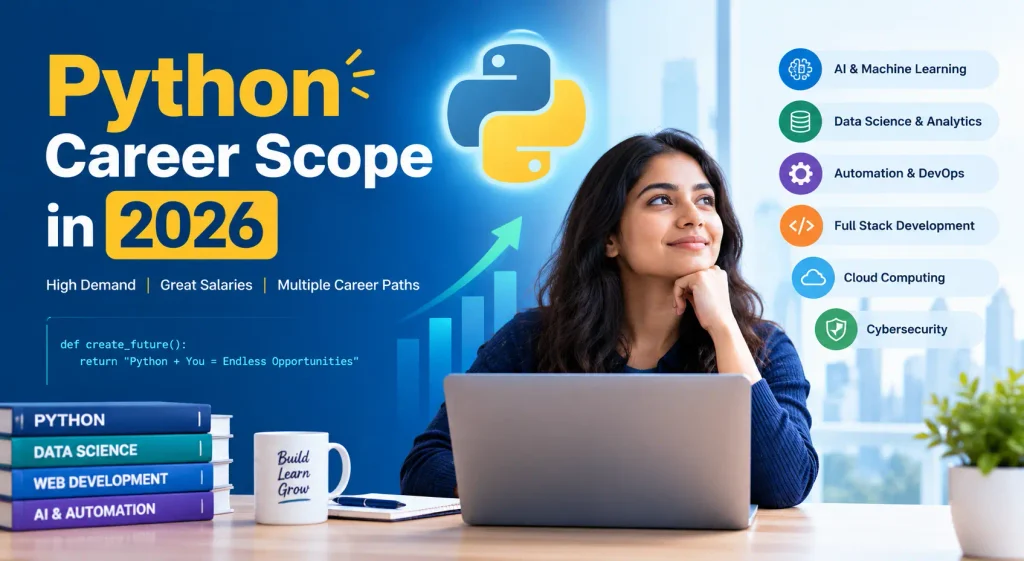
The Python job market in 2026 extends beyond the traditional Python Developer role.
Depending on your interests, you can build a career in several areas.
A Python Developer builds applications, scripts, backend services, APIs, and software solutions using Python.
Typical responsibilities include:
For freshers, Python Developer is one of the most straightforward career paths after learning core Python and backend development.
If you want to become a software developer, you can combine Python with frontend technologies.
A Python Full Stack Developer can work with:
This combination gives you broader development knowledge and can help you apply for full-stack development positions.
Python also provides opportunities in data analytics.
A beginner interested in data can learn:
Python allows analysts to clean, transform, analyze, and visualize data efficiently.
Therefore, learning Python alongside SQL and visualization tools can create a strong foundation for a data analytics career.
Data science is another important area within the Python
You can gradually learn:
However, freshers should understand that becoming a Data Scientist usually requires more than basic Python knowledge. Strong mathematics, statistics, data analysis, and machine learning skills are also important.
Python is widely used in machine learning workflows.
Machine Learning Engineers work on applications that use data and trained models to make predictions or automate decisions.
A fresher interested in this career can eventually learn:
Thus, Python can provide the programming foundation for a long-term machine learning career.
Artificial intelligence is one of the biggest reasons behind Python’s continued relevance.
Developers use Python to build AI applications, work with machine learning models, integrate APIs, and develop intelligent applications.
At the same time, AI is changing how developers work. The 2025 Stack Overflow survey found that 84% of respondents were using or planning to use AI tools in their development process.
Therefore, freshers should not think of AI as a replacement for learning programming. Instead, they should learn how to combine Python programming with AI tools and concepts.
Python is also excellent for automation.
Companies can use Python scripts to automate repetitive processes such as:
As businesses continue to automate repetitive work, Python automation skills can become useful across different industries.
One of the biggest advantages of learning Python in 2026 is its connection with artificial intelligence.
AI development requires programming, data handling, APIs, model integration, testing, and application development. Python has a mature ecosystem that supports many of these activities.
Moreover, developers increasingly use AI coding assistants while still needing to understand and review the generated code.
The Stack Overflow 2025 survey showed that AI tools are becoming a major part of development workflows, while many developers remain concerned about the accuracy of AI-generated output.
This creates an important opportunity for freshers.
Instead of asking whether AI will replace Python developers, a better question is:
How can I become a Python developer who knows how to use AI effectively?
That mindset can help you stay relevant.
Learning only Python may not be enough to compete for software jobs.
Therefore, build your skills around Python.
Start with:
Then select a specialization.
Learn:
Learn:
Learn:
Consequently, you can build a career profile instead of simply listing “Python” on your resume.
Another important part of building a Python career in 2026 is project experience.
Recruiters want candidates who can demonstrate how they apply their knowledge.
For example, you can create projects such as:
Start with smaller projects and gradually build more advanced applications.
Additionally, upload your projects to GitHub and maintain a simple portfolio. This gives recruiters something practical to evaluate during the hiring process.
Python is valuable, but Python alone does not guarantee a job.
This is an important point for every fresher.
Employers generally look for a combination of technical knowledge, practical skills, communication, problem-solving, and project experience.
Therefore, your goal should not be:
“I want to learn Python.”
Instead, your goal should be:
“I want to become job-ready using Python.”
That small change in mindset can make your learning process much more effective.
If you are completely new to programming, follow a structured roadmap.
Understand syntax, variables, operators, conditions, loops, functions, collections, and file handling.
Understand classes, objects, inheritance, encapsulation, and other OOP concepts.
Python developers frequently work with databases, so SQL is an important supporting skill.
Decide whether you prefer:
Apply your knowledge through real-time projects.
Prepare Python coding questions, SQL questions, project explanations, and basic technical interview questions.
Highlight your skills, projects, certifications, GitHub work, and practical experience.
For students and freshers in Chennai, structured training can provide a practical learning path instead of relying only on random online tutorials.
CloudData Technologies offers Python course training in Chennai with a focus on hands-on learning, real-time projects, Python fundamentals, databases, web development, data analysis, automation, interview guidance, and placement support.
A structured course can be especially useful if you are starting from zero because you can learn concepts in sequence and receive guidance while working on projects.
You can explore the Python Course Training in Chennai at CloudData Technologies for more information.
The future of Python looks strong because the language continues to adapt to new technology trends.
AI, machine learning, data engineering, backend development, automation, and API development are all areas where Python remains relevant.
Furthermore, the growth of AI does not remove the need for programming fundamentals. Instead, developers need to understand how applications work, how data flows through systems, how APIs communicate, and how to test and validate AI-generated code.
Therefore, Python can remain a valuable foundation even as the technology landscape changes.
So, is Python still worth learning in 2026?
Absolutely.
Python continues to have strong relevance across software development, AI, machine learning, data analytics, automation, and backend development. Recent developer survey data also shows continued growth in Python adoption.
However, freshers should not stop at learning Python syntax.
Instead, combine Python with SQL, Git, APIs, frameworks, AI concepts, projects, problem-solving, and communication skills. Choose a career path and develop practical experience around it.
If you are a fresher looking for a programming language that can open doors to multiple technology careers, Python remains one of the strongest choices in 2026.
The future of Python is not only about writing Python code. It is about using Python to build software, analyze data, automate work, and create AI-powered solutions.
Start with the basics, practice consistently, build real-time projects, and keep learning. Your Python career can grow as your skills grow.
1. Is Python worth learning in 2026?
Yes. Python remains highly relevant in AI, machine learning, data science, backend development, automation, and software development.
2. Is Python good for freshers?
Yes. Python has readable syntax and a broad ecosystem, making it a practical starting point for students and freshers.
3. What jobs can I get after learning Python?
Depending on your additional skills, you can target Python Developer, Full Stack Developer, Data Analyst, Machine Learning Engineer, AI Developer, Automation Developer, and related roles.
4. Is Python enough to get a job?
Python is an important foundation, but freshers should also develop SQL, Git, project experience, problem-solving, communication, and domain-specific skills.
5. What is the future of Python in 2026?
Python has strong future potential because of its continued use in AI, data science, backend development, automation, and machine learning.
6. Should freshers learn Python or AI?
You can learn both. Python provides an important programming foundation for many AI and machine learning applications. Learning Python first and then adding AI skills can be a practical approach for beginners.