
Generative AI is rapidly changing the way people create content, build software, analyze information, and automate business processes. From AI chatbots and coding assistants to document automation and intelligent applications, Generative AI is becoming an important part of modern technology.
As a result, companies need professionals who can build, integrate, test, and maintain AI-powered applications. This demand has created exciting opportunities for aspiring Generative AI Developers.
If you are a fresher wondering how to become a Generative AI Developer in 2026, you do not need to master every AI technology at once. Instead, you can follow a structured learning path, build practical projects, and gradually develop the skills required to work with modern AI systems.
This guide explains the Generative AI Developer roadmap, essential skills, tools, projects, and career opportunities for beginners.
A Generative AI Developer is a technology professional who builds applications and solutions using generative artificial intelligence models.
Unlike traditional software applications that follow predefined rules, Generative AI applications can work with technologies such as Large Language Models (LLMs) to generate text, summarize information, answer questions, write code, analyze documents, and perform other intelligent tasks.
A Generative AI Developer may work on:
Therefore, the role combines software development, artificial intelligence, APIs, databases, prompt engineering, and cloud technologies.
Generative AI has moved beyond simple chatbot applications. Today, developers can integrate AI capabilities into websites, mobile applications, enterprise software, data platforms, and automation systems.
Furthermore, businesses are exploring AI applications to improve productivity, customer experiences, knowledge management, and repetitive workflows.
For freshers, this creates an opportunity to build a career by combining software development fundamentals with modern AI skills.
A strong Generative AI Developer does not simply know how to write prompts. Instead, they understand how to connect AI models with real applications and solve practical problems.
That is why learning programming, APIs, databases, LLMs, RAG, and application development can give beginners a stronger foundation.
You do not need to learn everything in one day. Instead, build your skills step by step.
Python is an important starting point for anyone interested in AI development.
If you are a fresher, begin with Python fundamentals such as:
After learning the fundamentals, practice by creating small applications.
For example, you can build a command-line chatbot, text-processing application, API-based application, or document analyzer.
Next, understand the fundamentals of Artificial Intelligence and Machine Learning.
You should know concepts such as:
You do not necessarily need advanced mathematical knowledge at the beginning. However, understanding the basic concepts will help you understand how modern AI systems work.
Large Language Models, commonly called LLMs, are an important part of modern Generative AI applications.
As a beginner, learn:
You should also learn how developers connect applications to AI models through APIs.
Prompt engineering involves designing effective instructions for AI models.
Although prompt engineering alone is not enough to become a professional Generative AI Developer, it is a useful skill when developing AI applications.
Learn how to create prompts using:
For example, instead of asking an AI model to “analyze this document,” you can provide a specific task, expected format, context, and rules.
This approach can make AI applications more consistent and useful.
One of the most valuable concepts for aspiring Generative AI Developers is Retrieval-Augmented Generation, commonly called RAG.
RAG allows an AI application to retrieve relevant information from an external knowledge source before generating an answer.
For example, imagine a company has thousands of internal documents. Instead of expecting an AI model to know those documents, a RAG application can retrieve relevant content from the company’s knowledge base and provide it to the model.
A beginner should understand:
Learning RAG can help you build practical AI applications rather than only experimenting with chat interfaces.
Generative AI applications often need to search large collections of information.
Vector databases help applications store and retrieve information based on semantic similarity.
As a beginner, learn the basic concepts of:
You can then use these concepts when building RAG-based projects.
A Generative AI Developer needs to connect models with applications.
Therefore, learn how to work with APIs and modern AI development frameworks.
Depending on your project, you may work with:
The goal is not to memorize every framework. Instead, understand the development concepts behind them and learn tools as your projects require them.
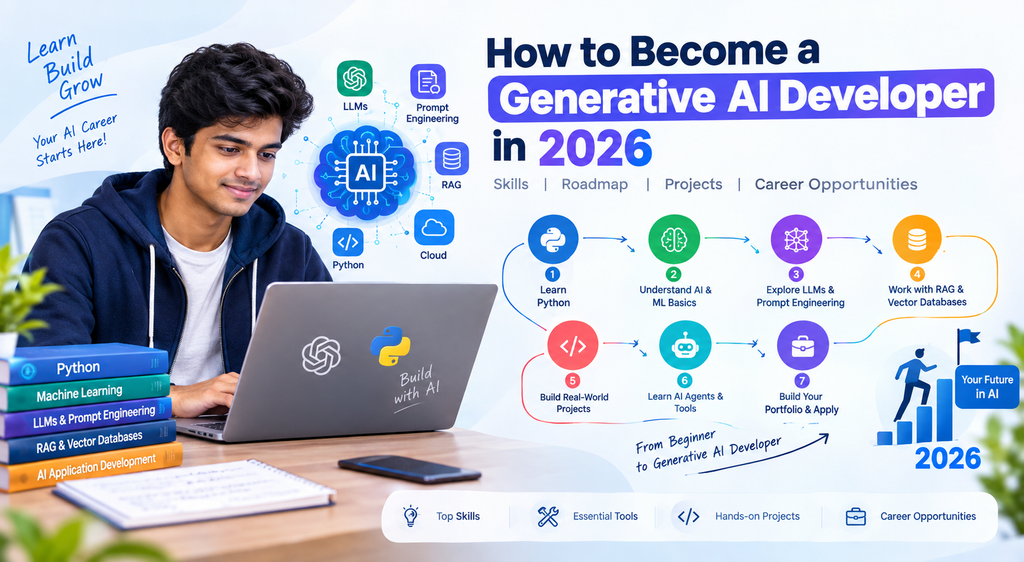
If you are starting from zero, follow this simple roadmap.
Spend time building a strong programming foundation.
Understand the basic concepts behind artificial intelligence and machine learning.
Understand how Large Language Models work and how developers use them through APIs.
Learn how to design clear prompts and structured AI interactions.
Learn document processing, embeddings, retrieval, and vector databases.
Connect AI models to Python applications, APIs, databases, and web interfaces.
Once you understand basic LLM applications, explore AI agents and tool-using systems.
An AI agent can be designed to perform multiple steps, use external tools, retrieve information, and complete defined tasks.
Finally, create practical projects and publish them on platforms such as GitHub.
Your portfolio can demonstrate your ability to solve real problems with Generative AI.
Projects can help you demonstrate your practical skills during interviews.
Here are some project ideas:
Build an application that accepts a resume and extracts skills, experience, education, and other relevant information.
Create a RAG application that allows users to upload a PDF and ask questions about its content.
Build a chatbot that answers questions using a company’s knowledge base.
Create an application that generates structured blog drafts from a topic and selected keywords.
Develop an application that generates interview questions based on a candidate’s skills and provides feedback on answers.
Build a tool that summarizes long documents and produces structured key points.
After learning the fundamentals, create an AI agent that can use predefined tools to perform multiple tasks.
These projects can demonstrate programming, API integration, LLM usage, prompt engineering, RAG, and application development skills.
The Generative AI ecosystem continues to evolve. Therefore, beginners should focus on learning concepts rather than depending on one specific tool.
Depending on your learning path, you can explore:
Additionally, learn Git and GitHub because version control and project documentation can make your portfolio easier for recruiters and technical teams to evaluate.
After developing the required skills, you can explore several technology roles.
Possible career paths include:
The exact job title can vary from company to company. Therefore, focus on the skills listed in job descriptions rather than searching for only one job title.
Generative AI can be an interesting career area for freshers who enjoy programming, problem-solving, and learning new technologies.
However, simply completing a Generative AI course does not automatically make someone job-ready.
Instead, focus on practical learning.
Build projects. Understand your code. Learn how APIs work. Practice debugging. Study how RAG applications retrieve information. Experiment with different prompts. Document your projects.
Most importantly, develop the ability to explain how your application works.
Once you start applying for jobs, prepare for both technical and practical questions.
You may encounter questions about:
For example, an interviewer may ask:
What is RAG?
You should be able to explain that RAG combines information retrieval with generative AI so an application can retrieve relevant external information and use it as context when generating a response.
Similarly, you should be able to explain your own projects clearly.
A structured Generative AI course can help beginners learn concepts in the right sequence.
However, when choosing a Generative AI training program, look for practical components such as:
A practical learning approach can help freshers connect theoretical concepts with real-world development.
For students looking for Generative AI training in Chennai, a structured classroom or online learning environment can provide a clear path for building these skills.
A Generative AI Developer builds applications that use generative AI models to generate content, answer questions, retrieve information, automate tasks, and solve business problems.
Yes. Freshers can begin by learning Python, AI fundamentals, LLMs, APIs, RAG, and application development. Building practical projects is especially important.
Python is highly useful for Generative AI development because it has a large ecosystem for AI, machine learning, APIs, data processing, and application development.
The learning time depends on your existing programming knowledge, learning schedule, and project experience. A fresher should focus on consistent practice rather than trying to master everything quickly.
Freshers can build RAG chatbots, PDF question-answering systems, AI document analyzers, resume analyzers, AI assistants, and automation applications.
Start with Python programming. Then learn AI fundamentals, LLM concepts, APIs, prompt engineering, RAG, vector databases, and AI application development.
Becoming a Generative AI Developer in 2026 is a journey that requires continuous learning and practical development.
For freshers, the best approach is to start with programming fundamentals and gradually move into modern AI technologies. First, learn Python. Next, understand AI and machine learning basics. Then, explore LLMs, prompt engineering, RAG, embeddings, vector databases, APIs, and AI agents.
Most importantly, build projects while learning.
A strong portfolio can demonstrate what you can actually build instead of simply showing completed courses or certificates. Therefore, document your projects, publish your code, practice explaining your solutions, and prepare for technical interviews.
Generative AI is continuing to evolve, so keep improving your skills as new models, frameworks, and development approaches emerge.
If you are a fresher looking to start your AI career, building a strong foundation today can help you move toward opportunities in Generative AI development, AI application development, Python AI development, and other AI-focused technology roles.