Choosing the right technology course can be challenging for freshers. With so many career options available, students often ask an important question: Python vs Python Full Stack — which course should freshers choose in 2026?
Python has become a popular programming language because of its simple syntax, versatility, and wide range of applications. At the same time, Python Full Stack development has become an attractive career path for learners who want to build complete web applications.
However, Python and Python Full Stack are not exactly the same. Python is a programming language and a foundation for several technology careers. Python Full Stack development combines Python with frontend, backend, databases, APIs, and other web development skills.
Therefore, the right choice depends on your career goal, learning time, interests, and the type of job you want to pursue.
In this guide, we will compare Python vs Python Full Stack, explain the skills involved, discuss career paths, and help freshers understand which learning path can match their goals in 2026.
Python is a high-level, general-purpose programming language known for its readable syntax and broad ecosystem. Beginners can start with fundamental programming concepts such as variables, data types, conditions, loops, functions, and object-oriented programming.
As a result, Python provides a strong foundation for several technology areas.
Python is used in:
For example, Python developers can use frameworks such as Django and Flask to create web applications. They can also work with libraries such as Pandas and NumPy for data-related tasks.
CloudData Technologies’ Python training follows a practical progression from fundamentals to object-oriented programming, databases, web development, data handling, and automation. The training also emphasizes hands-on projects.
Therefore, learning Python can give freshers a flexible starting point before they specialize in a particular technology area.
Python Full Stack development goes beyond learning the Python programming language.
A Python Full Stack Developer works with different layers of a web application. This generally includes frontend development, backend programming, databases, APIs, version control, and deployment concepts.
A typical Python Full Stack learning path may include:
In simple terms, Python helps you learn programming, while Python Full Stack training teaches you how to use programming skills to create complete web applications.
For instance, a learner may build a website interface using HTML, CSS, and JavaScript. Then, Python and Django can handle backend logic, while SQL can manage application data.
As a result, Python Full Stack development provides a broader web development skill set.
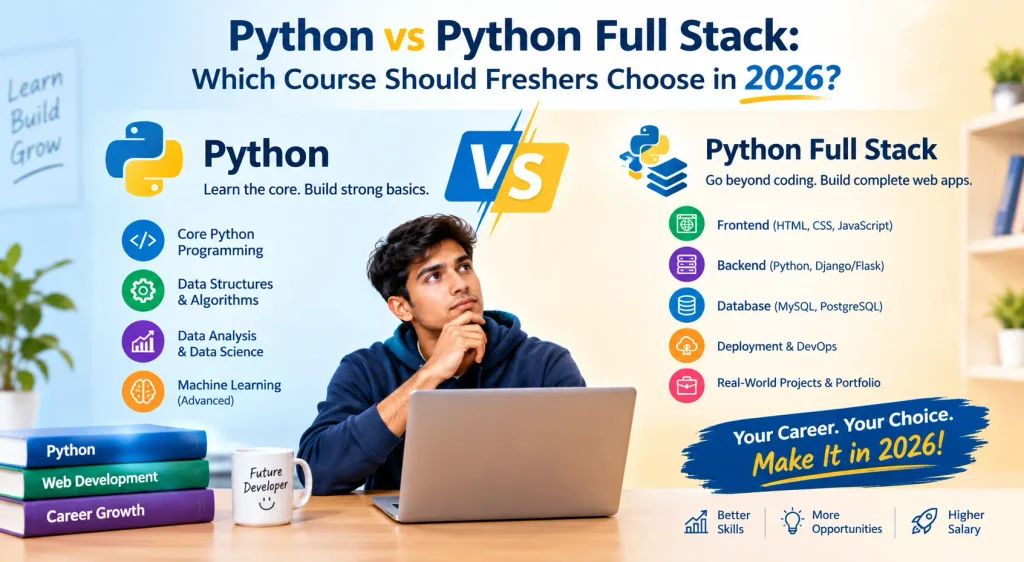
The biggest difference between Python and Python Full Stack is the scope of learning.
| Feature | Python | Python Full Stack |
|---|---|---|
| Main Focus | Programming language | Complete web development |
| Beginner Friendly | Yes | Yes, but broader |
| Frontend | Optional | Required |
| Backend | Can be learned separately | Core component |
| Database | Basic/optional | Important |
| APIs | Optional | Important |
| Web Development | One possible path | Primary focus |
| AI & Data | Strong option | Usually secondary |
| Career Scope | Multiple technology areas | Mainly full stack/web development |
| Learning Scope | Focused | Broader |
Therefore, freshers should not think of Python and Python Full Stack as competing technologies. Instead, Python Full Stack includes Python as one of its core technologies.
Python remains useful across several technology domains. In addition, its relatively simple syntax makes it accessible to beginners.
For a fresher, Python can provide a foundation for learning programming logic before moving into advanced areas.
Python uses readable syntax, which makes it easier for beginners to understand programming concepts.
Instead of struggling with complex syntax from the beginning, students can focus on problem-solving and programming logic.
Learning Python does not restrict you to one career.
After building strong Python fundamentals, you can explore:
CloudData Technologies also highlights Python applications in web development, automation, data analysis, backend development, and testing.
Python has an extensive ecosystem for artificial intelligence and machine learning.
Libraries and frameworks such as PyTorch, TensorFlow, Scikit-learn, Pandas, and NumPy make Python highly useful for AI and data-focused development.
Furthermore, Python is increasingly used for building AI applications and AI-agent workflows. CloudData Technologies’ recent Python content also emphasizes Python’s role in AI application development and AI agents.
If your goal is specifically to become a web developer, Python Full Stack can provide a more complete learning path.
A Full Stack Developer needs to understand both the user-facing and server-side parts of an application.
Therefore, you learn technologies such as HTML, CSS, JavaScript, Python, and a Python web framework.
Python Full Stack training allows you to create projects that combine multiple technologies.
For example, you could build:
These projects can become valuable portfolio pieces when you apply for entry-level roles.
Instead of learning Python in isolation, you understand how different components communicate.
For example:
Frontend → API → Python Backend → Database
Understanding this complete flow can help you troubleshoot applications and collaborate with other developers.
For most beginners, learning Python alone is more focused because you initially concentrate on one programming language and its core concepts.
Python Full Stack requires a broader learning path.
You may need to learn:
Consequently, Python Full Stack can require more learning time and consistent practice.
However, the broader curriculum also gives you exposure to more parts of the software development process.
The answer depends on your intended career.
If you want to explore AI, machine learning, data science, automation, or backend development, Python provides a flexible foundation.
On the other hand, if you specifically want to become a web developer or full stack developer, Python Full Stack provides a more directly relevant skill set.
Therefore, instead of asking which course is universally better, freshers should ask:
“What type of technology career do I want to build?”
This question can make the decision much easier.
Here is a simple way to think about the two paths.
As a result, your career objective should guide your course selection.
If you decide to pursue Python Full Stack development, follow a structured learning roadmap.
Start with:
Next, understand:
These concepts help you write organized and reusable code.
Build your frontend foundation with:
Then move into Django or Flask.
Learn how to create:
Database knowledge is essential for full stack development.
Learn:
Finally, combine your skills into complete applications.
CloudData Technologies emphasizes hands-on learning and real-time projects as part of its Python training approach.
Learning syntax alone is not enough.
Instead, focus on practical skills.
First, practice coding regularly. Then, build projects that solve realistic problems. After that, upload suitable projects to GitHub and create a portfolio.
You should also prepare for technical interviews.
Important interview areas include:
Additionally, improve your communication skills because you may need to explain your projects and technical decisions during interviews.
CloudData Technologies states that its Python program includes hands-on practice, real-time projects, interview guidance, flexible batches, and placement support.
The answer depends on your starting point and career objective.
If you are completely new to programming and want to understand Python before specializing, start with Python fundamentals.
However, if you already know that your goal is web development, you can consider a Python Full Stack course that covers frontend, backend, databases, APIs, and projects.
You can also follow a staged approach:
Python Fundamentals → Advanced Python → Web Development → Databases → APIs → Full Stack Projects
This approach gives you a strong foundation while gradually expanding your development skills.
The technology industry continues to evolve. Therefore, freshers need more than theoretical knowledge.
A practical learning approach helps you understand how concepts work in real applications.
CloudData Technologies describes its training model around practical exposure, real-time projects, expert guidance, flexible online and offline learning, and career support.
Moreover, project-based learning gives you something concrete to discuss during interviews.
For example, instead of saying:
“I know Django.”
You can explain:
“I built an employee management application using Python, Django, SQL, authentication, and REST APIs.”
That difference can make your technical profile easier to understand.
So, Python vs Python Full Stack: which course should freshers choose in 2026?
There is no single course that fits every fresher.
Python is a powerful starting point if you want to build programming skills and explore careers across AI, automation, data, backend development, and other technology areas.
Python Full Stack, meanwhile, is designed for learners who want to develop complete web applications and pursue full stack or web development careers.
Therefore, choose based on your career goal rather than simply following a trend.
If you are still unsure, start with Python fundamentals. Once you understand programming concepts, you can expand into web development, databases, APIs, and full stack projects.
For freshers, the most important goal is not simply completing a course. The goal is to learn, practice, build projects, develop a portfolio, and become confident enough to solve real problems.
CloudData Technologies offers Python training in Chennai with a practical learning approach covering Python fundamentals, advanced concepts, databases, web development, data handling, automation, real-time projects, certification, and placement support. Online and offline learning options are also available.
If your goal is to build a career in Python development, full stack development, automation, data, or AI, developing strong Python fundamentals can be an important first step.
Learn Python. Build projects. Develop real skills. Move toward your IT career in 2026.