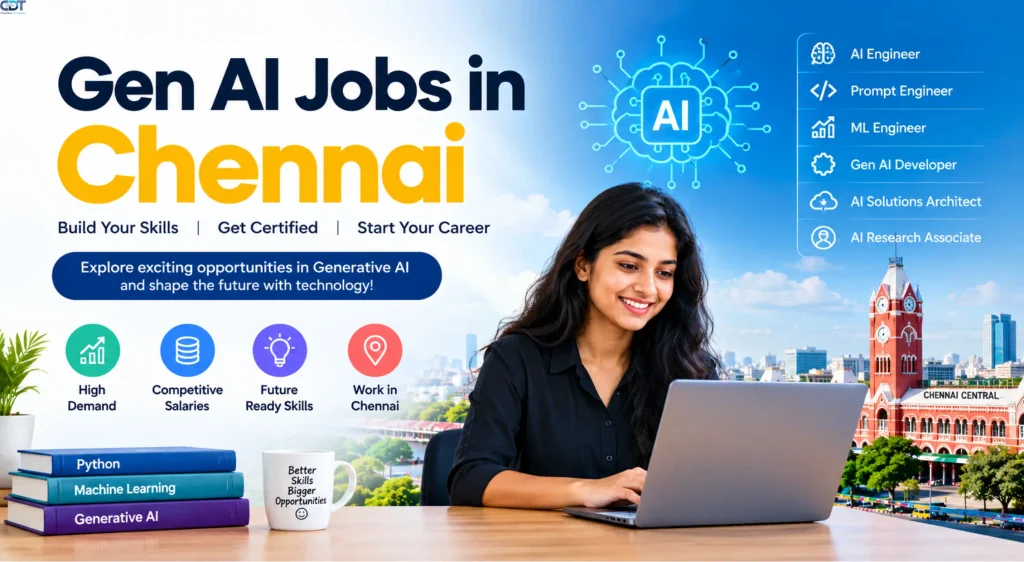
Generative Artificial Intelligence is rapidly changing the technology industry. From AI chatbots and content generation to intelligent automation and AI-powered applications, companies are using Gen AI to improve productivity and create new digital solutions. As a result, Gen AI jobs in Chennai are becoming an important career option for graduates and freshers who want to enter the growing AI industry.
Chennai has a strong IT ecosystem with software companies, technology service providers, startups, and product-based organizations. Current job listings in Chennai include opportunities related to AI development, AI chatbots, Gen AI engineering, prompt-based workflows, and other AI applications. Some listings specifically mention skills such as Python, machine learning, LLMs, RAG, AI agents, and Generative AI tools.
Therefore, if you are a fresher planning your first technology career, learning Generative AI skills can help you prepare for several emerging roles.
Gen AI jobs involve developing, integrating, testing, or using artificial intelligence systems that can generate new content. These systems can create text, images, code, summaries, answers, and other forms of digital content.
Unlike traditional software development, Generative AI development often combines programming with AI models, APIs, data, prompt engineering, and automation.
For example, a Gen AI professional may build:
CloudData Technologies’ current Gen AI training curriculum covers areas including Python, Large Language Models, prompt engineering, LLM APIs, RAG, embeddings, vector databases, chatbots, AI agents, and AI application development.
First, businesses are adopting AI across different functions. Companies can use Generative AI to automate repetitive tasks, improve customer interactions, analyze information, generate content, and support employees.
Second, Generative AI is becoming part of existing software applications. Developers increasingly need to understand how to connect applications with LLMs and AI APIs.
Third, Chennai already has a large technology and software-services ecosystem. This creates opportunities for professionals who combine traditional software skills with modern AI capabilities.
Current Chennai job listings demonstrate demand for different levels of AI expertise. For example, some roles ask for Python, RAG, LLM fine-tuning, agentic frameworks, APIs, and cloud deployment, while fresher-oriented listings include AI tools, prompt engineering, AI workflows, and basic programming knowledge.
However, freshers should understand that not every Gen AI position is an entry-level role. Some Chennai positions currently advertised require several years of professional experience. Therefore, beginners should focus on building foundational skills and practical projects before applying for advanced positions.
One of the biggest advantages of learning Generative AI is that it can connect with several technology career paths.
A Generative AI Developer builds applications that use AI models to solve business problems.
Typical responsibilities may include integrating LLM APIs, creating AI workflows, developing chatbots, handling prompts, and connecting AI systems with applications.
Freshers can start by learning Python, APIs, LLM fundamentals, prompt engineering, and basic application development.
AI and Machine Learning Engineers work with machine learning models, data, algorithms, and AI applications.
A fresher interested in this career path should gradually develop knowledge of Python, statistics, machine learning, deep learning, NLP, and Generative AI.
Prompt engineering involves designing effective instructions for AI models.
A prompt-focused professional needs to understand how different instructions affect AI outputs. They may create, test, evaluate, and improve prompts for business workflows.
Current fresher-oriented AI job listings in Chennai specifically mention prompt engineering, AI tools, output evaluation, and AI workflow development.
Businesses increasingly use chatbots for customer support, internal knowledge systems, and automated assistance.
An AI chatbot developer can work with LLM APIs, Python, RAG, databases, APIs, and web technologies to create intelligent conversational applications.
Retrieval-Augmented Generation, commonly called RAG, allows an AI application to retrieve relevant information from external data before generating an answer.
For example, a company can create a document assistant that answers questions using internal PDFs, policies, manuals, or knowledge bases.
RAG is therefore an important skill for students who want to move beyond simple chatbot development.
AI agents can perform multiple steps to accomplish a task by interacting with tools, APIs, data, and other systems.
Agentic AI is becoming another important area within the Generative AI ecosystem. Current Chennai job listings mention agentic frameworks, tool orchestration, LLM integration, RAG pipelines, and AI workflow development.
If you are a fresher searching for Gen AI jobs in Chennai, focus on building a combination of programming, AI, and problem-solving skills.
Python is one of the most useful programming languages for AI and machine learning.
Learn Python fundamentals first. Then move toward APIs, data processing, AI libraries, and application development.
Understand how Generative AI works and how it differs from traditional AI and machine learning.
Learn concepts such as:
Learn how to write clear instructions for AI models.
You should practice different prompt structures, provide useful context, define expected output formats, and evaluate responses.
Understanding LLMs is important for modern Gen AI development.
Learn how applications communicate with LLMs through APIs and how developers can use models to create useful business applications.
RAG is an important practical skill for building AI systems that work with external information.
Learn the basic workflow:
Documents → Text Processing → Embeddings → Vector Database → Retrieval → LLM Response
Embeddings help applications represent information in a format that can be searched based on semantic similarity.
Understanding embeddings and vector databases can help you build document-search and RAG applications.
Learn how AI agents can use tools, APIs, memory, and workflows to complete multi-step tasks.
This area can be particularly useful for freshers who want to understand the next stage of Generative AI application development.
Companies need professionals who can integrate AI models into existing applications.
Therefore, learn how to work with REST APIs, authentication, JSON, API requests, and basic web application development.
Getting a Gen AI job involves more than completing a course. You should demonstrate that you can actually use the technology.
First, build a strong foundation in Python.
Next, learn Generative AI concepts and LLM fundamentals.
Then, practice prompt engineering and work with AI APIs.
After that, learn RAG, embeddings, vector databases, and AI agents.
Finally, create projects that demonstrate your knowledge.
A strong beginner portfolio could include:
CloudData Technologies’ Gen AI program similarly emphasizes practical projects such as AI chatbots, RAG-based document assistants, PDF question-answering applications, customer-support systems, content generation workflows, and intelligent automation solutions.
Freshers often face a common problem: they know the theory but have little practical experience.
Projects help solve this problem.
For example, instead of simply writing “Knowledge of Generative AI” on your resume, you can demonstrate:
Project: RAG-Based Document Assistant
Technologies: Python, LLM API, embeddings, vector database, RAG
What you built: An application that allows users to upload documents and ask questions about their content.
This gives recruiters something concrete to discuss during an interview.
Therefore, focus on quality projects rather than adding a long list of tools to your resume.
If you are starting from zero, structured training can provide a clear learning path.
CloudData Technologies offers a Generative AI Training Course in Chennai covering Python for AI, machine learning fundamentals, LLMs, prompt engineering, RAG, vector databases, AI chatbots, AI agents, APIs, and practical AI applications.
The course is designed for students, fresh graduates, developers, data professionals, and others interested in AI. The institute also describes hands-on projects and practical application development as part of its approach.
For a fresher, this type of structured learning can help connect individual topics into a complete AI development workflow.
Your resume should clearly communicate your technical skills and projects.
Include sections such as:
Technical Skills
Projects
Mention what you built, which technologies you used, and what problem your project solved.
Certifications
Add relevant AI or Generative AI certifications that you have genuinely completed.
Education
Clearly mention your degree, specialization, college, and graduation year.
Also, keep your resume concise and customize it for each relevant job description.
If you are confused about where to start, follow a simple roadmap.
1: Learn Python basics.
2: Understand AI and machine learning fundamentals.
3: Learn Generative AI and LLM concepts.
4: Practice prompt engineering.
5: Work with LLM APIs.
6: Learn embeddings and vector databases.
7: Build RAG applications.
8: Explore AI agents and automation.
9: Create three or more practical projects.
10: Prepare your resume, GitHub portfolio, LinkedIn profile, and interview skills.
This approach allows you to progress from basic programming to practical Generative AI application development.
Generative AI is not limited to one job title. It connects with software development, data science, automation, customer service, marketing, analytics, healthcare, finance, education, and other business functions.
As organizations integrate AI into their applications and workflows, professionals may need a combination of traditional technology knowledge and AI skills.
Therefore, freshers should avoid learning only one AI tool. Instead, build transferable skills such as Python, APIs, data handling, prompt engineering, LLM concepts, RAG, AI agents, testing, and problem-solving.
Yes, Chennai has AI-related job listings that include opportunities suitable for candidates with limited experience, although requirements vary considerably between employers. Some fresher-oriented listings mention prompt engineering, AI tools, AI workflows, Python or JavaScript, and basic knowledge of LLMs, embeddings, RAG, or AI agents.
Python is not required for every AI-related role, but it is highly useful for building AI applications, working with APIs, handling data, and integrating AI models.
Yes. A fresher can start preparing for entry-level AI and software roles by learning programming fundamentals, Generative AI concepts, LLM APIs, prompt engineering, RAG, and practical application development.
Start with practical applications such as an AI chatbot, document assistant, RAG application, PDF question-answering tool, or AI automation workflow.
Generative AI can complement traditional software development skills. Learning both programming and AI application development can help freshers prepare for a broader range of technology roles.
The demand for AI-related skills is creating new opportunities while also changing the skills expected from technology professionals. For freshers, the best starting point is not simply learning how to use an AI chatbot. Instead, learn how AI applications work and practice building useful solutions.
Start with Python, move into Generative AI and LLMs, and then progress to prompt engineering, APIs, RAG, embeddings, vector databases, chatbots, and AI agents.
With consistent practice and a portfolio of practical projects, you can prepare yourself for the evolving Gen AI jobs in Chennai market.
If you are looking for structured learning, CloudData Technologies provides Generative AI training in Chennai with practical topics and project-based learning designed to help learners develop job-oriented AI skills.