Are you a fresher looking to start your career in the IT industry? Do you want to learn programming but have no previous coding experience? Joining the right Python classes in T Nagar can help you take the first step towards your career goals.
CloudData Technologies offers Python training in Chennai for learners who want to understand programming concepts and develop practical coding skills. Our training approach focuses on building a strong foundation, practising code, understanding real-world applications, and preparing for technical interviews.
Python is a popular programming language used in software development, automation, data analysis, artificial intelligence, and web development. Therefore, learning Python can help freshers explore different career paths in the technology industry.
Whether you have recently completed your degree or want to improve your technical skills, our Python programming course in T Nagar can help you begin your learning journey.
Python is known for its simple syntax and readable code. As a result, beginners can understand programming concepts without facing the complexity associated with some other programming languages.
However, learning Python requires more than reading theory. You must practise regularly, solve coding problems, and apply concepts to practical tasks.
At CloudData Technologies, learners can develop their Python knowledge step by step. First, you understand the fundamentals. Next, you practise coding exercises. Finally, you apply your knowledge through projects and practical assignments.
Here are some reasons to consider Python classes in T Nagar, Chennai:
Moreover, learning in a structured environment can help you maintain consistency and improve your confidence as you progress.
Fresh graduates often face a common challenge: they understand academic concepts but lack confidence when writing code independently. A structured Python course can help bridge this gap.
Our Python training approach begins with fundamental concepts and gradually introduces more complex topics. Therefore, you can build your skills without trying to learn everything at once.
The course is suitable for students, recent graduates, beginners, and aspiring IT professionals who want to develop Python programming knowledge.
You do not need to be an expert programmer to begin. Instead, you need an interest in technology, a willingness to practise, and the patience to solve problems.
As you continue learning, you can understand how programmers develop applications, automate repetitive tasks, work with data, and solve everyday business problems using Python.
A good Python programming course should cover the essential concepts required to write clear, effective code. The following topics provide a useful learning roadmap for beginners.
First, learn the basic concepts that form the foundation of Python programming.
You will understand variables, data types, operators, input and output, and basic syntax. These concepts help you store information, perform calculations, and write simple programs.
For example, you can create a program that calculates student marks or performs basic arithmetic operations.
By practising these exercises, you can gradually improve your understanding of programming logic.
Next, learn how to control the flow of a program using conditional statements and loops.
Conditional statements help your program make decisions based on specific conditions. Meanwhile, loops allow you to repeat tasks without writing the same code multiple times.
These concepts are essential for solving programming problems efficiently.
For instance, you can write a program to identify whether a number is even or odd, calculate a total, or display a series of numbers.
After understanding the basics, move on to functions and data structures.
Functions help you organise code into reusable blocks. Similarly, lists, tuples, sets, and dictionaries allow you to store and manage different types of information.
These concepts make your programs easier to understand, maintain, and improve.
Furthermore, practising data structures helps you develop the problem-solving skills required for technical interviews.
Object-oriented programming, commonly called OOP, helps you organise code using classes and objects.
During this stage, learn about classes, objects, inheritance, encapsulation, and other important OOP concepts.
Although these topics may seem difficult at first, practical examples can make them easier to understand.
For example, you can create a simple student management program to learn how classes and objects work together.
Python applications often need to read files, save information, and manage unexpected errors.
Therefore, file handling and exception handling are important parts of your learning journey.
You can learn how to open files, read and write data, and handle common errors without stopping a program unexpectedly.
These skills help you develop more reliable applications.
Once you understand the fundamentals, explore Python libraries based on your learning goals.
For example, Pandas and NumPy support data processing and analysis. Flask and Django help developers build web applications. Python also supports automation through scripts and third-party libraries.
As a result, you can explore different technical areas after developing a solid programming foundation.
The exact topics covered should be confirmed with CloudData Technologies before enrolment.
Understanding programming concepts is important. However, applying them to practical problems helps you develop stronger technical skills.
At CloudData Technologies, the training approach emphasises practical coding and project work. These activities can help you connect classroom learning with real-world programming tasks.
Here are some beginner-friendly Python project ideas:
These projects allow you to practise programming logic, identify errors, and understand how individual concepts work together.
Additionally, you can document your projects and add suitable examples to your portfolio. This gives you something practical to discuss during interviews.
Python skills can support several career paths. However, your opportunities will depend on your overall technical knowledge, project experience, communication skills, and the requirements of individual employers.
After developing a strong foundation, you can explore roles such as:
Junior Python Developer: Write, test, and maintain Python code under the guidance of experienced developers.
Software Developer Trainee: Learn software development practices and contribute to application development tasks.
Automation Engineer Trainee: Use scripts to automate repetitive processes and improve workflow efficiency.
Data Analyst Trainee: Build on your Python knowledge with SQL, spreadsheets, statistics, and data visualisation tools.
Web Development Trainee: Combine Python with frameworks such as Django or Flask to learn how web applications work.
Furthermore, Python provides a foundation for exploring artificial intelligence and machine learning. However, these fields require additional knowledge of mathematics, data handling, relevant libraries, and model development.
Therefore, focus on mastering Python fundamentals first. After that, choose a specialisation that matches your interests and career goals.
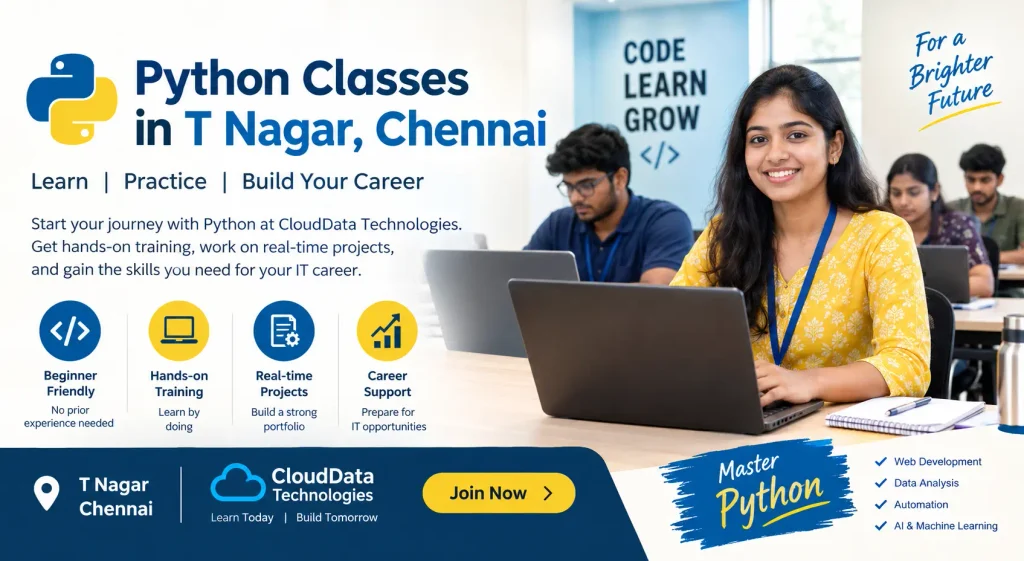
Choosing the right training institute can make your learning experience more structured and productive.
CloudData Technologies provides software training in Chennai, including Python training. Its website highlights practical learning, project work, and career-oriented training.
Here are some factors to consider when evaluating our Python classes in T Nagar:
Step-by-step learning: Build your knowledge from basic concepts before progressing to more advanced programming topics.
Practical approach: Reinforce your understanding by writing code, completing exercises, and working on projects.
Industry-oriented skills: Learn concepts that can help you understand common programming tasks and application development.
Career preparation: Use your training period to strengthen your technical foundation and prepare for entry-level interviews.
Learning guidance: Ask questions, clarify difficult concepts, and practise consistently to improve your coding confidence.
In addition, you can discuss the course syllabus, trainer experience, batch timings, project requirements, and available career support with the training team before enrolling.
Our Python training is worth considering if you belong to any of the following groups:
Even if you come from a non-computer science background, you can start learning Python with consistent practice. However, you should spend enough time understanding basic programming logic before moving to advanced subjects.
Starting a new technical skill can feel challenging. Nevertheless, following a clear learning plan makes the process easier.
Step 1: Learn the fundamentals. Understand variables, data types, conditions, loops, and functions.
Step 2: Practise every day. Write small programs and solve basic coding problems instead of only watching lessons.
Step 3: Learn to debug. Read error messages carefully and identify the reasons your code does not work.
Step 4: Build projects. Apply your knowledge to small applications and gradually increase their complexity.
Step 5: Prepare for interviews. Revise Python concepts, practise coding questions, and explain your projects clearly.
Step 6: Keep improving. Learn Git, SQL, data structures, and other relevant technologies as you progress towards your chosen career.
By following these steps, you can develop a stronger foundation and demonstrate your learning through practical work.
Yes. Beginners and freshers can start learning Python without previous professional programming experience. Start with the fundamentals and practise regularly to build confidence.
Python has readable syntax, which makes it a suitable starting point for many beginners. However, you still need regular practice to understand programming logic and solve problems independently.
You generally need basic computer skills and an interest in programming. Basic mathematics can help with some exercises, but you do not need advanced programming knowledge to begin.
Python can support your preparation for entry-level software, automation, and data-related roles. However, employment depends on your skills, projects, interview performance, and employer requirements. Training alone does not guarantee a job.
Yes. Python is widely used in data science, machine learning, and AI development. You should first learn the fundamentals and then study the additional tools and concepts required for your chosen specialisation.
Visit the official website to explore the available courses and contact the training team. You can ask about the Python syllabus, fees, batch timings, practical projects, and career support before registering.
Learning Python can be a valuable first step towards developing your technical skills and exploring opportunities in the IT industry.
At CloudData Technologies, you can begin your Python learning journey by focusing on programming fundamentals, practical exercises, and project-based learning. Furthermore, consistent practice can help you improve your problem-solving ability and prepare for future technical challenges.
If you are a fresher searching for Python classes in T Nagar, Chennai, take the next step today. Explore the course details, clarify your learning goals, and choose a training plan that suits your needs.
Start building your Python programming skills with CloudData Technologies.
Website: https://clouddatatechnologies.com/
Address: First Floor, 24/38, S. W. Boag Road, T. Nagar, Chennai, Tamil Nadu 600017.
Contact: +91 7550327779 | 044 46429444
Take the first step towards your IT career with Python training in T. Nagar, Chennai.