
Artificial Intelligence is changing the way companies build software, analyze information, automate tasks, and interact with customers. As a result, AI skills for freshers are becoming increasingly valuable for students and recent graduates who want to start a career in technology.
However, learning AI does not mean trying to master every new AI tool available. Instead, freshers should build a strong foundation and gradually learn practical skills such as Python, machine learning, Generative AI, prompt engineering, Large Language Models (LLMs), AI agents, data handling, and application development.
In 2026, employers are also looking for candidates who can apply AI concepts to real-world problems. Therefore, freshers should focus not only on theoretical knowledge but also on projects, problem-solving, and practical implementation.
This AI skills roadmap for freshers explains what to learn, where to start, and how to build a job-ready AI profile.
AI is becoming part of many technology workflows. Companies are using AI for software development, customer support, data analysis, content creation, automation, and business applications.
Recent industry reporting also points to increasing demand for advanced technology skills in areas such as AI, data, cloud, and cybersecurity in India’s technology ecosystem.
At the same time, simply knowing how to use an AI chatbot is not enough to demonstrate technical capability. Freshers can differentiate themselves by learning how AI systems work and by showing that they can build useful applications.
For example, a fresher who knows Python can move from basic programming to data processing, machine learning, AI APIs, and Generative AI applications. This creates a broader technical foundation.
Therefore, developing AI skills for freshers in 2026 can be approached as a step-by-step learning journey rather than a race to learn every AI technology.
Python is one of the most useful programming languages for AI, machine learning, data analysis, automation, and Generative AI development.
Freshers should first understand Python fundamentals, including:
After learning the fundamentals, learners can move into libraries such as NumPy and Pandas and start working with data.
CloudData Technologies also structures its Python training from fundamentals toward data analysis, automation, web development, and practical projects.
Why learn Python for AI? Because Python connects programming fundamentals with many AI and data technologies. It can therefore become the foundation for an AI career.
Generative AI has become an important area for freshers to explore in 2026.
Unlike traditional systems that primarily classify or predict information, Generative AI can produce content such as text, images, code, and other outputs.
Freshers can learn:
CloudData Technologies’ Generative AI curriculum includes Python, LLMs, prompt engineering, RAG, vector databases, AI chatbots, AI agents, APIs, and practical AI applications.
As a result, Generative AI skills for freshers can complement traditional programming and data skills.
Prompt engineering involves designing clear and effective instructions for AI models.
For freshers, prompt engineering is useful because it teaches them how to communicate with AI systems systematically rather than simply entering random questions.
Learners can practice:
However, prompt engineering works best when combined with other technical abilities. For example, a developer who understands Python, APIs, LLMs, and prompt design can build AI-powered applications instead of only using AI tools.
Freshers interested in a deeper AI career should understand the basics of machine learning.
Important concepts include:
You do not necessarily need advanced mathematics at the beginning. Instead, start with the basic concepts and gradually learn the mathematics behind the models.
Once you understand the fundamentals, you can use Python-based machine learning libraries to create small projects.
Large Language Models, commonly called LLMs, are an important part of modern Generative AI applications.
Freshers can start by understanding:
The goal should not be to memorize complicated terminology. Instead, build small applications that demonstrate how these technologies work together.
RAG is another valuable skill for freshers interested in Generative AI development.
A RAG application can retrieve relevant information from a knowledge source and provide that information to an AI model before generating a response.
For example, you could build a chatbot that answers questions based on:
This makes RAG an excellent project topic for an AI portfolio.
CloudData Technologies specifically includes RAG, embeddings, vector databases, document question-answering systems, and AI chatbots in its Generative AI training.
AI agents are another emerging area that freshers can explore after understanding basic Generative AI concepts.
Instead of simply responding to one prompt, an AI agent can use tools, follow a sequence of actions, work with information, and complete multi-step tasks.
For example, an AI agent could:
Python is particularly useful for building AI applications and agent workflows. CloudData Technologies has also published learning material focused on building AI agents with Python.
AI depends heavily on data. Therefore, freshers should not overlook basic data skills.
Learning SQL can help you understand how to retrieve and manipulate structured data. Similarly, Python libraries such as Pandas can help you clean and analyze datasets.
Important skills include:
These skills can complement AI, data analytics, and software development career paths.
Knowing how to connect an AI model to an application is increasingly useful.
Freshers can learn how APIs work and then practice integrating AI models into simple applications.
For example, you could build:
This practical approach helps transform AI knowledge into demonstrable development skills.
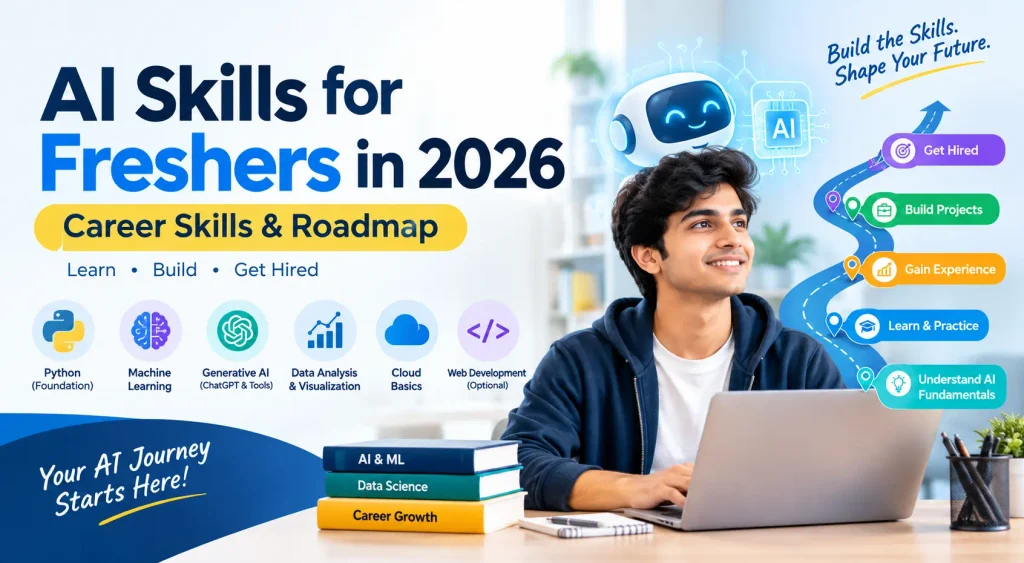
Instead of learning everything simultaneously, follow a structured roadmap.
Start with Python fundamentals. Practice writing small programs every day.
Move into SQL, Pandas, NumPy, data cleaning, and basic visualization.
Learn the basic machine learning concepts and build simple models.
Learn LLM fundamentals, prompt engineering, APIs, and AI tools.
Once you understand LLM applications, explore RAG, embeddings, vector databases, and AI agent workflows.
Projects are essential. Instead of creating ten small projects without depth, build two or three useful applications and understand every part of them.
Publish your projects on platforms such as GitHub and explain:
A practical portfolio gives interviewers something concrete to discuss.
Freshers can build projects based on their interests and current skill level.
Some project ideas include:
Create a chatbot that answers questions using an LLM API.
Build a RAG application that allows users to upload documents and ask questions about them.
Create an application that analyzes a resume and provides suggestions for improving its structure and content.
Build a simple application that generates structured content from user instructions.
Create a chatbot that uses company information to answer frequently asked questions.
Build an agent that performs a multi-step task using tools and APIs.
These projects can help demonstrate practical AI skills for freshers during interviews.
No.
This is one of the most important points for beginners.
AI is a large field, and new tools appear regularly. Trying to learn everything can create confusion. Instead, select skills based on your career goal.
For example:
AI Developer:
Python → APIs → LLMs → RAG → AI agents → projects
Machine Learning Path:
Python → Mathematics → Statistics → Machine Learning → Deep Learning → Projects
Data & AI Path:
SQL → Python → Pandas → Data Analysis → Machine Learning → Generative AI
Generative AI Path:
Python → Prompt Engineering → LLMs → APIs → RAG → AI Agents → Projects
This approach creates a focused AI career roadmap for freshers.
Learning concepts is only the first stage. To become more prepared for entry-level opportunities, combine technical knowledge with practical experience.
First, practice coding consistently. Next, build projects that solve realistic problems. Then, document your projects clearly.
In addition, improve your communication and problem-solving skills. During interviews, you should be able to explain why you selected a particular technology and how your application works.
You should also keep learning because AI technologies continue to evolve rapidly.
Recent education and industry initiatives continue to emphasize practical Python and AI/ML skills, reinforcing the importance of combining programming fundamentals with modern AI applications.
Self-learning provides flexibility, but structured training can help beginners follow a clear path.
For example, a structured program can combine Python, machine learning fundamentals, Generative AI, prompt engineering, LLMs, RAG, AI agents, and projects in a logical sequence.
CloudData Technologies offers Generative AI training in Chennai with practical exposure to LLMs, prompt engineering, RAG, AI agents, APIs, and AI application development. The institute also offers Python training and focuses on hands-on learning and real-time projects.
For freshers who prefer classroom learning, CloudData Technologies is based in T. Nagar, Chennai, and provides both online and offline learning options for its relevant training programs.
The demand for AI-related skills is creating new learning opportunities for freshers. However, the best approach is not to chase every new AI trend. Instead, build strong fundamentals and gradually develop practical skills.
Start with Python, then learn data fundamentals and machine learning concepts. After that, explore Generative AI, prompt engineering, LLMs, RAG, APIs, and AI agents.
Most importantly, build projects and create a portfolio that demonstrates what you can actually do.
If you are a fresher planning an AI career in 2026, start small, practice consistently, and follow a structured AI skills roadmap. With the right combination of programming, AI knowledge, problem-solving, and project experience, you can build a stronger foundation for your technology career.
Looking to develop practical AI skills? Explore the Generative AI and Python training programs at CloudData Technologies in Chennai and learn through structured training, hands-on practice, and real-world projects.
1. What are the most important AI skills for freshers in 2026?
Python, machine learning fundamentals, Generative AI, prompt engineering, LLMs, RAG, AI agents, SQL, APIs, and practical project development are useful skills to explore.
2. Can freshers learn AI without prior experience?
Yes. Beginners can start with Python and basic programming concepts before gradually moving into machine learning and Generative AI.
3. Is Python necessary for an AI career?
Python is highly useful for AI, machine learning, data analysis, automation, and Generative AI application development.
4. Should freshers learn Generative AI?
Generative AI is a useful area to explore because modern AI applications increasingly use LLMs, APIs, RAG, chatbots, and AI-powered workflows.
5. How can freshers demonstrate their AI skills?
Build practical projects, maintain a GitHub portfolio, document your work, and be prepared to explain the technologies and decisions behind each project.
6. Where can freshers learn Generative AI in Chennai?
CloudData Technologies offers Generative AI training in Chennai covering Python, LLMs, prompt engineering, RAG, AI agents, APIs, and practical projects.