
In today’s fast-paced digital economy, companies face mounting pressure to deliver faster results, reduce operational overhead, and maintain flawless service quality. Traditional software automation, while helpful, often falls short when confronted with unstructured data, complex decision-making, and dynamic customer demands. Enter AI workflow automation for business, a transformative paradigm shift that combines artificial intelligence with routine process automation to handle tasks that traditionally required human cognition.
Whether you run a growing startup or manage an established enterprise, implementing intelligent workflows can drastically reshape your daily operations. This guide explores the mechanics, benefits, real-world use cases, and strategic implementation steps required to harness AI workflow automation for business effectively.
To understand this concept fully, we must first separate standard automation from intelligent automation. Traditional workflow automation relies on rigid, rule-based logic—if a specific trigger occurs, execute a predetermined action. While effective for simple, repetitive chores like data entry or automated email receipts, it breaks down when exceptions occur.
Conversely, AI workflow automation for business integrates cognitive technologies such as machine learning, natural language processing (NLP), computer vision, and generative AI. These systems do not just follow rules; they learn from patterns, interpret unstructured text or voice inputs, make autonomous decisions, and continuously optimize themselves. By embedding intelligence into the core of your operational loops, your business processes become adaptive, resilient, and inherently scalable.
Many organizations have invested heavily in legacy automation tools over the last decade. However, modern business environments present challenges that these tools simply cannot handle. Consider the following limitations of legacy systems:
Inability to Process Unstructured Data: Traditional software struggles with emails, customer feedback forms, audio files, and PDFs that lack standardized formatting.
Lack of Contextual Awareness: Rule-based bots cannot gauge customer sentiment, tone, or intent, often leading to frustrating automated interactions.
High Maintenance Overhead: Whenever business rules shift, developers must manually rewrite code and configure new triggers, draining valuable time and resources.
By deploying AI workflow automation for business, organizations bypass these roadblocks entirely. Cognitive agents can read between the lines, categorize messy data, escalate critical anomalies to human supervisors, and adapt to changing workflows without constant manual intervention.
Several underlying technologies work in harmony to drive modern AI-powered workflows. Understanding these components helps demystify how automation platforms function under the hood.
NLP enables systems to parse, comprehend, and generate human language. In customer service and HR onboarding workflows, NLP allows automated engines to read incoming inquiries, extract key entities (like names, order numbers, and dates), and trigger appropriate downstream tasks instantly.
Machine learning algorithms analyze historical operational data to predict future outcomes. For instance, in supply chain management, predictive ML models forecast inventory shortages and automatically initiate reorder workflows before bottlenecks occur.
Recent advancements in large language models (LLMs) allow autonomous agents to reason, plan multi-step actions, and execute complex business assignments—such as drafting custom proposals, summarizing extensive meeting notes, or analyzing financial statements—with minimal human prompting.
Integrating artificial intelligence into your daily operations yields profound advantages across every department.
Manual data processing and repetitive administrative tasks consume thousands of man-hours annually. When you utilize AI workflow automation for business, routine operations run continuously in the background, freeing your human workforce to focus on high-value creative and strategic initiatives.
Human fatigue often leads to costly mistakes in data entry, invoice processing, and compliance reporting. Automated cognitive pipelines execute tasks with high precision, ensuring that compliance standards are met uniformly across every transaction.
In competitive markets, speed equals revenue. Intelligent workflows analyze incoming market data, customer metrics, and performance indicators in real time, giving leadership teams actionable insights instantly rather than waiting for weekly manual reports.
Scaling a traditional business usually requires hiring proportional numbers of support staff and administrative personnel. AI-driven workflows scale effortlessly, handling tenfold increases in customer volume or data processing loads without a corresponding surge in overhead costs.
Different business units benefit uniquely from intelligent automation. Let us examine how various departments integrate AI workflow automation for business into their daily routines.
+-----------------------------------------------------------------------+
|                      DEPARTMENTAL USE CASES                           |
+---------------------------+-------------------------------------------+
| Customer Support          | Instant triage, 24/7 resolution, sentiment|
|                           | analysis, and smart routing.              |
+---------------------------+-------------------------------------------+
| Human Resources           | Automated resume parsing, preliminary     |
|                           | screening, and onboarding workflows.      |
+---------------------------+-------------------------------------------+
| Sales & Marketing         | Dynamic lead scoring, personalized email  |
|                           | sequences, and CRM data enrichment.       |
+---------------------------+-------------------------------------------+
| Finance & Operations      | Automated invoice matching, fraud         |
|                           | detection, and predictive restocking.     |
+---------------------------+-------------------------------------------+
Modern customers expect immediate responses at any hour of the day. By deploying intelligent conversational agents combined with automated ticketing pipelines, businesses can resolve up to eighty percent of routine inquiries instantly. Furthermore, the system analyzes customer sentiment during interactions, automatically routing frustrated users to senior support specialists.
Recruiting top talent involves reviewing hundreds of resumes, scheduling interviews, and managing onboarding documentation. Intelligent recruitment workflows parse incoming resumes against job descriptions, rank candidates objectively based on skills, and dispatch personalized interview invites, drastically cutting time-to-hire metrics.
Sales teams waste valuable hours chasing cold leads and manually updating CRM databases. Implementing AI workflow automation for business allows marketing and sales platforms to score inbound leads dynamically, trigger tailored follow-up sequences based on user behavior, and keep records meticulously updated.
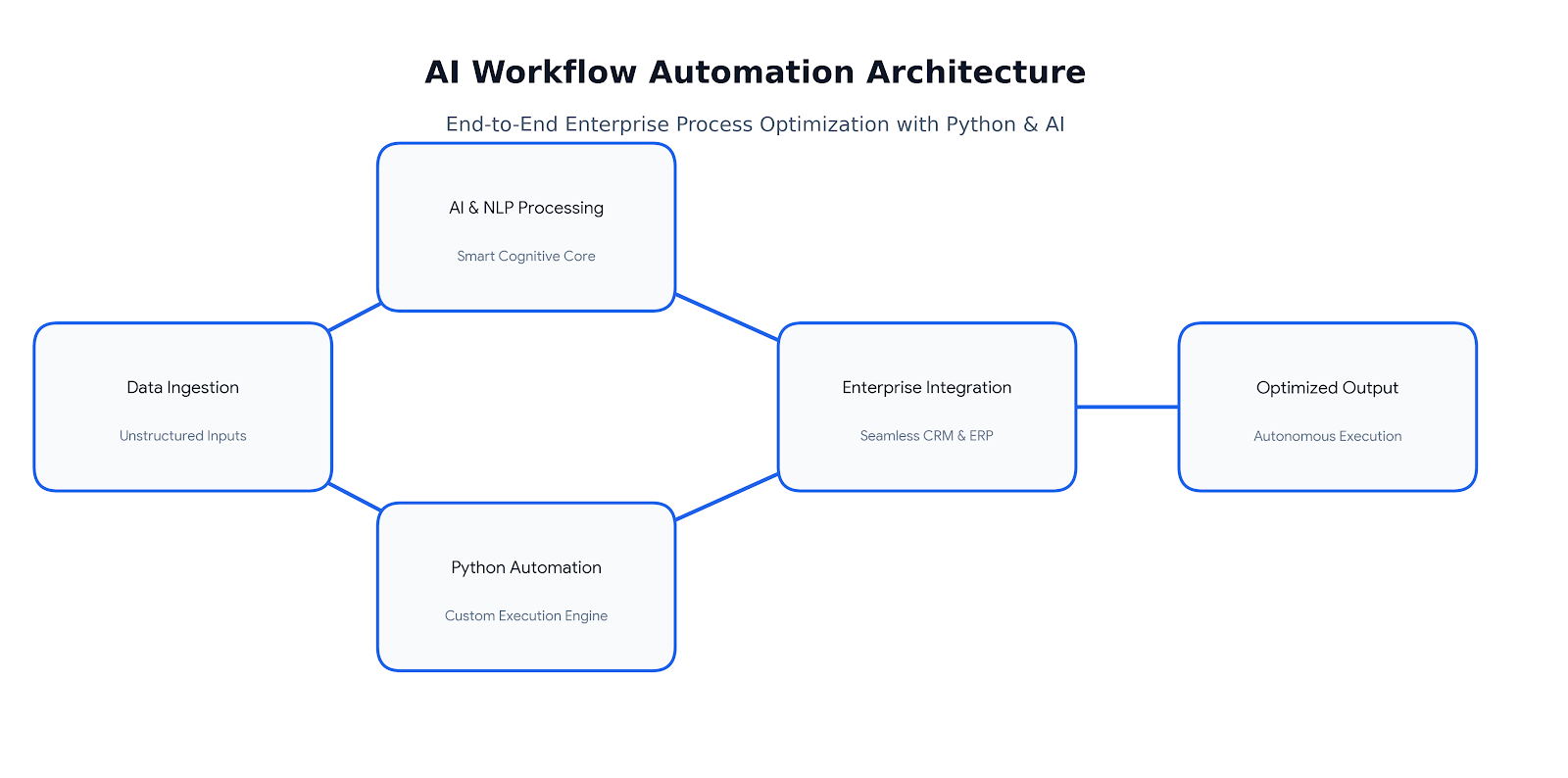
AI Workflow Automation for Business
Invoice processing is notoriously tedious. Intelligent document processing tools extract data from diverse vendor invoices, cross-reference purchase orders, flag discrepancies, and route bills for managerial approval without human data entry.
Adopting intelligent automation requires a structured, strategic approach. Rushing into implementation without a clear plan often leads to disjointed systems and low adoption rates. Follow this roadmap to ensure success:
Begin by mapping your existing operational workflows. Look for bottlenecks, tasks characterized by heavy manual data entry, high error rates, or significant customer wait times. Prioritize processes that offer the highest return on investment once automated.
Establish what success looks like. Are you aiming to reduce customer support response time by fifty percent, or cut invoice processing costs? Clear metrics ensure your implementation team stays focused on measurable business outcomes.
Select software platforms and integration tools that align with your technical maturity and security requirements. Ensure the chosen tools can connect seamlessly with your existing infrastructure, CRM systems, and cloud databases.
Artificial intelligence models rely heavily on quality data. Before launching automated workflows, audit your databases to eliminate duplicates, resolve formatting inconsistencies, and establish robust data governance protocols.
Do not attempt to automate your entire enterprise overnight. Launch a controlled pilot project in a single department—such as automated lead qualification or invoice routing. Measure performance, gather user feedback, and refine the system.
Once the pilot proves successful, expand the automation framework across other departments. Continuously monitor performance dashboards, track error logs, and update your AI models as business requirements evolve.
While the benefits are undeniable, organizations frequently encounter hurdles during deployment. Anticipating these challenges ensures smoother adoption:
Data Privacy and Security Concerns: Processing sensitive customer or financial data through AI models requires stringent compliance with regulations like GDPR and HIPAA. Always choose enterprise-grade platforms with robust encryption and data isolation guarantees.
Employee Resistance to Change: Workers often fear that automation will render their jobs obsolete. Leadership must communicate transparently, framing AI as a collaborative tool that removes mundane chores rather than a replacement for human talent.
Integration Complexity: Connecting modern AI tools with legacy enterprise systems can prove technically challenging. Partnering with experienced technical consultants or leveraging flexible API-driven architectures helps mitigate this friction.
As artificial intelligence continues its rapid evolution, AI workflow automation for business will transition from a competitive advantage into a fundamental survival requirement. We are moving toward hyper-autonomous enterprises where cross-departmental workflows communicate seamlessly, self-heal when errors occur, and proactively suggest operational improvements.
Organizations that embrace this technological wave today position themselves to operate with unprecedented agility, leaner cost structures, and superior customer satisfaction levels.
Implementing AI workflow automation for business is no longer reserved for tech giants and multinational conglomerates. With accessible cloud platforms, flexible APIs, and advanced machine learning tools, businesses of all sizes can modernize their operations. By auditing current processes, selecting the right tools, and fostering a culture of continuous innovation, you can unlock extraordinary efficiency and propel your organization toward sustainable long-term growth.
As organizations navigate this technological shift, having the right expertise makes all the difference. At CloudData Technologies, we bridge the gap between emerging technology and real-world execution by offering specialized, hands-on training programs and expert consulting in Python, AI, and modern automation. Whether you are looking to upskill your team or integrate intelligent workflows directly into your business infrastructure, we are here to help you build for tomorrow.