Artificial Intelligence has changed rapidly in the last few years. Earlier, most people interacted with AI through simple chatbots that answered questions or followed predefined instructions. Today, AI is moving toward intelligent systems that can understand goals, make decisions, use tools, and complete tasks with less human intervention.
This shift from chatbots to AI agents represents an important stage in the evolution of Generative AI.
For freshers entering the technology industry, understanding this change can be valuable. Generative AI is no longer limited to creating text or answering questions. Modern AI applications can combine Large Language Models (LLMs), Retrieval-Augmented Generation (RAG), APIs, tools, memory, automation, and agentic workflows to solve practical problems.
So, how did we move from traditional chatbots to AI agents? What is the difference between them? And what should freshers learn to prepare for the future of AI?
Let’s explore.
Generative AI refers to artificial intelligence systems that can create new content based on user instructions and available information.
For example, Generative AI can create:
Large Language Models have played an important role in this transformation. These models can understand natural-language instructions and generate responses that appear conversational.
As a result, people started using Generative AI for writing, coding, research, customer support, education, marketing, and many other activities.
However, generating an answer is only one part of the AI journey.
The next step is enabling AI systems to take action.
That is where AI agents become important.
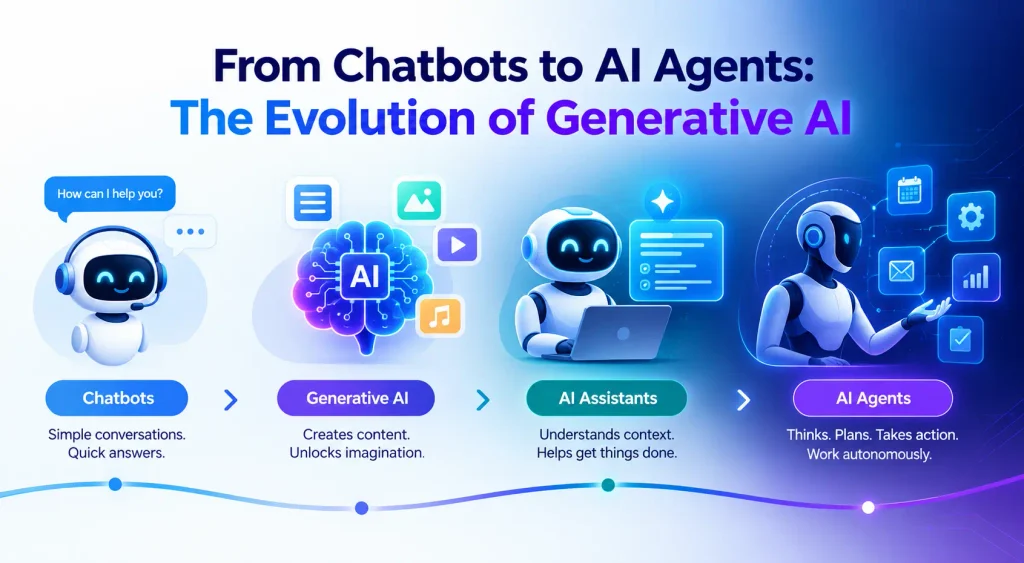
Traditional chatbots were among the earliest popular forms of conversational AI.
They usually worked with predefined rules, keywords, menus, or decision trees. For example, a customer might select:
1 – Check Order
2 – Cancel Order
3 – Contact Support
The chatbot would then follow a predefined path.
These systems worked well for simple and repetitive questions. However, they had limitations.
Traditional chatbots usually struggled when users asked unexpected questions. They could not easily understand complex context, make decisions, or perform multiple tasks independently.
For example, if a customer asked:
“My order is delayed, I want to change the delivery address, and can you tell me whether I am eligible for a refund?”
A basic chatbot might handle only one part of the request.
Therefore, businesses needed smarter conversational systems.
The arrival of modern Generative AI and LLMs changed chatbot technology.
Instead of relying entirely on predefined responses, AI chatbots could understand natural language and generate responses dynamically.
This made conversations more flexible.
For example, an AI chatbot can understand different ways of asking the same question:
The system can understand the intent instead of simply matching keywords.
Furthermore, AI chatbots can maintain conversational context and generate more natural responses.
This development made AI chatbots useful for customer service, education, software development, healthcare, finance, marketing, and internal business support.
However, another limitation remained.
Most chatbots were still primarily designed to respond.
AI agents are designed to act.
The transition from chatbots to AI agents introduces a more advanced approach to artificial intelligence.
An AI agent can receive a goal, reason about the task, decide what steps are required, use available tools, evaluate results, and continue working toward the objective.
Consider a simple example.
A chatbot might answer:
“Your flight is delayed by three hours.”
An AI agent could potentially go further. Based on its available permissions and tools, it could check alternative flights, compare options, update information, and initiate the next approved action.
The important difference is that the agent does not simply generate a response.
It works toward completing a task.
An AI agent is a software system that uses AI models to perform tasks based on goals or instructions.
Depending on its design, an AI agent may include:
The LLM can act as the reasoning layer, while external tools allow the system to interact with the real world.
For example, an AI agent could use one tool to search a database, another to calculate information, and another to send an approved message.
Therefore, AI agents combine reasoning and action.
Understanding the difference between AI chatbots and AI agents is important for beginners.
| AI Chatbots | AI Agents |
|---|---|
| Primarily respond to users | Work toward completing goals |
| Generate conversational answers | Plan and execute tasks |
| Usually have limited actions | Can use external tools |
| Often depend on predefined workflows | Can dynamically determine next steps |
| Focus mainly on conversation | Focus on task completion |
| Limited autonomy | Greater autonomy within defined permissions |
However, this does not mean chatbots are becoming useless.
Instead, chatbots are becoming one component of larger AI systems.
An AI agent can even use a conversational interface to communicate with users.
Large Language Models are a major foundation of modern Generative AI applications.
An LLM can understand instructions, summarize information, generate text, analyze content, and help an AI application decide what to do next.
However, an LLM alone does not automatically become an AI agent.
Developers need to connect the model with tools, data, instructions, workflows, and application logic.
For freshers, this distinction is important.
Learning how to use an LLM API is a good starting point. However, learning how to build complete AI applications provides a stronger foundation.
Another important technology in the evolution from chatbots to AI agents is Retrieval-Augmented Generation (RAG).
An LLM may not know a company’s latest internal information. RAG helps an AI application retrieve relevant information from a knowledge base before generating an answer.
For example, a company could build an AI assistant that searches:
The system can retrieve relevant information and provide a more useful response.
As a result, RAG has become an important concept for people learning modern Generative AI application development.
The biggest potential of AI agents comes from combining intelligence with automation.
Imagine an organization receiving hundreds of customer requests every day.
Instead of simply answering questions, an AI-powered workflow could:
This approach can reduce repetitive manual work and help employees focus on more complex activities.
However, businesses still need proper security, monitoring, permissions, human oversight, and testing.
AI agents should not receive unlimited access simply because they can perform actions.
AI agents can support many industries and business functions.
AI agents can understand customer requests, retrieve information, and support service workflows.
AI-powered systems can help developers understand code, generate code, identify errors, create documentation, and automate repetitive development tasks.
AI agents can interact with data tools, summarize results, identify patterns, and generate reports.
AI systems can assist with content research, campaign ideas, customer segmentation, and reporting.
AI applications can assist with information retrieval, documentation, administrative workflows, and patient-support systems while maintaining appropriate human oversight.
AI-powered workflows can support document analysis, reporting, customer service, and repetitive operational tasks.
Therefore, the future of AI is not limited to one industry.
For freshers, the growth of Generative AI creates an opportunity to build modern technology skills from the beginning of their careers.
You do not need to become an AI researcher immediately.
Instead, start with the fundamentals.
A practical learning path can include:
1: Learn Python
Python provides a strong foundation for AI application development and automation.
2: Understand Generative AI
Learn how Generative AI and LLMs work at a practical level.
3: Learn Prompt Engineering
Understand how to create clear and effective instructions for AI models.
4: Work With LLM APIs
Learn how applications communicate with AI models.
5: Learn RAG
Understand embeddings, vector databases, retrieval, and context-based generation.
6: Build AI Chatbots
Create simple conversational applications using real project scenarios.
7: Move Toward AI Agents
Learn how agents use tools, workflows, memory, and decision-making logic.
8: Build Projects
Finally, create projects that demonstrate your skills.
This progression allows beginners to move gradually from basic concepts to more advanced AI applications.
Technology will continue to change. Therefore, freshers should focus on transferable skills rather than learning only one tool.
Important areas include:
In addition, communication and analytical thinking remain important.
AI tools can generate code and content, but professionals still need to understand requirements, validate results, identify problems, and make responsible decisions.
The evolution of Generative AI is continuing.
We started with systems that could generate content. Then, AI chatbots became better at understanding natural language. Now, AI agents are combining language models with tools, workflows, data, and automation.
This development is often described as Agentic AI.
Instead of asking AI to perform one isolated task, users can give an AI system a larger objective.
The system can then break the objective into smaller tasks and work through them using available tools.
However, the future will not simply be about making AI more autonomous.
It will also involve making AI systems more reliable, secure, explainable, controllable, and useful.
For this reason, developers who understand both AI capabilities and software engineering principles will have an important role to play.
For freshers who want to enter the AI field, practical learning can make a significant difference.
CloudData Technologies offers Generative AI training in Chennai covering areas such as Generative AI, LLMs, prompt engineering, AI application development, RAG, chatbots, AI agents, and AI-powered workflows. The training approach focuses on practical learning and real-world applications rather than theory alone.
The institute also emphasizes hands-on projects and industry-aligned learning. Its Gen AI curriculum is designed to take learners from fundamentals toward building practical Generative AI applications.
For beginners, this type of structured learning can help connect concepts such as Python, LLMs, APIs, RAG, chatbots, and AI agents.
The journey from chatbots to AI agents shows how quickly Generative AI is evolving.
Traditional chatbots mainly followed predefined conversations. Modern AI chatbots can understand natural language and generate flexible responses. AI agents take another step forward by combining AI models with tools, data, reasoning, workflows, and automation.
For freshers, this evolution creates an exciting opportunity.
Instead of only learning how to use AI tools, start learning how to build AI applications.
Begin with Python and Generative AI fundamentals. Then learn LLMs, prompt engineering, APIs, RAG, and chatbot development. Finally, move toward AI agents and practical automation projects.
The future of AI will not belong only to people who use AI.
It will increasingly belong to people who understand how to build, integrate, test, and responsibly use intelligent AI systems.
If you are a fresher planning an AI-focused career, now is a good time to start building those skills.
Learn Generative AI. Build real projects. Understand AI agents. Prepare for the next generation of technology.