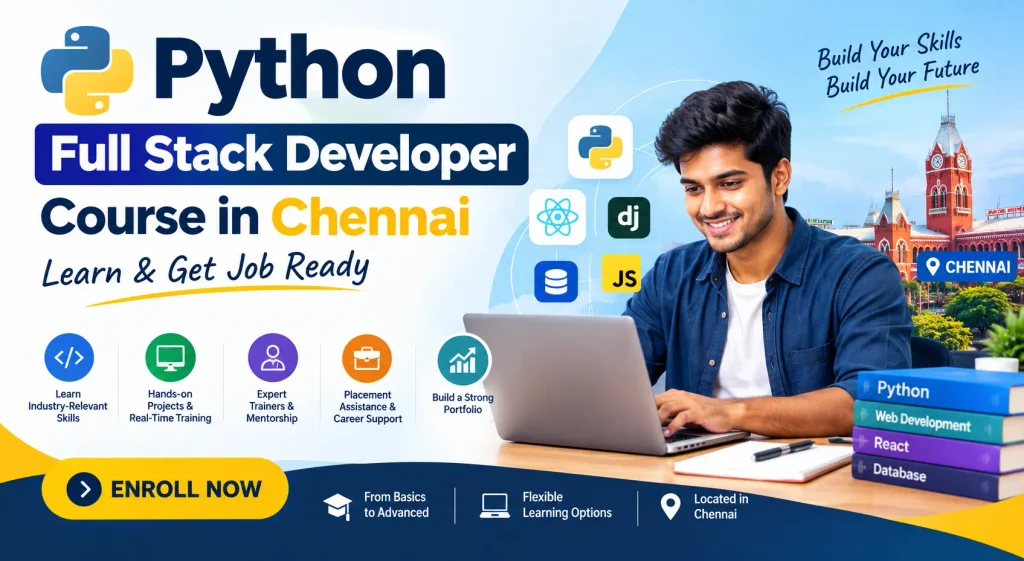
Starting a career in software development can feel challenging, especially for freshers who are unsure which technology to learn first. A Python Full Stack Developer Course in Chennai can provide a practical path for students and graduates who want to build both frontend and backend development skills.
Python is widely used for web development, automation, data applications, artificial intelligence, and backend development. When you combine Python with frontend technologies, databases, APIs, and development tools, you can build complete web applications from start to finish.
At CloudData Technologies, Python training focuses on practical learning, real-time projects, and career-oriented skills. The training starts with Python fundamentals and progresses toward web development, databases, automation, and project-based learning.
For freshers, this approach can make learning easier because you gradually build your technical knowledge instead of trying to learn everything at once.
Python Full Stack Development involves working on both the frontend and backend components of a web application.
The frontend is the part of a website or application that users see and interact with. It commonly includes:
The backend manages application logic, databases, APIs, authentication, and server-side operations. Python developers commonly use frameworks such as Django or Flask for backend development.
A Python Full Stack Developer may therefore work with:
CloudData Technologies’ current Python training covers core programming and progresses into areas such as Django or Flask web development, databases, data handling, and practical projects.
Chennai has a strong IT and software-development ecosystem, creating opportunities for people who want to start careers in technology. However, completing a degree alone may not provide enough practical development experience for an entry-level developer role.
Therefore, freshers should focus on building practical skills alongside theoretical knowledge.
A Python Full Stack Developer Course in Chennai can help you develop a structured learning path. Instead of studying Python, frontend development, databases, and backend development separately, you can learn how these technologies work together.
For example, you can start by learning Python programming. Next, you can understand databases and SQL. After that, you can learn Django or Flask and build APIs. Finally, you can connect your backend with a frontend application.
This step-by-step process helps you understand how a complete software application works.
Python is considered beginner-friendly because its syntax is relatively easy to read and understand. This makes it a practical starting point for students who are new to programming.
However, learning only basic Python may not be enough if your goal is to become a web developer.
Full stack development expands your knowledge by combining programming with frontend development, backend development, databases, APIs, and version control.
As a fresher, you can benefit from learning full stack development because you can:
CloudData Technologies also states that its Python training is suitable for beginners and includes practical projects such as web applications, data analysis scripts, and automation tasks.
A well-structured Python Full Stack Developer Course in Chennai should begin with programming fundamentals and gradually introduce advanced development concepts.
The first step is to understand Python programming.
You can learn:
These concepts create the foundation for advanced Python development.
After learning Python basics, you can move into Object-Oriented Programming, commonly called OOP.
Important concepts include:
OOP helps developers organize applications into reusable and maintainable components.
Next, you learn how websites are structured and styled.
HTML helps create the structure of a webpage, while CSS controls its appearance.
You can learn:
JavaScript adds functionality and interactivity to websites.
Freshers can learn concepts such as:
Understanding JavaScript also prepares you for modern frontend frameworks.
React can be introduced after learning the fundamentals of frontend development.
You can explore:
This knowledge can help you create modern user interfaces.
Python becomes especially useful for backend development through frameworks such as Django and Flask.
You can learn how to:
CloudData Technologies’ Python course specifically includes web development using frameworks such as Flask or Django.
Almost every modern application needs a database.
Therefore, a Python Full Stack Developer should understand SQL and relational databases.
Important topics include:
You can then connect your Python backend with a database and create applications that store and retrieve information.
APIs allow different software applications to communicate with each other.
As a full stack developer, you should understand:
API development is an important part of modern web application development.
Version control helps developers manage source code and collaborate with other developers.
Freshers should learn:
A well-maintained GitHub profile can also help demonstrate your projects and coding practice to recruiters.
Projects are one of the most important parts of learning full stack development.
Instead of only watching tutorials, freshers should build applications that demonstrate their technical skills.
Possible Python Full Stack projects include:
Build an application that allows administrators to add, update, search, and delete student information.
Create a basic e-commerce application with products, categories, user accounts, shopping carts, and order management.
Develop a platform where companies can publish jobs and candidates can search and apply for opportunities.
Build an application for managing employee information, departments, attendance, and basic records.
Create a web application where users can create, update, complete, and delete tasks.
These projects can help you understand how frontend, backend, database, and API components work together.
CloudData Technologies emphasizes hands-on learning and real-time projects as part of its Python training approach.
After developing the necessary technical skills and completing practical projects, freshers can explore several entry-level career paths.
Potential roles include:
The exact role you qualify for depends on your technical skills, projects, interview performance, education, and employer requirements.
Python also provides opportunities beyond traditional web development. It is used in automation, data analysis, artificial intelligence, and other technology areas.
Technology continues to evolve. Therefore, freshers should focus on building a combination of fundamental and modern development skills.
A useful skill set includes:
Programming: Python, JavaScript
Frontend: HTML, CSS, JavaScript, React
Backend: Django or Flask
Database: SQL and relational databases
API: REST APIs and JSON
Version Control: Git and GitHub
Development: Debugging, testing, deployment basics
Emerging Skills: AI-assisted development and basic Generative AI concepts
Learning these technologies together can help freshers understand the complete software development process.
Technical training is only one part of becoming job ready. You also need to prepare for the recruitment process.
Start by creating a clear resume that highlights your technical skills and projects.
Next, prepare for common interview areas such as:
You should also practice writing Python programs without depending completely on online solutions.
Mock interviews can help you become more comfortable explaining your projects and answering technical questions.
CloudData Technologies provides career-oriented support that includes resume guidance, interview preparation, and placement assistance as part of its training approach.
A Python Full Stack Developer Course in Chennai can be suitable for:
You do not necessarily need advanced programming knowledge before starting. A beginner-friendly course can take you from Python fundamentals toward application development step by step.
Different learners have different preferences. Some students prefer classroom learning because they can interact directly with trainers and classmates. Others prefer online training because it provides greater flexibility.
CloudData Technologies offers both online and offline learning options, with flexible weekday and weekend schedules.
Therefore, you can select a learning format that matches your schedule and learning style.
Choosing the right training institute is an important step when starting your development career.
CloudData Technologies is a Chennai-based IT training institute offering Python training with practical learning, projects, mentoring, and career support. Its Python program progresses from fundamentals to advanced topics and includes areas such as web development, data handling, databases, and automation.
The training approach focuses on helping learners understand concepts through practice rather than relying only on theoretical lessons.
For freshers, this can provide a structured environment to develop coding confidence and create projects for a portfolio.
You can follow a simple roadmap:
1: Learn Python fundamentals.
2: Practice Python programming regularly.
3: Learn OOP and advanced Python concepts.
4: Learn HTML, CSS, and JavaScript.
5: Learn React or another modern frontend technology.
6: Learn Django or Flask for backend development.
7: Learn SQL and databases.
8: Understand REST APIs.
9: Learn Git and GitHub.
10: Build real-world projects.
11: Create a professional resume and GitHub portfolio.
12: Practice technical and HR interviews.
Following this roadmap consistently can help you move from a beginner level toward entry-level full stack development.
Yes. Freshers can start with Python fundamentals and gradually learn frontend, backend, databases, APIs, and development tools. A structured course can make this learning process easier.
Not necessarily. Beginner-oriented Python training can start with basic programming concepts before moving into advanced development. CloudData Technologies states that its Python course starts from fundamentals and is suitable for learners without prior programming knowledge.
A typical skill set includes Python, HTML, CSS, JavaScript, React, Django or Flask, SQL, REST APIs, Git, and GitHub.
Course completion alone does not guarantee employment. However, developing strong technical skills, completing real-world projects, preparing a portfolio, and practicing interviews can help you apply for relevant entry-level positions.
Yes. Python is also used for automation, data analysis, artificial intelligence, machine learning, and other technology applications.
For freshers, learning software development requires consistency, practice, and the right learning path. A Python Full Stack Developer Course in Chennai can help you build skills across frontend development, backend programming, databases, APIs, and real-world application development.
Instead of focusing only on completing a certificate, concentrate on understanding concepts and building projects. Create applications, practice coding problems, maintain your GitHub profile, improve your resume, and prepare for interviews.
If you are looking for structured Python Full Stack Training in Chennai, CloudData Technologies provides practical Python learning with project-based training and career-oriented support. The institute offers online and classroom learning options in Chennai.
Ready to start your journey? Visit CloudData Technologies to explore Python training options and take the first step toward becoming a job-ready Python Full Stack Developer.