
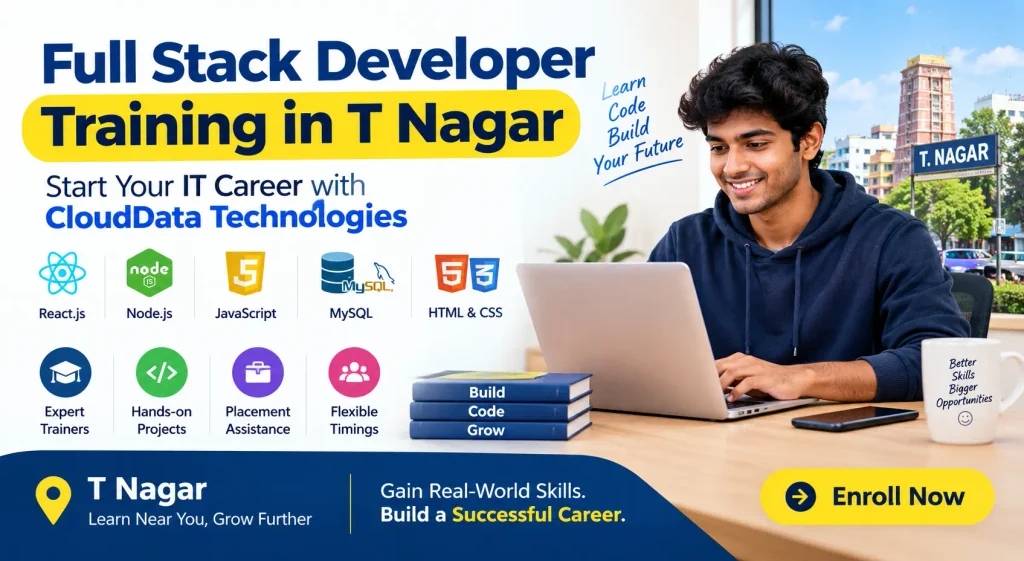
Are you a fresher looking to start your career in the IT industry? Do you want to learn how to build websites, develop web applications, and create software solutions? Full Stack Developer Training in T Nagar at CloudData Technologies can help you build the technical foundation you need to pursue a career in software development.
Today, businesses use websites and web applications to connect with customers, manage information, and improve their services. Therefore, they need developers who understand both frontend and backend technologies. Full stack development helps you learn how different parts of a web application work together.
At CloudData Technologies in T. Nagar, Chennai, aspiring developers can explore practical software training and develop their technical knowledge. With consistent practice, project-based learning, and career preparation, freshers can work towards becoming confident full stack developers.
If you have recently completed your degree or want to enter the IT industry without prior professional experience, learning full stack development can be a useful starting point.
T. Nagar is a well-known commercial and educational area in Chennai. Students and working professionals can explore different training options in this location while preparing for software development careers.
Choosing a Full Stack Developer Course in T Nagar gives you an opportunity to learn programming concepts, practise development tasks, and understand how modern web applications operate.
Moreover, structured training helps beginners follow a clear learning path instead of trying to master several technologies without a plan.
At CloudData Technologies, learners can explore software training designed around practical skills and career development. Before enrolling, students should review the current syllabus, available batch timings, teaching mode, and project details to select a course that matches their goals.
As a result, you can gradually move from learning basic programming concepts to creating complete web application projects.
Full stack development involves working with the different layers of a web application. These layers commonly include the frontend, backend, and database.
The frontend represents the part of a website that users see and interact with. The backend handles application logic, processes requests, and communicates with databases. Meanwhile, the database stores and manages information.
A full stack developer understands how these components connect to deliver a working application.
For example, consider an online shopping website. The frontend displays products and shopping cart details. The backend processes orders and manages business rules. The database stores customer information, product records, and order details.
Therefore, full stack development training helps you understand the complete application workflow rather than focusing on only one component.
A good Full Stack Developer Course in T Nagar should introduce programming fundamentals before progressing to advanced development concepts. The exact technologies depend on the course you choose, so confirm the current syllabus with the training institute.
First, learn how to create the structure and design of web pages.
HTML defines page elements such as headings, paragraphs, images, forms, and links. CSS controls their appearance, including colours, spacing, layouts, and responsive designs.
During practice, you can create a personal portfolio website, a landing page, or a simple business website.
Next, learn JavaScript to make websites interactive.
You can explore variables, data types, operators, functions, arrays, objects, conditions, loops, and event handling. You can also learn how JavaScript updates webpage content and validates form inputs.
These concepts provide a foundation for frontend frameworks and more advanced web development.
After learning the basics, you can explore modern frontend development concepts. Depending on the course syllabus, this may include React or another JavaScript framework.
You can learn to build reusable components, manage application state, handle user interactions, and connect frontend interfaces to backend services.
Consequently, you will understand how developers create interactive and maintainable user interfaces.
Backend development teaches you how applications process information behind the scenes.
Depending on the chosen learning path, you may study Python with Django or Flask, or Java with Spring Boot. A JavaScript-based course may introduce Node.js and Express.
You can practise creating application routes, processing requests, validating information, and building APIs.
However, beginners should focus on one primary backend path first. Learning multiple frameworks simultaneously can make the process unnecessarily difficult.
Web applications need databases to store and retrieve information. Therefore, database knowledge is an important part of full stack development.
You can learn SQL fundamentals, tables, relationships, queries, joins, and basic database design. Depending on the syllabus, you may also explore a database such as MySQL or PostgreSQL.
For example, you could create a student management application that stores student details and retrieves records through database queries.
Modern applications often exchange information between different services. Application Programming Interfaces, or APIs, make this communication possible.
You can learn how a frontend sends requests to a backend and how the backend returns data. You may also practise handling responses, errors, and basic authentication concepts.
As a result, you will understand how separate application components work together.
Version control helps developers track changes to their code and collaborate with other developers.
Learn basic Git commands, repositories, commits, branches, and pushing projects to GitHub. These skills also help you maintain a portfolio that employers can review during recruitment.
Practical experience is essential because understanding programming concepts alone does not always prepare you to develop complete applications.
During Full Stack Development Training in Chennai, beginners should practise applying their knowledge through projects. Start with small exercises and gradually build applications that combine frontend, backend, and database components.
Here are some useful project ideas for freshers:
Personal portfolio website: Create a website that introduces your skills, education, projects, and contact details.
Student management system: Build an application to add, view, update, and delete student records.
Online shopping application: Develop product listings, a shopping cart, and basic order management functionality.
Employee management system: Create a database-backed application to manage employee information.
Task management application: Allow users to create tasks, update their status, and organise their work.
While building these projects, practise debugging, testing, and writing readable code. Furthermore, document each project on GitHub and explain the technologies you used.
A portfolio with a few well-developed projects can demonstrate your practical skills more effectively than a list of technologies alone.
Fresh graduates often face a common challenge: they understand academic concepts but lack experience applying them to practical development tasks.
Full stack training can help address this gap by introducing a structured approach to learning software development.
First, you develop programming fundamentals. Next, you practise building user interfaces and backend functionality. Then, you connect your application to a database and test the complete workflow.
This progression helps you understand how software teams build and maintain web applications.
In addition, full stack development introduces you to several related technical areas. You can later specialise in frontend development, backend development, database engineering, or application development based on your interests.
However, completing a course does not automatically guarantee employment. Your results will depend on your practical skills, consistency, interview preparation, and the requirements of individual employers.
After developing the required skills and completing practical projects, freshers can explore entry-level positions such as:
The responsibilities and eligibility requirements vary between companies. Some employers accept fresh graduates with strong programming fundamentals, while others expect experience with particular frameworks or databases.
Therefore, review job descriptions regularly and identify the skills employers request most often.
Additionally, prepare a clear resume that highlights your technical skills, academic projects, personal projects, and GitHub profile. Practise explaining how your applications work, which challenges you encountered, and how you solved them.
Learning technical concepts is only one part of preparing for your first IT job. You must also communicate your knowledge clearly and demonstrate your problem-solving abilities.
When evaluating a Full Stack Training Institute in T Nagar, ask about its placement assistance and career preparation services.
Useful support may include resume preparation, mock interviews, coding practice, project reviews, and guidance on applying for relevant job openings.
At CloudData Technologies, learners can enquire about available placement assistance and the support currently offered with the course.
Meanwhile, you should practise common interview topics such as HTML, CSS, JavaScript, programming fundamentals, SQL queries, APIs, and basic data structures.
Most importantly, explain your own projects confidently. Interviewers may ask you to describe your application structure, database design, coding decisions, and methods for handling errors.
Consistent preparation will help you approach entry-level interviews with greater confidence.
CloudData Technologies provides software training in Chennai, with its listed training centre located in T. Nagar. The institute offers training across software and technology subjects, and learners can contact the team to clarify the availability and details of its full stack development course.
When choosing a training institute, consider the following factors:
By comparing these details, you can choose a learning programme that matches your career goals and learning requirements.
If you are new to programming, follow a step-by-step learning plan instead of trying to learn every technology at once.
1: Understand programming basics. Learn variables, conditions, loops, functions, and problem-solving techniques.
2: Learn HTML and CSS. Build simple webpages and understand responsive layouts.
3: Practise JavaScript. Create interactive features and solve beginner coding problems.
4: Choose a backend technology. Select a suitable path, such as Python, Java, or JavaScript with Node.js.
5: Learn SQL and databases. Practise storing, retrieving, and updating application data.
6: Build complete projects. Connect your frontend, backend, and database to create working applications.
7: Prepare for jobs. Update your resume, publish projects on GitHub, practise interviews, and apply for suitable fresher openings.
With regular practice, you can steadily improve your technical knowledge and build a stronger foundation for a software development career.
Yes. Beginners can start with programming fundamentals and gradually learn frontend, backend, and database technologies. Consistent practice and project development are important throughout the learning process.
Not necessarily. Many beginner-level courses start with basic programming concepts. Confirm that the course syllabus supports students with no previous coding experience.
Start with HTML, CSS, JavaScript, a suitable backend technology, SQL, and Git. Depending on your chosen learning path, you can then explore React, Django, Spring Boot, or Node.js.
Yes. Freshers can apply for suitable entry-level positions after developing the required skills. Employers may assess coding ability, project experience, communication, and technical knowledge during recruitment.
CloudData Technologies describes placement assistance as part of its broader software training offering. Contact the institute to confirm the specific services, eligibility conditions, and current arrangements available for its full stack course.
The institute lists its address as First Floor, 24/38, S. W. Boag Road, T. Nagar, Chennai, Tamil Nadu 600017. Contact the team to confirm course availability and classroom timings.
Building a career in software development starts with learning the right fundamentals and applying them through regular practice. Full stack development introduces you to the technologies behind modern web applications and helps you understand how different software components work together.
If you are searching for Full Stack Developer Training in T Nagar, explore the course syllabus, practical project opportunities, and career support available at CloudData Technologies.
Visit CloudData Technologies to learn more about its training programmes.
Contact CloudData Technologies
Take the first step towards your software development career by strengthening your programming fundamentals, building practical projects, and preparing for entry-level IT opportunities.