
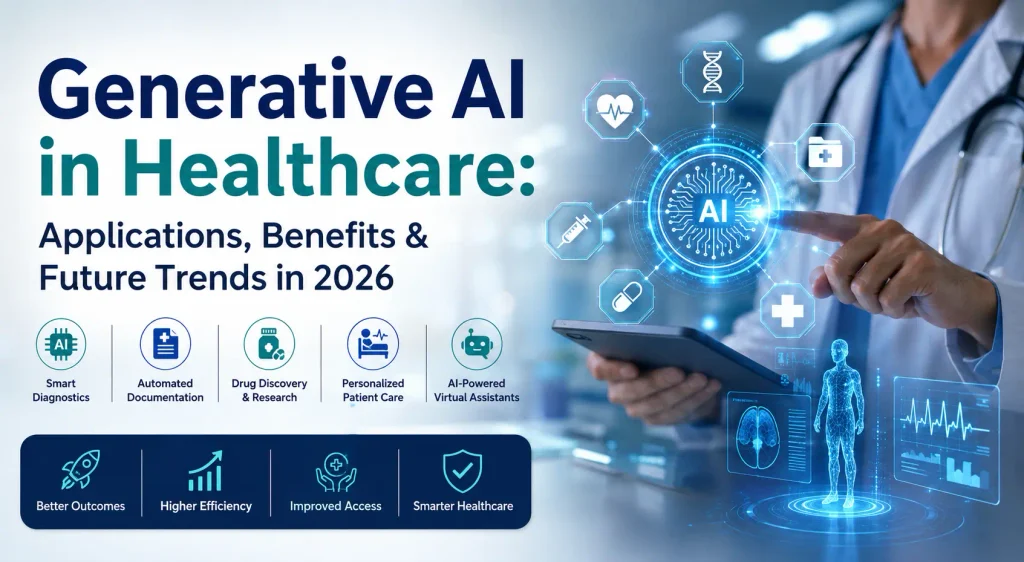
Generative AI in healthcare is changing the way healthcare organizations manage information, support clinicians, communicate with patients, and accelerate medical research. Unlike traditional software that follows fixed instructions, generative AI can create new content such as text, summaries, images, code, and other outputs based on the information it receives.
For freshers who want to build a career in artificial intelligence, healthcare is becoming an important area to explore. Healthcare organizations generate enormous amounts of data through electronic health records, medical research, diagnostic reports, clinical documentation, and patient interactions. Generative AI can help professionals process this information more efficiently while keeping human expertise at the center of healthcare decisions.
Recent research identifies applications of generative AI across healthcare consultations, treatment support, medical education, clinical research, documentation, and other workflows. At the same time, experts emphasize the importance of accuracy, privacy, security, human oversight, and responsible AI adoption.
Generative AI in healthcare refers to the use of generative artificial intelligence technologies to create, summarize, transform, or analyze healthcare-related information.
For example, an AI system can summarize a patient’s medical notes, help organize clinical information, generate a draft report, answer questions about medical literature, or assist researchers in analyzing large volumes of information.
Large Language Models (LLMs) are one of the most important technologies behind many generative AI applications. These models can understand and generate human-like language. Healthcare organizations can combine LLMs with trusted healthcare databases, electronic health record systems, and specialized applications to create AI-powered healthcare solutions.
However, generative AI does not replace doctors, nurses, researchers, or other healthcare professionals. Instead, it can support them by reducing repetitive work and helping them access relevant information more quickly.
Healthcare professionals spend significant time handling documentation, searching for information, communicating with patients, and completing administrative activities. Consequently, organizations are exploring AI to improve efficiency.
Generative AI can assist with several of these tasks.
For example, healthcare AI applications can help:
Recent industry research shows that healthcare organizations are increasingly moving from experimental generative AI projects toward practical implementation. Administrative efficiency, clinical productivity, patient engagement, and software-related workflows are among the areas receiving significant attention.
One of the most practical applications of generative AI in healthcare is clinical documentation.
Healthcare professionals often need to create detailed notes after patient interactions. Generative AI can help summarize conversations and organize information into structured documentation.
As a result, healthcare professionals may spend less time on repetitive documentation and more time focusing on patient care.
However, AI-generated documentation should be reviewed by qualified professionals before it becomes part of an official medical record.
Generative AI can support patient communication through AI-powered chatbots and virtual assistants.
These systems can answer general questions, provide information about appointments, explain healthcare terminology in simpler language, and guide patients toward appropriate resources.
For example, an AI assistant could transform complicated medical information into easy-to-understand language.
Nevertheless, healthcare organizations must design these systems carefully because incorrect medical information can create serious risks.
Medical researchers must review large amounts of scientific literature, clinical information, and research data.
Generative AI can help researchers summarize papers, identify relevant information, organize research findings, and generate initial drafts for documentation.
Therefore, AI can potentially reduce the amount of time researchers spend on repetitive information-processing tasks.
Recent reviews highlight the use of LLMs in medical research, healthcare education, patient treatment support, and healthcare consultations.
Drug discovery can take years and requires extensive research.
Generative AI can support researchers by helping explore potential molecules, analyze biological information, and generate candidate structures for further investigation.
This does not mean AI independently creates an approved medicine. Instead, researchers can use AI-generated results as inputs for laboratory testing, validation, and further scientific analysis.
As AI models become more specialized, researchers expect generative AI and other AI technologies to play an increasing role in drug discovery and biomedical research.
Every patient has different characteristics, medical history, lifestyle factors, and treatment requirements.
Generative AI can help organize and analyze patient information to support personalized healthcare workflows.
For example, AI systems can assist professionals in generating patient-specific information summaries or educational materials.
However, healthcare professionals must validate recommendations because AI output can contain errors or incomplete information.
Generative AI can also support medical education.
Students and healthcare professionals can use AI systems to create practice questions, summarize complex concepts, explain medical terminology, and generate learning scenarios.
Consequently, AI can become a useful learning assistant for students who want to understand healthcare concepts more efficiently.
For freshers entering AI, healthcare education is also an interesting area for developing AI-powered learning applications.
Generative AI offers several potential benefits when organizations implement it responsibly.
AI can automate repetitive information-processing tasks. Therefore, professionals can spend more time on activities that require human judgment.
Healthcare professionals often need to find relevant information quickly. Generative AI can summarize large amounts of content and make information easier to access.
AI-powered assistants can provide patients with accessible information and support communication outside traditional workflows.
Generative AI can act as a digital assistant rather than a replacement for healthcare professionals.
Researchers can use AI to organize literature, summarize information, and explore large datasets more efficiently.
Administrative tasks consume significant time in healthcare. Generative AI can support documentation, information processing, and other repetitive workflows.
Research has identified rapid access to information and improved prediction or diagnostic support among potential benefits, while also emphasizing the risks of inaccurate or fabricated outputs.
Although generative AI provides exciting opportunities, it also creates important challenges.
Healthcare information is highly sensitive. Organizations must protect patient data and follow applicable privacy and security requirements.
Generative AI can sometimes produce information that sounds convincing but is incorrect. Therefore, healthcare professionals must verify important outputs.
AI systems can reproduce biases present in their training data. Developers need to evaluate models carefully to reduce unfair or unreliable results.
Some AI systems can make it difficult to understand why a particular output was generated. This creates challenges when organizations use AI in sensitive healthcare workflows.
AI should support healthcare professionals rather than independently make critical medical decisions.
For this reason, responsible AI development requires testing, monitoring, validation, security controls, and human review. Research on generative AI in healthcare specifically highlights inaccurate outputs, unreliable sources, and other limitations as important concerns.
The future of generative AI in healthcare is moving toward more specialized and integrated systems.
Instead of relying only on general-purpose chatbots, healthcare organizations are increasingly exploring AI assistants designed for specific professional workflows.
These healthcare copilots could help professionals with documentation, information retrieval, administrative activities, and other tasks.
Future healthcare AI systems will increasingly work with multiple data types, including text, images, audio, electronic health records, and other information.
This approach can help AI systems understand healthcare information from multiple sources instead of relying only on text.
Another emerging trend is agentic AI.
AI agents can perform multiple connected tasks rather than simply answering individual questions. In healthcare, organizations are exploring how agentic workflows could support administrative and operational processes.
Industry research indicates that healthcare organizations are increasingly interested in moving from individual generative AI tasks toward more complex agentic workflows.
General-purpose language models may not always be suitable for specialized healthcare tasks. Therefore, future systems are likely to use domain-specific models trained or adapted for medical terminology, clinical workflows, research, and healthcare operations.
The growth of healthcare AI creates opportunities for students and freshers who develop the right technical foundation.
A fresher does not necessarily need to become a medical professional to work on healthcare AI. Instead, aspiring AI professionals can develop skills in programming, data, machine learning, natural language processing, and generative AI.
Some potential career paths include:
Python is particularly useful because it is widely used for artificial intelligence, machine learning, data analysis, and automation. Building a foundation in Python can therefore help freshers move toward advanced AI technologies.
CloudData Technologies’ Gen AI training approach combines Python, machine learning basics, LLMs, prompt engineering, and practical generative AI applications. The institute specifically positions its training for students, freshers, and professionals who want job-oriented AI skills.
If you are a fresher interested in Generative AI in Healthcare, follow a practical learning path.
1: Learn Python
Start with Python fundamentals such as variables, functions, loops, data structures, and object-oriented programming.
2: Understand AI and Machine Learning
Learn basic machine learning concepts, datasets, model training, evaluation, and common algorithms.
3: Learn NLP and LLMs
Understand natural language processing, tokens, embeddings, transformers, large language models, and AI APIs.
4: Learn Prompt Engineering
Learn how to create clear prompts, evaluate AI responses, and design reliable AI workflows.
5: Build Generative AI Projects
Create practical projects such as healthcare information assistants, document summarization tools, medical literature assistants, or healthcare FAQ applications.
6: Learn Responsible AI
Understand privacy, security, bias, hallucinations, validation, and human oversight.
7: Build a Portfolio
Add your projects, GitHub work, certifications, and technical skills to your resume and LinkedIn profile.
A project-based approach can help freshers demonstrate practical skills instead of relying only on theoretical knowledge.
Generative AI is becoming an important technology across software development, healthcare, finance, education, marketing, and other industries.
For freshers, learning Gen AI alongside Python, machine learning, and data skills can create a broader technical profile.
Moreover, healthcare offers an especially interesting domain because AI can support clinical workflows, research, documentation, patient communication, and healthcare operations.
However, successful AI professionals need more than knowledge of AI tools. They also need programming skills, problem-solving ability, data awareness, communication skills, and an understanding of responsible AI.
Generative AI in Healthcare is creating new possibilities for healthcare organizations, researchers, professionals, and patients. From clinical documentation and patient communication to medical research and drug discovery, generative AI can improve efficiency and support healthcare innovation.
At the same time, healthcare requires a careful approach to AI. Privacy, security, accuracy, bias, and human oversight must remain priorities.
For freshers, this growing field provides an opportunity to combine Python, machine learning, LLMs, prompt engineering, and Generative AI with a high-impact industry such as healthcare.
If you are planning an AI career, now is a good time to start building practical Gen AI skills and developing real-world projects. A strong foundation can help you move from learning AI concepts to creating intelligent applications for industries such as healthcare.
CloudData Technologies offers career-oriented Gen AI training in Chennai covering Python, machine learning foundations, LLMs, prompt engineering, and practical generative AI applications, making it a relevant learning path for freshers who want to explore AI careers.