Artificial Intelligence (AI), Data Science, and Automation are transforming the way businesses work. From personalized recommendations on streaming platforms to intelligent chatbots and automated business processes, these technologies have become part of everyday life. At the center of many of these innovations is Python, one of the most popular programming languages in the world.
If you are a fresher planning to build a career in technology, learning Python for AI is one of the smartest decisions you can make. Python offers a simple syntax, powerful libraries, and a vast community, making it the preferred language for beginners and professionals alike.
In this guide, you’ll learn how Python is used in Artificial Intelligence, Data Science, and Automation, why it dominates these industries, and how mastering Python can open exciting career opportunities.
Python has become the first choice for Artificial Intelligence development because it combines simplicity with powerful capabilities. Unlike many programming languages, Python allows developers to focus on solving problems instead of worrying about complex syntax.
Here are some reasons why Python leads AI development:
Whether you are building an AI chatbot, recommendation system, or predictive model, Python provides everything you need.
Artificial Intelligence enables machines to perform tasks that normally require human intelligence. These tasks include learning, reasoning, speech recognition, image processing, and decision-making.
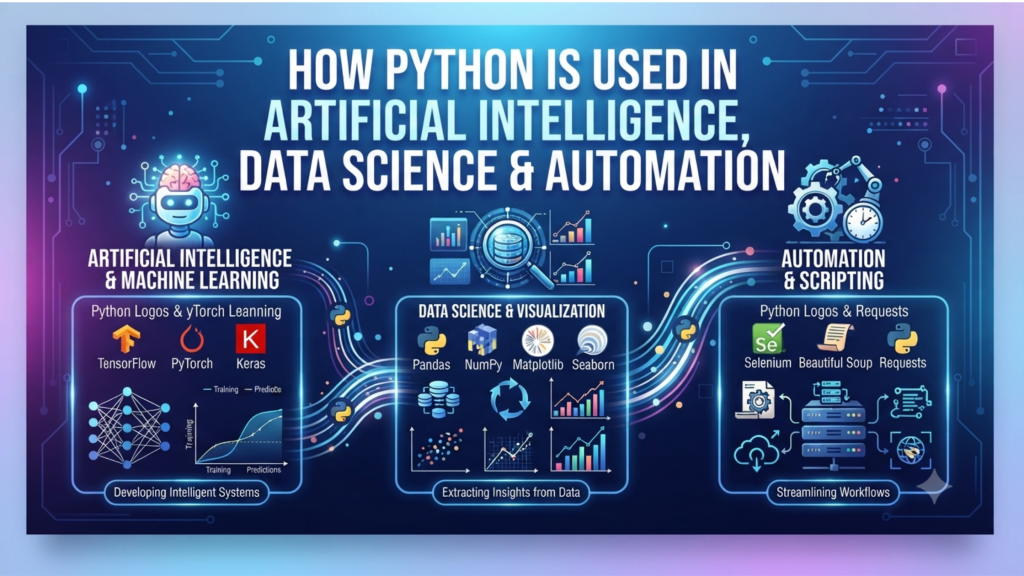
Python simplifies AI development through powerful frameworks and libraries.
TensorFlow
TensorFlow helps developers build deep learning models for image recognition, speech processing, and recommendation systems.
PyTorch
PyTorch is widely used in research and production because it offers flexibility while developing neural networks.
Scikit-learn
Scikit-learn provides machine learning algorithms for classification, regression, clustering, and predictive analytics.
OpenCV
OpenCV enables image recognition, facial detection, and computer vision applications.
NLTK and SpaCy
These libraries process natural language, making chatbots and virtual assistants possible.
Python powers thousands of AI applications across industries.
Healthcare
Banking
E-commerce
Education
Manufacturing
These real-world applications demonstrate why companies continue investing in Python-based AI solutions.
Data Science helps organizations analyze large volumes of data to make informed decisions. Python has become the most widely used programming language in this field because it offers powerful tools for collecting, cleaning, analyzing, and visualizing data.
Freshers who learn Python for Data Science gain valuable analytical skills that employers actively seek.
Pandas
Pandas helps organize, clean, and analyze structured data.
NumPy
NumPy performs mathematical calculations efficiently.
Matplotlib
Matplotlib creates charts and graphs for data visualization.
Seaborn
Seaborn generates attractive statistical visualizations.
Plotly
Plotly creates interactive dashboards for business intelligence.
A typical Data Science project follows these steps:
Data Collection
Gather information from databases, APIs, spreadsheets, or websites.
Data Cleaning
Remove duplicate records, fix missing values, and improve data quality.
Data Analysis
Identify trends, patterns, and business insights.
Data Visualization
Present findings using graphs and dashboards.
Machine Learning
Build predictive models for forecasting and decision-making.
Python supports every stage of this workflow, making it an essential skill for aspiring Data Scientists.
Automation reduces repetitive manual work by allowing software to perform routine tasks automatically.
Python excels at automation because it requires fewer lines of code and supports numerous automation libraries.
Common Automation Tasks Using Python
Businesses use Python to automate:
Automation improves productivity while reducing human errors.
Business Reporting
Companies generate daily reports automatically using Python scripts.
Email Automation
Python sends scheduled emails, invoices, and notifications.
Web Scraping
Businesses collect market data and competitor information using automated scripts.
Social Media Scheduling
Python automates content publishing across multiple platforms.
Cloud Automation
Organizations automate cloud infrastructure management using Python.
Python skills are valuable across many industries.
Information Technology
Software companies develop AI products, websites, and applications using Python.
Healthcare
Hospitals analyze patient records and improve diagnostics.
Finance
Banks automate fraud detection and financial forecasting.
Retail
Retailers personalize customer experiences using AI.
Telecommunications
Telecom companies optimize networks through machine learning.
Logistics
Python predicts delivery times and optimizes routes.
Learning Python creates multiple career paths.
Popular job roles include:
Many companies prefer candidates with Python skills because the language supports modern technologies like Artificial Intelligence, Data Science, Cloud Computing, and Automation.
If you’re starting your career, focus on building these skills:
Learning these skills alongside Python makes you more competitive in today’s job market.
Hands-on projects strengthen your resume and improve practical knowledge.
Consider building:
These projects showcase your abilities during interviews.
Learning Python becomes easier with a structured approach.
Consistency matters more than speed.
Technology continues evolving rapidly, and employers increasingly seek professionals who understand Artificial Intelligence and automation. Python provides an accessible entry point because of its readability, extensive ecosystem, and industry adoption.
By learning Python for AI, freshers can explore careers in Artificial Intelligence, Machine Learning, Data Science, Automation, Cloud Computing, and software development. Python also serves as a foundation for emerging fields like Generative AI and intelligent business automation.
Python has become the backbone of Artificial Intelligence, Data Science, and Automation. Its simple syntax, extensive libraries, and strong community support make it the ideal programming language for beginners and experienced developers alike. Whether you want to build intelligent applications, analyze data, or automate repetitive tasks, Python gives you the tools to succeed.
If you’re a fresher looking to launch a rewarding career in technology, now is the perfect time to start learning Python for AI. Build a strong foundation, work on practical projects, and continuously upgrade your skills. As organizations continue investing in AI-driven solutions, Python expertise will remain one of the most valuable skills in the global job market.