
Technology is changing rapidly, and artificial intelligence is becoming an important part of modern software development. At the same time, Java continues to play a major role in enterprise applications, backend development, cloud platforms, financial systems, e-commerce applications, and large-scale business software.
For freshers planning to start a software development career in 2026, learning Java with AI can create a valuable combination of programming and artificial intelligence skills. Instead of treating Java and AI as completely separate technologies, beginners can learn how Java applications can connect with AI models, APIs, databases, and intelligent automation tools.
This combination is especially relevant because modern Java developers can now use frameworks such as Spring AI to build AI-powered applications. Spring AI provides Java-oriented abstractions for working with chat models, embeddings, vector databases, Retrieval-Augmented Generation (RAG), tool calling, and other AI capabilities.
So, if you are a fresher wondering what skills to learn in 2026, understanding Java with AI can help you build a more future-ready development skill set.
Java with AI means using Java programming skills together with artificial intelligence technologies to develop intelligent applications.
Java traditionally powers backend systems, enterprise applications, APIs, web applications, and business software. AI, meanwhile, enables applications to understand information, generate content, analyze data, automate tasks, and interact with users more intelligently.
By combining both areas, developers can create applications such as:
For example, a Java Spring Boot application can provide the backend, authentication, database connectivity, and business logic while an AI model provides conversational or generative capabilities.
This makes Java AI development an interesting learning path for freshers who want to enter modern software development.
There are several reasons why freshers should consider learning Java and AI together.
Java has been used for decades to build large-scale business applications. Its ecosystem includes frameworks, libraries, development tools, databases, cloud integrations, and enterprise technologies.
Java also works particularly well with Spring Boot, which is widely used for developing backend applications and APIs.
Therefore, learning Java gives freshers a strong foundation in programming, object-oriented concepts, backend development, APIs, databases, and application architecture.
Once you understand these fundamentals, you can add AI capabilities to your applications.
AI is no longer limited to research laboratories or specialized data science teams. Developers increasingly integrate AI features into existing software applications.
For example, a company may already have a Java-based customer management system. Instead of rebuilding the entire application, developers can add an AI-powered assistant that helps employees search information, summarize customer interactions, or answer questions.
Spring AI is specifically designed to help Java developers integrate AI capabilities into Spring applications. Its current ecosystem supports major model providers and capabilities such as chat completion, embeddings, image generation, transcription, text-to-speech, moderation, RAG, and vector stores.
Therefore, learning Java with AI allows freshers to understand both application development and AI integration.
One of the important developments for Java developers is Spring AI.
Spring AI provides a framework for connecting enterprise data and APIs with AI models. It also provides APIs and abstractions that allow developers to work with different AI providers.
In June 2026, Spring AI 2.0.0 was released, bringing further improvements to AI application development and adding capabilities around MCP integration, model providers, and the Spring ecosystem.
For freshers, this means they can start learning AI application development without abandoning their Java knowledge.
Instead, they can gradually move from:
Java → Spring Boot → REST APIs → Databases → AI APIs → Spring AI → RAG → AI Applications
This provides a practical learning path.
Freshers often struggle to demonstrate their skills because they have limited professional experience.
Projects can help solve this problem.
Instead of creating only traditional Java CRUD applications, beginners can build projects that combine Java and AI.
For example:
AI-Powered Student Assistant
Build a Java Spring Boot application where students can ask questions about course materials.
The application can use AI to generate answers based on uploaded documents.
AI Resume Analyzer
Create a Java application that accepts resumes and analyzes skills, experience, and keywords.
The application can then generate a structured summary.
Customer Support Chatbot
Build a Java backend that connects a conversational AI model with customer information.
The chatbot can answer frequently asked questions and retrieve relevant information.
AI Document Search
Create a RAG-based application where users upload documents and ask questions about their content.
Spring AI supports RAG-related capabilities and vector-store integrations, making this type of project relevant to Java AI learning.
These projects can help freshers demonstrate programming, API integration, database, backend, and AI skills together.
One of the useful AI concepts for freshers to learn is Retrieval-Augmented Generation, commonly called RAG.
A traditional chatbot may rely primarily on the information available to its underlying model. A RAG application can retrieve relevant information from a knowledge source and provide that information to an AI model before generating a response.
A simplified RAG workflow looks like this:
User Question → Search Knowledge Base → Retrieve Relevant Information → Send Context to AI Model → Generate Response
A Java developer can build the application backend using Spring Boot and use AI frameworks and vector databases to implement the retrieval workflow.
Learning RAG therefore gives freshers exposure to an increasingly common AI application pattern.
Freshers should not make the mistake of learning AI while ignoring programming fundamentals.
Strong Java fundamentals still matter.
Before moving deeply into AI development, beginners should understand:
After learning these concepts, students can move toward Spring Boot and AI integration.
This approach creates a stronger foundation than simply learning how to call an AI API.
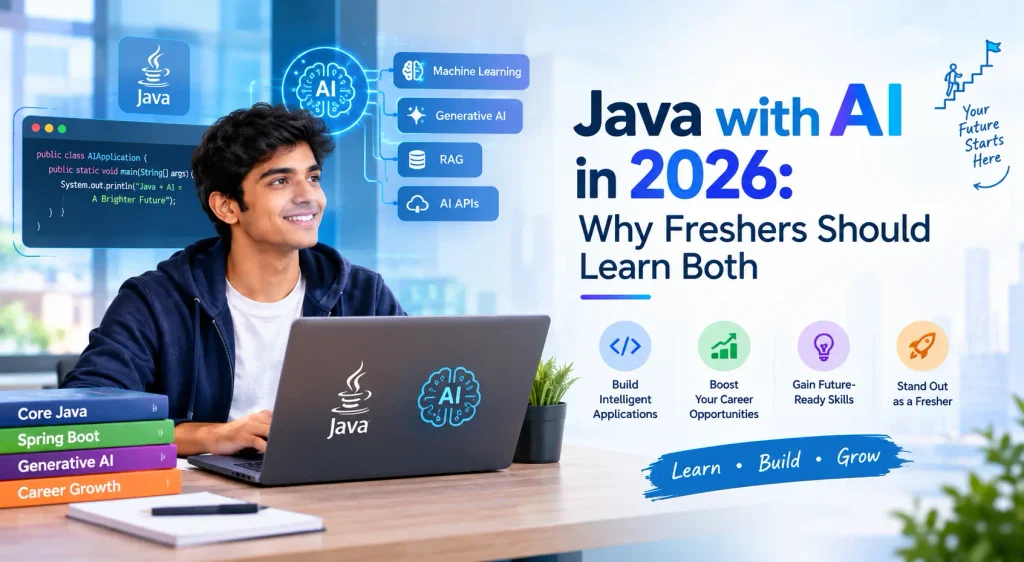
A practical Java AI roadmap for freshers can include the following stages.
Start with programming fundamentals and object-oriented programming.
Focus on writing clean and understandable Java code.
Next, learn collections, streams, exception handling, multithreading, JDBC, and related backend concepts.
Java applications frequently communicate with databases.
Learn SQL and understand relational database concepts. Practice connecting Java applications with databases.
Spring Boot is important for modern Java backend development.
Learn:
You do not necessarily need advanced mathematics to begin AI application development.
Start with concepts such as:
After understanding Java and Spring Boot, explore Spring AI.
The framework provides Java-friendly ways to connect applications with AI models and services. Current Spring AI documentation includes support for chat models, embeddings, vector stores, RAG, tool calling, and other AI application capabilities.
Finally, build projects that solve practical problems.
For example:
Java + Spring Boot + SQL + Spring AI + AI Model + RAG
This combination can help demonstrate your development skills in a portfolio.
Learning Java alone can provide a solid foundation for software development. However, adding AI application skills can broaden the types of projects you can build.
| Java Skills | Java with AI Skills |
|---|---|
| Backend development | AI-powered backend development |
| REST APIs | AI-integrated APIs |
| Database applications | AI + database applications |
| Business logic | Intelligent business workflows |
| Traditional web applications | AI-enabled applications |
| CRUD projects | AI-powered real-world projects |
| Java frameworks | Java + Spring AI |
This does not mean that every Java developer needs to become an AI researcher.
Instead, freshers can focus on AI application development and learn how to integrate existing AI models into useful software applications.
Learning Java with AI can support several career directions.
Depending on their skills and projects, freshers can explore roles such as:
However, job requirements vary between companies. Freshers should therefore study job descriptions and develop the specific technical skills employers request.
A strong portfolio can make your learning visible to recruiters.
Instead of adding ten basic projects, focus on a few practical projects that demonstrate different skills.
For example:
1: AI Chatbot
Technologies: Java, Spring Boot, REST API, AI API
2: AI Document Assistant
Technologies: Java, Spring Boot, RAG, embeddings, vector database
3: AI Resume Analyzer
Technologies: Java, Spring Boot, database, AI API
4: AI Customer Support System
Technologies: Java, Spring Boot, SQL, AI integration
For each project, explain the problem, technology stack, architecture, features, and your contribution.
Also, publish your code on a suitable code repository and create a simple project README.
While learning Java with AI, avoid these common mistakes.
Do not try to learn Java, Python, cloud computing, machine learning, multiple AI frameworks, and several databases simultaneously.
Build a strong foundation first.
AI does not replace programming fundamentals.
Strong Java knowledge will help you understand frameworks and application architecture more effectively.
Tutorials are useful for learning, but portfolio projects should solve a real problem.
Try changing the features, adding authentication, connecting a database, or introducing an AI capability.
AI coding assistants can help you learn faster. However, you should understand the code you use.
Be prepared to explain your implementation during an interview.
AI applications can work with sensitive business data. Therefore, freshers should learn basic concepts such as API-key protection, authentication, authorization, input validation, and secure application configuration.
Java with AI provides a practical combination for freshers who want to enter modern software development.
Java provides programming and backend development foundations, while AI skills allow developers to build intelligent application features. Furthermore, frameworks such as Spring AI are making it easier for Java developers to connect applications with AI models and enterprise data.
The goal should not be to learn every AI technology available.
Instead, focus on a structured path:
Core Java → Advanced Java → SQL → Spring Boot → REST APIs → Generative AI Fundamentals → Spring AI → RAG → AI Projects
This approach allows freshers to build skills step by step.
The software development landscape is changing, and AI is becoming an important part of modern applications. At the same time, Java continues to provide a strong foundation for enterprise and backend development.
Therefore, Java with AI can be a valuable skill combination for freshers in 2026.
Start with Core Java. Then learn Spring Boot, databases, APIs, and backend development. After building those fundamentals, add Generative AI concepts, Spring AI, RAG, embeddings, and AI APIs.
Most importantly, practice by building projects.
A fresher who can explain Java fundamentals, develop a Spring Boot backend, work with databases, integrate an AI model, and build a useful AI-powered application can demonstrate a broader set of practical development skills.
If you are planning your software development career in 2026, learning Java with AI can help you prepare for the growing intersection of backend development and intelligent applications.