Businesses today rely on automation to improve productivity, reduce operational costs, and eliminate repetitive manual work. From processing invoices to updating spreadsheets and sending emails, repetitive tasks consume valuable time that employees could spend on strategic activities. This is where Python for RPA (Robotic Process Automation) becomes a game changer.
Python is one of the most popular programming languages for automation because of its simplicity, flexibility, and extensive library support. When combined with RPA tools, Python helps organizations automate repetitive business processes quickly and efficiently.
If you want to build a successful career in automation, learning Python for RPA is one of the smartest investments you can make in 2026.
Robotic Process Automation (RPA) is a technology that uses software bots to perform repetitive and rule-based tasks without human intervention.
These bots can:
Unlike traditional automation, RPA does not require changing existing business systems. Instead, software robots interact with applications just as humans do.
Python enhances RPA by making automation workflows more intelligent, flexible, and customizable.
Python has become the preferred programming language for automation because it is easy to learn and offers powerful libraries for handling almost every automation task.
Easy to Learn
Python has a simple syntax that beginners can understand quickly. Even students without prior programming experience can start building automation scripts within a few weeks.
Huge Library Support
Python offers thousands of libraries for automation, including:
These libraries simplify tasks such as web automation, Excel processing, PDF handling, and data extraction.
Cross-Platform Compatibility
Python works on Windows, Linux, and macOS, making automation projects portable across different environments.
Cost-Effective
Python is open-source and free, allowing businesses to automate workflows without paying expensive licensing fees.
Organizations worldwide use Python Robotic Process Automation because it delivers measurable business benefits.
Saves Time
Automation completes repetitive tasks much faster than manual work.
Reduces Human Errors
Python bots perform the same process consistently without mistakes.
Improves Productivity
Employees can focus on strategic decision-making instead of routine administrative work.
Enhances Customer Experience
Automation speeds up service delivery, leading to faster response times and higher customer satisfaction.
Scalable Automation
Python scripts can easily scale as business processes grow.
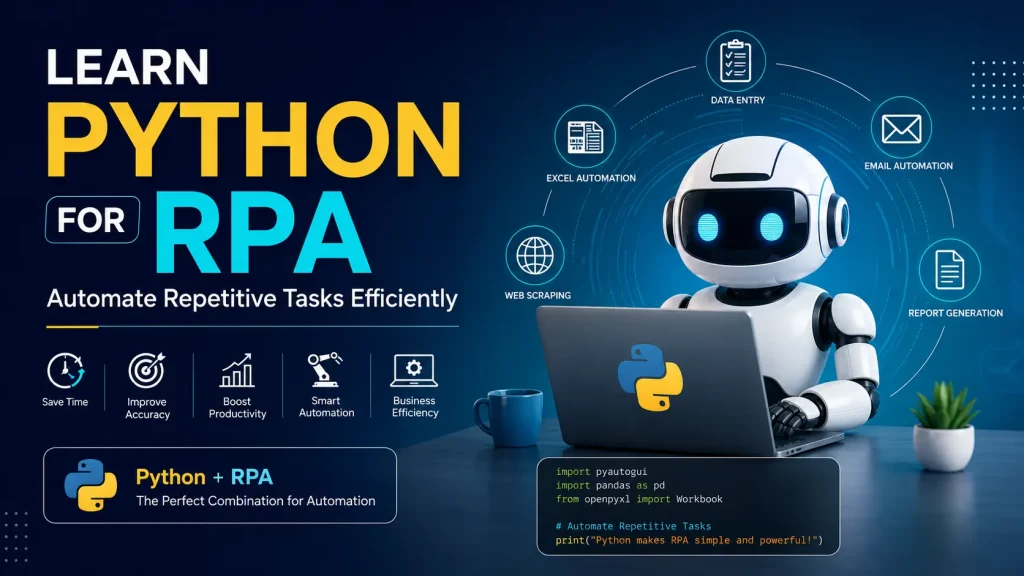
Learning the right libraries is essential when you learn Python for RPA.
Selenium
Selenium automates web browsers and is widely used for:
PyAutoGUI
PyAutoGUI controls the keyboard and mouse to automate desktop applications.
It helps automate:
OpenPyXL
OpenPyXL simplifies Excel automation.
You can:
Pandas
Pandas processes large datasets efficiently.
Businesses use it for:
BeautifulSoup
BeautifulSoup extracts structured information from websites.
It is widely used for web scraping and data collection.
Python automation is transforming multiple industries.
Healthcare
Healthcare organizations automate:
Banking
Banks automate:
Human Resources
HR teams automate:
Finance
Finance departments automate:
E-commerce
Online businesses automate:
Many popular RPA platforms support Python integration.
Examples include:
Python extends these tools by adding advanced scripting, artificial intelligence, machine learning, and data processing capabilities.
This combination helps businesses create intelligent automation solutions rather than simple rule-based bots.
Career Opportunities in Python RPA
Demand for automation professionals continues to grow as organizations embrace digital transformation.
Common job roles include:
Professionals with Python and RPA skills often receive competitive salaries because automation expertise is in high demand across industries.
Skills You Should Learn
To become an RPA developer, focus on mastering these technologies:
Adding AI and machine learning skills further enhances your career opportunities.
Why Choose Cloud Data Technologies for Python Training?
If you want practical experience in Python automation and RPA, Cloud Data Technologies offers industry-oriented training designed for students, freshers, and working professionals.
The course focuses on real-world automation scenarios that prepare learners for modern IT roles.
Future of Python for RPA
The future of automation is becoming more intelligent with Artificial Intelligence, Machine Learning, and Generative AI.
Python plays a central role in this evolution because it integrates seamlessly with AI technologies. Organizations are increasingly combining RPA with intelligent document processing, predictive analytics, and conversational AI to automate complex workflows.
As businesses continue adopting digital transformation strategies, professionals skilled in Python for RPA will remain in high demand.
Learning Python today opens opportunities not only in automation but also in AI, data science, cloud computing, and software development.
Conclusion
Python has become one of the most powerful languages for Robotic Process Automation. Its simplicity, extensive library ecosystem, and compatibility with leading RPA platforms make it the ideal choice for automating repetitive tasks efficiently.
Whether you want to automate business processes, improve productivity, or start a rewarding career in automation, learning Python is the perfect first step.
At Cloud Data Technologies, we provide practical Python training that equips learners with real-world automation skills through live projects, expert mentorship, and placement support. Start your Python automation journey today and build the expertise needed for the future of intelligent automation.
Python for RPA involves using Python programming and its libraries to automate repetitive, rule-based tasks such as data entry, report generation, and web interactions.
Yes. Python is widely used for RPA because it is easy to learn, open-source, and offers powerful automation libraries like Selenium, PyAutoGUI, Pandas, and OpenPyXL.
Absolutely. Python’s simple syntax makes it beginner-friendly, allowing new learners to build automation scripts quickly.
Healthcare, banking, finance, HR, insurance, manufacturing, retail, and e-commerce all use Python-based automation to streamline business processes.
Yes. Cloud Data Technologies offers industry-focused Python training with live projects, expert guidance, placement assistance, and practical automation exercises to help learners become job-ready.