
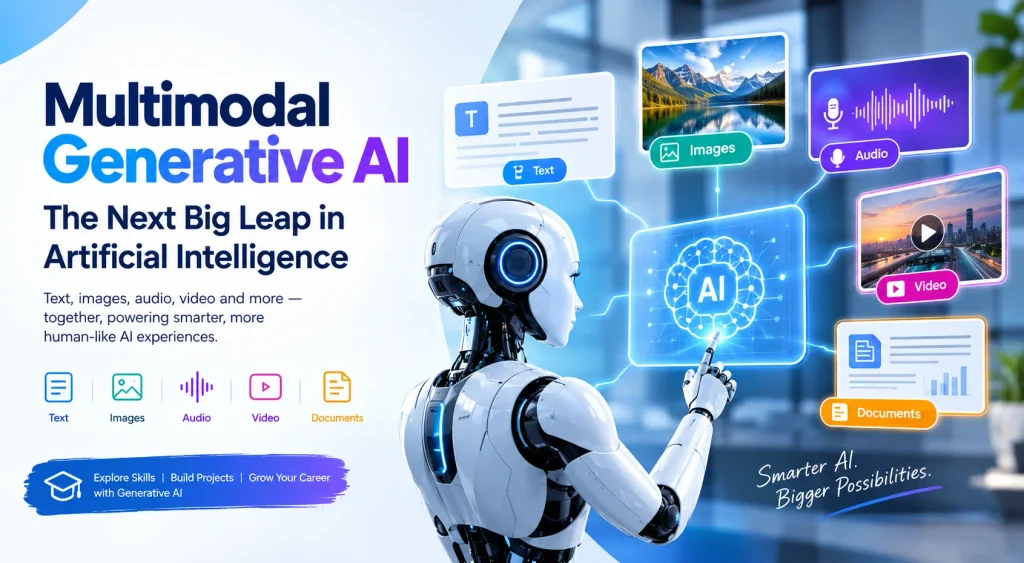
Artificial Intelligence is evolving rapidly, and Multimodal Generative AI is becoming one of the most exciting developments in the AI industry. Traditional AI applications often work with one type of information, such as text, images, audio, or video. However, multimodal AI can understand and work with multiple types of data together.
For freshers planning to build a career in artificial intelligence, understanding Multimodal Generative AI can provide an important advantage. Instead of working only with text-based AI tools, learners can explore systems that combine language, images, audio, video, documents, and other forms of information.
As businesses increasingly adopt AI for automation, customer support, content creation, software development, analytics, and decision-making, professionals who understand modern AI technologies can explore new career opportunities.
Multimodal Generative AI refers to AI systems that can understand, process, and generate information across multiple modalities.
A modality simply means a type of information. For example:
A traditional text-based AI model may receive a question and generate a text response. In contrast, a multimodal AI system can potentially analyze an image, understand accompanying text, process audio, and generate an appropriate response.
For example, imagine uploading a product image and asking an AI system to identify the product, describe its features, summarize customer information, and create marketing content. A multimodal system can combine different types of input to perform the task.
Therefore, multimodal artificial intelligence moves AI beyond a single format and toward more natural interactions between humans and machines.
The basic idea behind Multimodal Generative AI is to process different types of information and connect them within an AI system.
First, the system receives multimodal inputs. These inputs could include text, images, audio, video, or documents. Next, AI models process the information and identify meaningful patterns.
After that, the system combines the information to understand the context. Finally, the generative component produces an output based on the user’s request.
For example, a student could upload a diagram and ask:
“Explain this diagram in simple terms.”
The AI system needs to understand the visual information and the text-based question before generating an answer.
Similarly, a business could provide a customer-support recording, product document, and customer question. A multimodal AI application could analyze these inputs and generate a useful response.
This ability to connect different forms of information makes multimodal AI particularly useful for modern applications.
The world does not communicate using text alone. People use images, voice messages, videos, documents, charts, and other forms of information every day.
Therefore, AI systems also need to understand information in different formats.
Multimodal Generative AI can help organizations create more intelligent and interactive applications. For instance, companies can develop AI assistants that understand documents and images, customer-service systems that process voice conversations, and content platforms that generate text and visuals.
Moreover, multimodal AI can improve user experiences because people can interact with AI in more natural ways.
Instead of typing a long description, a user could upload an image and ask a simple question. Consequently, AI becomes easier to use for people who may not have advanced technical knowledge.
The applications of Multimodal Generative AI are expanding across industries. Here are some important examples.
Companies can use multimodal AI to improve customer support. An AI assistant could analyze text conversations, screenshots, documents, or voice inputs to understand a customer’s problem.
As a result, support teams can respond faster while customers receive more relevant assistance.
AI can process different types of healthcare information, including medical documents, images, and clinical notes.
Multimodal systems can help professionals organize information and identify patterns. However, healthcare applications require strong validation, privacy protection, and human oversight.
Multimodal AI can transform learning experiences for students.
For example, a learner can upload a textbook page, diagram, or handwritten problem and ask the AI to explain it step by step.
Additionally, AI can generate summaries, quizzes, explanations, and study materials based on different types of educational content.
Marketing teams can use multimodal AI to create content from a combination of text, images, and other media.
For example, a marketer could provide a product image and product information and ask an AI application to generate social media captions, advertising copy, or promotional ideas.
Therefore, multimodal AI can support faster content workflows.
Multimodal AI can also support software developers.
Developers may use AI to analyze screenshots, documentation, diagrams, code, and error messages. This can help them understand problems and develop solutions more efficiently.
For freshers, this creates an interesting connection between Generative AI, Python, software development, and automation.
Businesses can combine multimodal AI with automation workflows to process documents, emails, images, reports, and customer requests.
For example, an organization could build an AI workflow that reads an invoice, extracts relevant information, checks the data, and sends the result to another business application.
Consequently, organizations can reduce repetitive manual work and improve operational efficiency.
Traditional Generative AI applications often focus on generating one primary type of content. For example, a text-based model generates text, while an image-generation model creates images.
Multimodal AI expands this capability by allowing systems to work with multiple forms of information.
| Traditional Generative AI | Multimodal Generative AI |
|---|---|
| Often focuses on one primary modality | Works across multiple modalities |
| Text-to-text applications are common | Text, image, audio, video and document interactions |
| Limited input formats | Multiple input formats |
| Useful for content generation | Useful for complex AI applications |
| Primarily language or media focused | Combines different information types |
However, the two technologies are not competitors. Instead, multimodal AI represents an evolution of generative AI capabilities.
Freshers do not need to become experts in every AI technology immediately. Instead, they should build their knowledge step by step.
Python is one of the most useful programming languages for AI and machine learning. Beginners can start with Python fundamentals and gradually move toward AI applications.
Understanding machine learning concepts gives freshers a foundation for understanding how AI models learn from data.
LLMs are an important part of the modern Generative AI ecosystem. Freshers should understand concepts such as tokens, context, model inference, and APIs.
Prompt engineering helps users communicate effectively with AI models. Learning how to create clear and structured prompts can improve AI outputs.
AI applications often connect models through APIs. Therefore, learning how to work with APIs can help freshers build practical AI projects.
Retrieval-Augmented Generation, or RAG, allows AI applications to retrieve relevant information from external data before generating responses.
Freshers interested in building enterprise AI applications should understand embeddings, vector databases, retrieval, and RAG pipelines.
AI agents can perform multi-step tasks using tools and workflows. Learning the fundamentals of AI agents can help freshers understand how modern AI applications move beyond simple chatbots.
CloudData Technologies’ current Gen AI curriculum similarly focuses on Python, LLMs, prompt engineering, RAG, vector databases, chatbots, AI agents, APIs, and practical application development.
As organizations explore AI-powered applications, freshers can build careers across several related areas.
Potential career paths include:
However, job titles vary between companies. More importantly, employers increasingly value practical skills and the ability to build useful applications.
Therefore, freshers should focus on developing a strong technical foundation and a portfolio of meaningful projects.
Projects can help freshers demonstrate their understanding during interviews.
Here are some project ideas:
Build an application that accepts documents and allows users to ask questions about their contents.
Create an application that analyzes an uploaded image and generates a natural-language description.
Develop a tool that accepts educational documents and images and generates summaries, explanations, and questions.
Build an AI assistant that can process customer questions, screenshots, and documents and generate helpful responses.
Create an application that combines product information and images to generate marketing content.
These projects can help students connect concepts such as Python, APIs, LLMs, prompt engineering, RAG, and AI automation.
Starting with advanced AI concepts can feel overwhelming. Therefore, follow a structured learning path.
1: Learn Python
Start with variables, functions, loops, data structures, object-oriented programming, and APIs.
2: Understand AI and Machine Learning
Learn basic machine learning concepts, datasets, models, training, evaluation, and common AI terminology.
3: Learn Generative AI
Understand LLMs, prompts, tokens, embeddings, APIs, and generative AI applications.
4: Explore RAG
Learn how AI applications retrieve information from external knowledge sources.
5: Build Multimodal Applications
Start working with applications that combine text, images, documents, audio, or other inputs.
6: Create Projects
Build practical projects and publish them in your portfolio.
7: Prepare for Interviews
Practice Python, AI concepts, project explanations, APIs, problem-solving, and common Generative AI interview questions.
This approach allows freshers to move from fundamentals to practical AI development without trying to learn everything at once.
The future of AI will not be limited to text-based conversations. Instead, AI systems will increasingly interact with multiple forms of information.
Imagine an AI assistant that can see a product, listen to a customer’s question, read a technical document, analyze a chart, and generate a detailed response. This type of interaction represents the direction in which Multimodal Generative AI is moving.
Furthermore, organizations can combine multimodal AI with RAG, AI agents, APIs, cloud platforms, and automation systems. This combination can create powerful business applications.
For freshers, this means learning AI is no longer limited to understanding theory. Building practical applications can become an important part of career preparation.
If you are a fresher interested in building a career in AI, learning through practical projects can make the journey easier.
CloudData Technologies offers a Generative AI Training Course in Chennai designed around practical AI application development. The training covers areas such as Python, Large Language Models, prompt engineering, RAG, vector databases, AI-powered chatbots, AI agents, APIs, and AI workflows.
The institute positions its training toward students, freshers, developers, data professionals, and AI enthusiasts, with hands-on projects and industry-oriented learning.
For beginners, this type of structured learning can provide a starting point for understanding modern AI technologies and developing a portfolio.
Multimodal Generative AI represents an important evolution in artificial intelligence. By combining text, images, audio, video, documents, and other information formats, multimodal systems can create more natural and useful AI applications.
For freshers, this technology offers an exciting area to explore. However, the best approach is to build skills progressively. Start with Python, understand AI fundamentals, learn Generative AI and LLMs, explore prompt engineering and RAG, and then move toward multimodal applications.
Most importantly, build projects that solve practical problems. A strong portfolio can demonstrate your ability to apply AI concepts rather than simply describe them.
As AI continues to evolve, professionals who combine programming skills, AI knowledge, problem-solving ability, and practical project experience can position themselves for opportunities in the growing AI ecosystem.