
In today’s data-driven world, organizations generate massive amounts of information every second. However, raw data alone cannot help businesses make informed decisions. Instead, companies need powerful tools that transform complex data into meaningful insights. This is exactly where Power BI Analytics stands out.
Microsoft Power BI has consistently remained the world’s leading Business Intelligence (BI) platform. Even in 2026, businesses across healthcare, finance, retail, manufacturing, education, logistics, and IT continue to rely on Power BI for interactive dashboards, real-time reporting, and advanced analytics.
If you are a fresher planning to build a successful career in data analytics, learning Power BI Analytics can significantly improve your job opportunities. Let’s explore why Power BI continues to dominate the Business Intelligence market in 2026.
Power BI Analytics is Microsoft’s powerful Business Intelligence solution that helps users collect, analyze, visualize, and share data through interactive dashboards and reports.
Rather than spending hours creating spreadsheets, businesses can connect Power BI to multiple data sources and generate meaningful insights within minutes.
Power BI supports data from:
As a result, organizations can make faster and smarter business decisions.
Several Business Intelligence platforms exist today. However, Power BI continues to lead the market for many compelling reasons.
One of the biggest advantages of Power BI Analytics is its beginner-friendly interface.
Unlike many complex BI platforms, Power BI allows freshers to create dashboards using simple drag-and-drop functionality. Therefore, students without programming experience can start learning quickly.
Moreover, Microsoft provides excellent documentation, tutorials, and community support.
Power BI transforms complex datasets into attractive visual reports.
Users can create:
Consequently, decision-makers can understand business performance much faster.
Artificial Intelligence is changing the future of Business Intelligence.
In 2026, Power BI offers several AI-powered capabilities, including:
As businesses increasingly adopt AI, Power BI Analytics becomes even more valuable.
Power BI works seamlessly with Microsoft’s business applications.
It integrates easily with:
Because many companies already use Microsoft products, adopting Power BI becomes simple and cost-effective.
Modern businesses cannot wait for yesterday’s reports.
Instead, they need real-time insights.
Power BI Analytics enables organizations to monitor live data, helping managers respond quickly to changing business conditions.
For example, retailers can monitor daily sales, while hospitals can track patient records in real time.
Today’s workforce is increasingly remote.
Fortunately, Power BI allows users to access dashboards securely from anywhere using laptops, tablets, or mobile devices.
As a result, teams can collaborate efficiently regardless of location.
The demand for Power BI professionals continues to grow worldwide.
Organizations are hiring:
Since every industry generates data, Power BI skills remain valuable across multiple sectors.
Therefore, freshers with Power BI Analytics skills enjoy better employment opportunities.
Learning Power BI Analytics opens doors to numerous career paths.
Popular job roles include:
Power BI Developer
Creates dashboards, reports, and business intelligence solutions.
Data Analyst
Analyzes business data to identify trends and support strategic decisions.
Business Intelligence Analyst
Designs reports that help management make informed decisions.
Reporting Analyst
Develops automated reports for various departments.
Data Visualization Expert
Converts raw business data into meaningful visual dashboards.
Because businesses increasingly rely on analytics, these roles continue to grow every year.
To become job-ready, freshers should focus on developing these essential skills:
Additionally, learning Microsoft Fabric and AI features will further enhance career prospects.
Power BI is widely used across different industries.
Some major sectors include:
Consequently, Power BI professionals can explore diverse career opportunities.
Fresh graduates often struggle to find their first job due to a lack of practical skills.
However, learning Power BI Analytics provides several advantages:
Furthermore, Power BI complements other in-demand skills such as SQL, Excel, Python, and Microsoft Fabric.
The future of Power BI looks exceptionally promising.
Microsoft continues to introduce innovative features powered by Artificial Intelligence, automation, and cloud computing.
Future developments include:
Therefore, investing in Power BI Analytics today is an excellent long-term career decision.
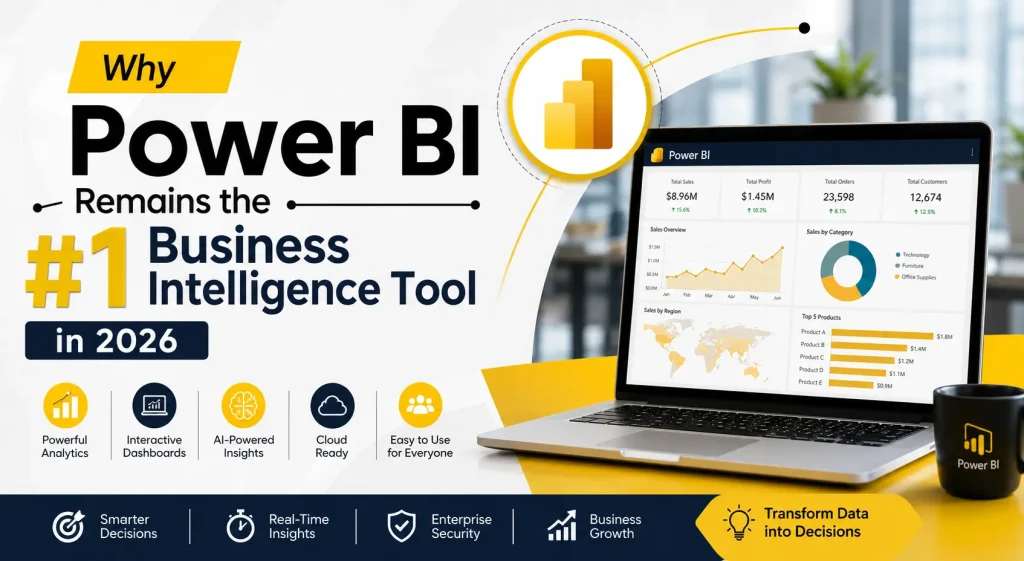
Power BI remains the #1 Business Intelligence tool in 2026 because it combines powerful analytics, user-friendly design, AI-driven capabilities, and seamless Microsoft integration. Whether you are a student, a fresher, or a working professional, mastering Power BI Analytics can significantly improve your career prospects.
Moreover, organizations across industries continue to invest heavily in business intelligence solutions, making Power BI one of the most sought-after technical skills. By learning Power BI, practicing real-world projects, and building interactive dashboards, you can stand out in today’s competitive job market.
If you want to start a rewarding career in data analytics, now is the perfect time to learn Power BI Analytics and prepare for the future of Business Intelligence.
Is Power BI good for freshers?
Yes. Power BI has an intuitive interface, making it one of the easiest Business Intelligence tools for beginners. It is also highly valued by employers.
Do I need coding to learn Power BI?
No. Basic Power BI can be learned without programming. However, learning SQL and DAX will help you create more advanced reports and dashboards.
Is Power BI in demand in 2026?
Yes. Organizations across industries continue to hire professionals with Power BI Analytics skills to analyze data and create interactive reports.
What should I learn before Power BI?
A basic understanding of Excel, data concepts, and SQL is helpful. You can then move on to Power Query, DAX, and dashboard design.
How long does it take to learn Power BI?
With regular practice, most beginners can learn the fundamentals in 6–8 weeks and build job-ready projects within a few months.