Python and machine learning continue to create exciting career opportunities for students and freshers entering the technology industry. As businesses increasingly use artificial intelligence, data analytics, automation, and intelligent applications, professionals who understand both Python and machine learning can build a strong foundation for an IT career.
For freshers, this combination is particularly valuable because Python is relatively easy to learn while also supporting a wide range of technologies. Python is used in software development, data analysis, artificial intelligence, automation, and machine learning. CloudData Technologies also positions Python training around practical coding, projects, data analysis, automation, and job preparation.
In this guide, we will explore Python and machine learning career opportunities in 2026, the skills freshers should develop, possible job roles, project ideas, and a practical roadmap for starting a career.
Technology companies are increasingly adopting AI-powered applications and data-driven solutions. As a result, the demand for professionals who can work with programming, data, and machine learning continues to create new career paths.
Python plays an important role because its ecosystem includes popular libraries and frameworks for data analysis and machine learning. Beginners can start with Python fundamentals and gradually move toward advanced areas such as data science, artificial intelligence, and machine learning.
Moreover, Python can support several career directions. A fresher can begin with programming fundamentals and later specialize in:
CloudData Technologies highlights Python applications across web development, data analysis, automation, and AI-related learning, making it a useful foundation for freshers.
Machine learning allows computers to identify patterns in data and make predictions or decisions based on those patterns. Python provides an accessible programming environment for working with data and developing machine learning applications.
A typical beginner journey may look like this:
Python fundamentals → Data handling → Statistics → Machine learning → Projects → Job preparation
First, you learn Python syntax, variables, conditions, loops, functions, and object-oriented programming. Next, you learn how to work with datasets using libraries such as NumPy and Pandas.
Then, you can explore machine learning concepts such as:
Finally, you apply these concepts to real-world projects.
This step-by-step approach is especially useful for freshers because it prevents them from trying to learn advanced AI concepts without understanding programming and data fundamentals.
Before moving deeply into machine learning, freshers should develop strong Python programming fundamentals.
Start with:
These concepts form the foundation for writing Python programs.
Learn classes, objects, inheritance, encapsulation, and other object-oriented programming concepts.
OOP becomes particularly useful when you start building larger applications and reusable software components.
Next, become comfortable with important Python libraries.
For data-focused careers, NumPy and Pandas are especially useful. CloudData Technologies’ Python training also includes data analysis with Pandas and NumPy.
You can then explore libraries and tools used in machine learning, data visualization, and AI.
Python should not be your only technical skill. Freshers interested in data and machine learning should also learn SQL.
SQL helps you retrieve, filter, aggregate, and analyze information stored in databases. Combining Python and SQL can make your profile more useful for entry-level data roles.
Machine learning relies heavily on data and statistics. Therefore, learn the basics of:
You do not need advanced mathematics at the beginning. However, a basic understanding of statistics can help you understand how machine learning models work.
Once you have a solid Python foundation, start learning machine learning.
Begin with data preprocessing. Real-world datasets often contain missing values, duplicate records, inconsistent formats, and irrelevant information. Learning how to clean and prepare data is therefore essential.
Next, understand common machine learning algorithms such as:
You should also understand how to divide datasets into training and testing sets and how to evaluate model performance.
Most importantly, do not focus only on memorizing algorithms. Learn why and when to use each algorithm.
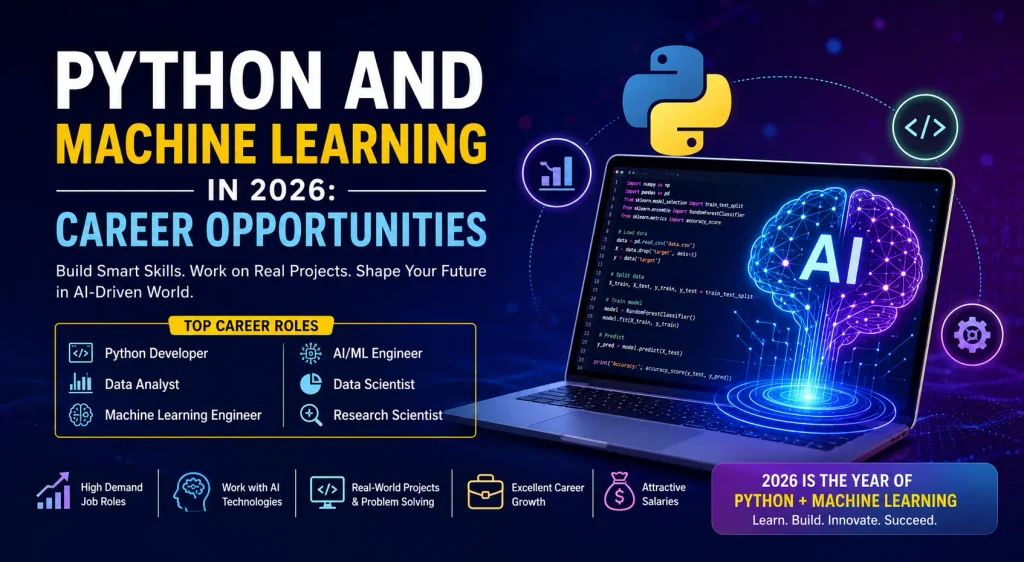
Learning Python and machine learning can open several career paths for freshers. Your first job may not always have “Machine Learning Engineer” in the title. Instead, you may enter through an adjacent role and build specialization through projects and experience.
Python developers create applications, scripts, APIs, and backend systems. Strong Python fundamentals, OOP, databases, APIs, and frameworks can help you prepare for this career.
Data analysts work with datasets to identify trends and generate useful business insights.
Python, SQL, Pandas, data visualization, and basic statistics can form a strong foundation for this role.
Internships can help freshers gain practical exposure to data preparation, model development, testing, and evaluation.
Junior ML roles typically require stronger programming, mathematics, statistics, data preprocessing, and machine learning knowledge. Building several practical projects can help demonstrate these skills.
AI/ML internships can provide exposure to artificial intelligence projects and help freshers understand how machine learning models are integrated into applications.
Python is also useful for automating repetitive tasks. CloudData Technologies highlights Python automation projects such as file management and web scraping as practical applications.
Freshers with Python, SQL, statistics, data analysis, and machine learning knowledge can also explore data science internships.
CloudData Technologies’ recent Python-for-data-science content identifies roles such as Junior Data Analyst, Python Developer, Machine Learning Intern, Data Science Intern, and AI/ML Intern among possible career directions.
Projects can make a significant difference when you apply for your first IT job.
Instead of building only basic calculator or to-do-list applications, try projects that demonstrate Python, data handling, and machine learning skills.
Build a regression model that predicts house prices based on factors such as location, size, number of rooms, and other features.
This project can demonstrate:
Create a machine learning model that predicts whether a customer may leave a service.
This project introduces classification, feature preparation, and model evaluation.
Build a model that classifies messages as spam or legitimate.
This project can introduce natural language processing and text classification.
Combine Python, data analysis, visualization, and machine learning to analyze historical sales and generate predictions.
This type of project can demonstrate both technical and business thinking.
Create a model that analyzes factors such as study time, attendance, and previous scores to predict academic performance.
For freshers, this project is easy to understand and can provide a good introduction to machine learning workflows.
Learning Python and machine learning requires consistent practice. Watching courses alone will not make you job-ready.
First, practice Python regularly. Write small programs and gradually increase their complexity.
Next, work with real datasets. Instead of copying every line from tutorials, try to solve problems independently.
After that, build at least three meaningful projects. Document your projects clearly and upload your code to a suitable portfolio or repository.
You should also prepare for technical interviews. Review Python fundamentals, OOP, SQL, data structures, statistics, and machine learning concepts.
Furthermore, create a resume that highlights skills and measurable project work rather than only course completion.
For example, instead of writing:
“Completed Python course.”
You can explain:
“Developed a machine learning model using Python and Pandas to predict customer churn and evaluated its performance using classification metrics.”
This approach gives recruiters a clearer picture of what you can actually do.
A practical roadmap can help you stay focused.
Start with syntax, data structures, functions, OOP, file handling, and exception handling.
Understand databases, queries, joins, grouping, subqueries, and basic database operations.
Practice NumPy, Pandas, data cleaning, exploratory data analysis, and visualization.
Study probability, distributions, correlation, variance, and basic statistical concepts.
Move into regression, classification, clustering, preprocessing, feature engineering, and model evaluation.
Create three to five projects that solve practical problems.
Improve your resume, GitHub or portfolio, communication skills, coding ability, and interview preparation.
This roadmap provides a structured path from Python beginner to entry-level AI or machine learning candidate.
For freshers, practical exposure can help connect theoretical concepts with real-world development. CloudData Technologies emphasizes hands-on Python learning, real-time projects, flexible batches, and placement support. Its Python program covers fundamentals, OOP, data handling, web development, automation, and projects.
The institute also offers Python training in Chennai for learners starting from basic programming concepts and progressing toward advanced topics.
Therefore, when choosing Python training in Chennai, freshers should look beyond course duration. Look for practical coding, real-time projects, experienced trainers, interview preparation, and opportunities to build a portfolio.
Yes, Python and machine learning can provide a strong foundation for a technology career in 2026. However, freshers should avoid treating machine learning as a shortcut to a high-paying job.
Instead, focus on building fundamentals.
Python + SQL + Data Analysis + Statistics + Machine Learning + Projects is a much stronger combination than learning machine learning algorithms without programming experience.
The technology landscape is also changing quickly because AI tools are becoming part of software development and business workflows. Current industry commentary emphasizes adaptability, problem-solving, and practical skills as technology continues to evolve.
As a result, continuous learning will remain important even after you get your first job.
Python and machine learning in 2026 offer multiple career opportunities for freshers who are willing to develop practical skills. Python provides an accessible starting point, while machine learning opens doors to AI, data science, automation, and intelligent application development.
The best approach is to learn progressively: start with Python, add SQL and data analysis, understand statistics, learn machine learning, and then build real-world projects.
If you are a fresher planning to enter the IT industry, now is a good time to start building this skill combination. With consistent practice, practical projects, and structured learning, you can prepare for roles such as Python Developer, Data Analyst, Machine Learning Intern, AI/ML Intern, Data Science Intern, and Junior Machine Learning Engineer.
For learners looking for practical Python training in Chennai, CloudData Technologies offers Python-focused training designed around hands-on learning, projects, and career preparation.