Have you noticed how fast the tech landscape is shifting? Just a short while ago, everyone was talking about basic chatbots and simple prompt engineering. But now, as we move through 2026, the tech world has completely evolved. Simple automated assistants are taking a backseat, and Agentic AI trends are officially driving the future of enterprise software.
If you are currently writing standard backend scripts, building APIs, or cleaning data, you are sitting on a goldmine of potential. Your programming background is the perfect launchpad to leap from a Python developer to an AI engineer.
But what exactly is Agentic AI, and how do you cross the bridge into this high-paying domain? Let us dive into the ultimate transition roadmap.
To understand why companies are actively hunting for AI talent, we have to look at how software has changed. Traditional automation follows strict, rigid rules. You code an if/else statement, and the machine executes it exactly as written. If something unexpected happens, the script breaks.
On the other hand, early Generative AI tools required constant human prompts to do anything useful. You type a prompt, get an answer, and then type another prompt to refine it.
[Traditional Software] ---> Follows strict, hardcoded rules.
[Early GenAI]            ---> Requires constant human prompts to keep moving.
[Agentic AI Systems]     ---> Takes a core goal, plans steps, uses tools autonomously.
Agentic AI completely shatters these limitations. Instead of waiting for a user to tell it what to do step-by-step, an intelligent AI agent acts autonomously based on high-level business goals. It can look at a problem, break it down into smaller tasks, choose the right digital tools, execute the plan, reflect on the results, and fix its own mistakes if something goes wrong.
Because businesses want autonomous systems that can manage cloud costs, handle customer support queues, or optimize supply chains without human delays, learning AI agent development with Python has become the single most valuable career move you can make today.
If you are worried that you need a PhD in advanced mathematics or statistics to understand how to become an AI engineer, we have excellent news for you. You absolutely do not.
The modern AI ecosystem relies heavily on application engineering, system design, and workflow orchestration. Guess what language powers nearly 99% of that infrastructure? Python.
Because you already understand object-oriented programming, data structures, error handling, and API integrations, you have already conquered the hardest part of the learning curve. Transitioning to AI engineering is not about throwing away your developer skills. Instead, it is about expanding your existing coding toolkit to handle foundation models, multi-agent orchestrations, and vector databases.
Shifting your career path takes focus, but breaking it down into clear, actionable phases makes it entirely achievable. Here is the exact roadmap to help you transition smoothly.
Before you can build complex systems, you must understand how large language models (LLMs) think. You need to move past standard web UI interfaces and start interacting with foundation models programmatically using Python libraries.
Focus on learning how to handle token limits, manage system prompts, and configure structured JSON outputs using Pydantic. The real magic happens when you teach an LLM to use external tools. By mastering function calling, you can write Python functions that allow an AI model to read databases, check local weather APIs, or interact with web scraping tools on its own.
An AI agent is only as good as the data it can access. Models often hallucinate or lack access to private, real-time enterprise records. This is where Retrieval-Augmented Generation (RAG) comes into play.
As an engineer, you will learn to take messy enterprise data—like PDFs, financial sheets, or customer histories—and break them down into text chunks. You will use embedding models to turn these chunks into mathematical vectors and store them in vector databases like Pinecone, Chroma, or Milvus. When an agent receives a query, your Python code will retrieve the most relevant data chunk and hand it to the model, ensuring accurate, grounded answers.
Once you understand single-agent mechanics, it is time to build multi-agent systems. Writing custom loops for complex tasks can quickly become messy. That is why mastering LangChain and CrewAI tools is vital.
These frameworks allow you to define specialized agent personas. For example, you can build a research agent that browses the web, a writer agent that synthesizes the data, and a supervisor agent that checks the final output for quality control. Learning how to manage state, handle agent memory, and orchestrate these multi-agent pipelines will immediately set you apart in the job market.
When corporate companies and recruitment managers search for AI talent, they look for builders who understand production-grade systems. To stand out, you need to emphasize these specific capabilities:
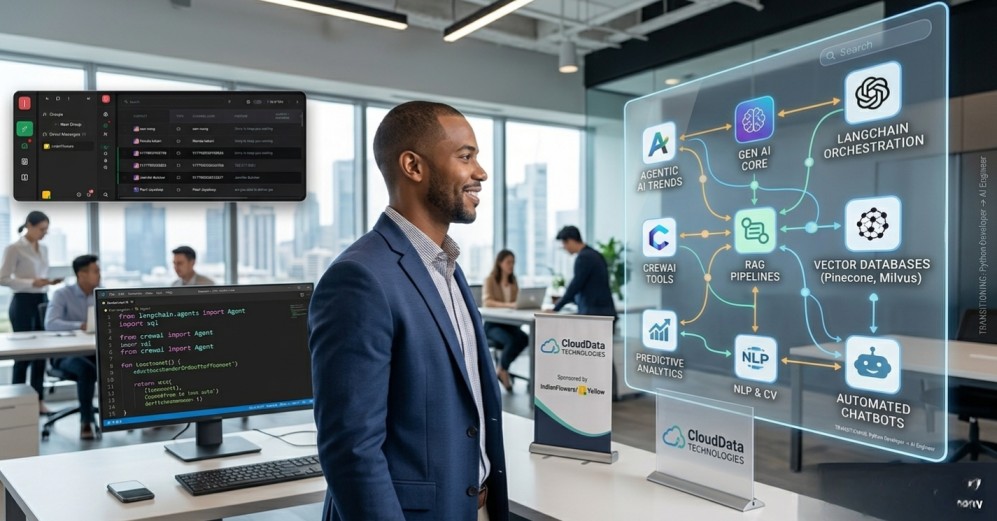
Python Developer to an AI Engineer
Multi-Agent Orchestration: Knowing how to design separate, specialized agents that communicate smoothly to solve complex enterprise problems.
Agent Governance and Safety: Implementing strict permission boundaries, guardrails, and audit trails so autonomous agents never access unauthorized data or execute unsafe code.
Evaluation and Optimization: Building testing frameworks to systematically measure agent latency, API token costs, and overall accuracy.
Self-study roadmaps are fantastic, but navigating the rapidly shifting world of Generative AI completely alone can feel overwhelming. If you want to skip the trial-and-error phase and fast-track your transition, checking out the structured programs at clouddatatechnologies.com is an excellent option.
At CloudData Technologies, we bridge the gap between academic theory and practical corporate requirements. Our comprehensive Generative AI crash course is built specifically for ambitious developers who want to dive deep into real-world projects.
Instead of working through basic tutorials, you will spend your time building production-grade multi-agent systems, integrating complex tool APIs, and designing advanced RAG pipelines. We focus on giving you hands-on experience with LangChain and CrewAI tools, ensuring you possess the exact portfolio pieces that corporate hiring managers are actively looking for.
The tech industry is starving for engineers who know how to build actual, production-ready AI applications. Companies are no longer investing in open-ended experimentation. Instead, they want clear, measurable ROI, and they need talented developers to construct those pipelines.
By combining your robust backend programming background with modern agentic architectures, you position yourself for some of the most lucrative roles in tech. Whether you want to work locally in major tech hubs or secure remote international opportunities, mastering AI agent deployment opens up incredible career paths.
Furthermore, when you train with specialized hubs like CloudData Technologies, you gain immediate access to an extensive, robust network of over 350+ corporate hiring partners across major hubs like Chennai and Bengaluru. This means your newly acquired technical skills connect directly with active job openings, giving you a smooth, stress-free path into the professional AI space.
The transition from a standard software developer to a specialized AI engineer is the most logical, high-impact evolution for your career. Your Python skills have already done the heavy lifting. Now, all you need to do is layer on the frameworks, agent patterns, and orchestration tools that define modern software architecture.
Are you ready to stop watching the AI revolution from the sidelines and start building it yourself? Visit clouddatatechnologies.com today to explore our specialized training programs, explore our cutting-edge curriculum, and take your first definitive step toward becoming a world-class AI engineer.
[Explore the Generative AI
Course Curriculum at CloudData Technologies]
Call us @+91 7550327779