Cloud computing has become an important part of modern software development. Businesses use cloud platforms to build applications, store data, automate processes, deploy services, and support artificial intelligence workloads. At the same time, Python remains one of the most accessible and versatile programming languages for developers.
For freshers, combining Python cloud computing skills can create a strong foundation for a career in software development, cloud engineering, DevOps, automation, data engineering, and AI. Python can also help beginners move from basic programming to practical cloud projects because its syntax is relatively easy to understand and its ecosystem includes libraries and tools for major cloud platforms.
In 2026, developers should learn more than Python syntax. They should understand cloud fundamentals, APIs, automation, containers, databases, security, deployment, and at least one major cloud platform.
Python cloud computing means using Python to build, deploy, manage, automate, and integrate applications and services in cloud environments.
Developers can use Python to communicate with cloud services through SDKs and APIs. For example, AWS provides Boto3, its SDK for Python, which allows developers to work with services such as Amazon S3, EC2, and DynamoDB.
Similarly, Microsoft provides Azure libraries for Python that help developers authenticate with Azure services, manage resources, and integrate applications with cloud services.
Google Cloud also provides Python libraries and tutorials for developing and deploying applications on its platform.
Therefore, learning Python alongside cloud computing can help freshers understand how modern applications operate beyond a local computer.
Freshers often start their programming journey by learning variables, loops, functions, and object-oriented programming. These fundamentals are valuable, but today’s development environment also requires knowledge of cloud platforms and deployment.
Python makes this transition easier because developers can use it for several tasks, including:
CloudData Technologies’ Python training follows a practical approach that covers fundamentals, object-oriented programming, databases, web development, data analysis, automation, and real-time projects. This type of foundation can help freshers progress toward cloud-focused development.
Moreover, Python skills can support multiple career paths instead of limiting a fresher to one programming role.
Before learning AWS, Azure, or Google Cloud, build a strong Python foundation.
Freshers should understand:
These concepts form the foundation for cloud development.
For example, a developer might write a simple Python script locally and later modify it to interact with cloud storage or a cloud database. Without a clear understanding of Python fundamentals, cloud SDKs can become difficult to understand.
Therefore, Python for cloud developers should begin with clean coding practices and problem-solving skills.
After learning Python, freshers should understand how cloud computing works.
You should learn concepts such as:
You do not need to become an expert in every cloud technology immediately. Instead, understand what each component does and how the components work together.
For example, a simple Python web application might run on a cloud server, store files in cloud storage, connect to a database, and expose functionality through an API.
Understanding this architecture gives freshers a better view of real-world software development.
Amazon Web Services is an important platform for developers interested in cloud computing.
Freshers who choose AWS should learn the basic services first. These can include compute, storage, databases, networking, identity, and monitoring.
Python developers can use Boto3, the AWS SDK for Python, to interact with AWS services programmatically. AWS documentation shows that Boto3 can be used with services including S3, EC2, and DynamoDB.
For example, instead of manually performing repetitive cloud operations, a Python script can automate certain tasks.
A beginner-friendly AWS learning path can include:
This approach helps freshers connect programming concepts with cloud infrastructure.
Microsoft Azure is another major cloud platform that Python developers can explore.
Azure supports Python applications across different environments, including web applications, serverless functions, containers, and machine learning workloads. Microsoft also provides Azure SDKs for Python.
Freshers can start by learning:
Microsoft’s current Python guidance also covers deploying Python applications using services such as App Service, Container Apps, Kubernetes, and Azure Functions.
As a result, Python developers can use Azure knowledge for both traditional application development and modern cloud-native projects.
Google Cloud is another platform worth learning in 2026.
Google provides Python documentation and developer resources for building applications on Google Cloud. Developers can deploy Python services to Cloud Run and work with services such as Cloud Storage and Firestore.
Freshers can start with:
You do not need to master AWS, Azure, and Google Cloud simultaneously. Choose one platform first and build practical knowledge. Later, you can explore another platform to understand multi-cloud environments.
Automation is one of the most useful applications of Python in cloud environments.
Developers can write scripts to automate repetitive tasks, interact with APIs, process files, monitor resources, and perform operational activities.
For example, Python automation can help with:
Cloud automation can save time and reduce repetitive manual work. Therefore, freshers who learn Python automation can develop skills that are useful beyond traditional application development.
Cloud applications frequently communicate through APIs.
Freshers should understand:
Python frameworks such as Flask and FastAPI can help developers create APIs. Django is another important Python framework for web development.
Once you understand APIs, you can connect Python applications with cloud services, databases, third-party platforms, and other applications.
Cloud-native development increasingly uses containers.
Freshers should understand what containers are and why developers use them. Docker is a good starting point.
A basic learning path includes:
You can take a Flask or FastAPI application, create a Docker image, and deploy it to a cloud platform. This type of project gives you practical experience with both Python and cloud deployment.
Serverless computing allows developers to run application logic without managing traditional servers directly.
Python works well with serverless services offered by major cloud providers.
For example, Azure supports Python applications through Azure Functions, while Google Cloud provides options such as Cloud Run for deploying Python services.
Freshers should understand:
A simple serverless project can make an excellent addition to a fresher’s portfolio.
Cloud applications need reliable ways to store and retrieve information.
Therefore, Python developers should understand both relational and NoSQL databases.
Start with:
Python can connect applications to databases and cloud storage through libraries, SDKs, and APIs.
For example, a Python application could accept a file upload, store the file in cloud storage, and save its metadata in a database.
This type of workflow represents a practical cloud development project.
Python cloud development does not happen in isolation. Developers also need basic software development tools.
Freshers should learn:
CI/CD allows teams to automate software testing and deployment. Once you combine Git, Python, Docker, and cloud services, you can create a development workflow that resembles a real software project.
Security should become part of your learning journey from the beginning.
Freshers should understand:
Never place passwords, API keys, or cloud credentials directly inside Python source code.
Instead, learn how cloud platforms and development tools securely manage credentials and application secrets.
Projects can help freshers turn theoretical knowledge into practical skills.
Consider building projects such as:
Python Cloud File Manager
Create a Python application that uploads files to cloud storage and retrieves them when required.
Cloud-Based REST API
Build a FastAPI or Flask application and deploy it to a cloud platform.
Serverless Data Processor
Create a Python function that automatically processes uploaded files.
Cloud Monitoring Script
Build a Python automation script that retrieves information from cloud resources and generates a report.
Python Expense Tracker
Develop a web application using Python, a database, and cloud deployment.
These projects can demonstrate Python programming, APIs, databases, deployment, cloud services, and automation on a resume.
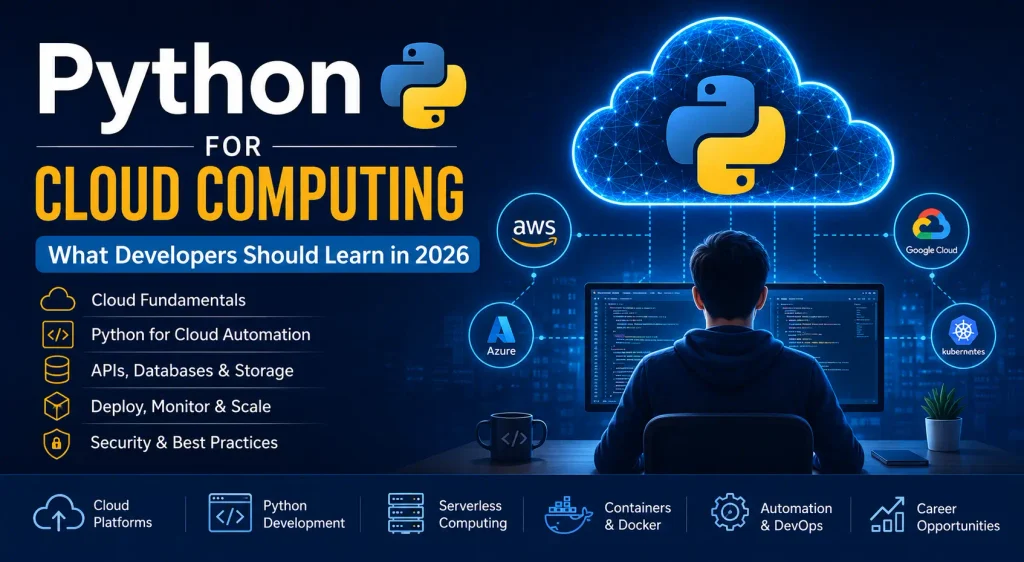
If you are a fresher, follow a step-by-step roadmap instead of trying to learn everything at once.
1: Learn Python fundamentals.
2: Practice problem-solving and write small programs.
3: Learn object-oriented programming and databases.
4: Learn Git and basic Linux commands.
5: Understand cloud computing fundamentals.
6: Choose AWS, Azure, or Google Cloud.
7: Learn the selected platform’s core services.
8: Learn Python SDKs and cloud APIs.
9: Learn Docker and basic CI/CD.
10: Build two or three Python cloud projects.
11: Document your projects on GitHub.
12: Prepare your resume and practice technical interviews.
This roadmap allows freshers to build skills gradually without becoming overwhelmed.
Learning Python cloud computing can support several career paths.
Depending on your skills and experience, you can explore roles such as:
However, learning Python alone does not guarantee a job. Employers usually look for practical problem-solving ability, projects, cloud knowledge, communication skills, and an understanding of software development practices.
Therefore, focus on building demonstrable skills rather than simply collecting course certificates.
For beginners, practical learning can make a major difference. CloudData Technologies’ Python program focuses on hands-on training, real-time projects, flexible batches, and placement support. The course also covers Python fundamentals, web development, data analysis, automation, and related practical skills.
The institute’s 2026 Python training content also positions Python learning toward real-world projects and career preparation for fresh graduates.
For a fresher, this type of project-based learning can provide a structured path from basic Python programming toward more advanced development skills.
Python for cloud computing is a valuable skill combination for developers entering the technology industry in 2026. Python provides an approachable programming foundation, while cloud computing introduces developers to scalable applications, APIs, automation, containers, databases, and modern deployment practices.
You do not need to learn every cloud platform immediately. Start with strong Python fundamentals, choose one cloud provider, learn its core services, and gradually add Docker, APIs, Git, CI/CD, security, and automation.
Most importantly, build real projects. A portfolio that demonstrates how you use Python to solve practical cloud problems can make your skills easier for recruiters to evaluate.
For freshers who want to start their journey, Python cloud computing can become a strong foundation for building a career in software development, cloud engineering, automation, DevOps, data, and AI.
Yes. Python is widely used for cloud applications, automation, APIs, data processing, and cloud service integrations. Major cloud providers provide Python SDKs and development resources.
Yes. Freshers can start with Python fundamentals and gradually learn cloud computing. Prior professional experience is not required, although consistent coding practice and project work are important.
AWS, Azure, and Google Cloud are all useful options. Beginners should choose one platform first, learn its fundamentals, and build projects before expanding into additional platforms.
Python is an important skill, but it is not enough by itself. A cloud developer should also understand cloud services, APIs, databases, networking basics, Git, containers, deployment, and security.
Important skills include Python fundamentals, object-oriented programming, APIs, automation, databases, testing, cloud SDKs, Docker, Git, Linux, and basic CI/CD.
CloudData Technologies offers Python training in Chennai with hands-on projects, practical learning, flexible batches, and placement support. Its Python course is designed for beginners as well as learners who want to build job-ready skills.