Data is now one of the most valuable resources for modern businesses. Companies use data to understand customers, improve products, predict trends, automate decisions, and increase revenue. As a result, data science continues to offer exciting career opportunities for graduates and freshers who want to enter the technology industry.
Among the many programming languages available, Python for Data Science remains a popular choice because it combines simple syntax with a large ecosystem of data analysis, visualization, machine learning, and artificial intelligence libraries. Python’s official documentation continues to support a broad ecosystem for programming, third-party packages, and scientific applications.
For freshers, learning Python can therefore provide a strong foundation for careers in data science, data analytics, machine learning, and AI. However, knowing basic Python alone is not enough. You need to develop practical skills, learn the right tools, work with real datasets, and build projects that demonstrate your abilities.
This guide explains the essential Python data science skills, tools, libraries, career opportunities, and learning roadmap you should know in 2026.
Python has become an important part of the data science ecosystem because it makes complex programming tasks easier to understand and implement. Beginners can start with basic programming concepts and gradually move toward data analysis, visualization, machine learning, and AI.
Python also provides libraries for almost every stage of the data science workflow. For example, pandas provides DataFrame and Series structures for working with tabular and other forms of data, while scikit-learn provides tools for predictive data analysis and machine learning.
For freshers, this ecosystem creates a practical learning path:
Python basics → Data handling → Data visualization → Statistics → Machine learning → Projects → Job preparation
Moreover, Python skills can open doors to several technology roles instead of limiting you to one career path.
Python for Data Science refers to using Python programming and its supporting libraries to collect, clean, analyze, visualize, and model data.
A typical data science workflow may include:
Therefore, Python acts as a common programming foundation across many of these activities.
Before learning advanced data science concepts, freshers should build strong Python fundamentals.
Start with the core concepts, including:
These concepts form the foundation for writing efficient Python programs.
Cloud Data Technologies’ Python training also starts learners with fundamentals such as variables, loops, functions, and conditional statements before progressing to more advanced concepts.
Next, learn object-oriented programming concepts such as classes, objects, inheritance, encapsulation, and polymorphism.
Although you may not use every OOP concept extensively in beginner data analysis projects, understanding them helps you read and maintain professional Python code.
You should also understand how Python stores and processes information. Practice using lists, dictionaries, sets, tuples, and other data structures.
At the same time, solve programming problems regularly. This improves logical thinking and prepares you for technical interviews.
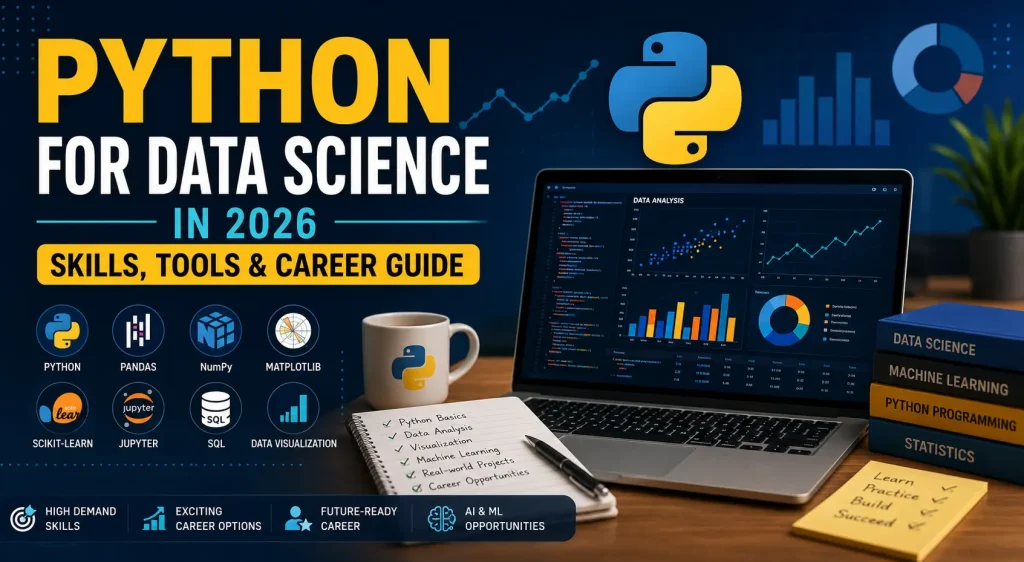
Learning the right Python data science libraries is essential for becoming job-ready.
NumPy
NumPy provides powerful numerical computing capabilities and forms an important foundation for many scientific Python tools.
You can use NumPy for:
Because many data science libraries work with numerical arrays, understanding NumPy is highly valuable.
Pandas
Pandas is one of the most important tools for Python data analysis. Its DataFrame and Series structures make it easier to manipulate and analyze structured datasets. The official pandas documentation highlights capabilities such as missing-data handling, grouping, merging, reshaping, time-series operations, and file input/output.
Freshers should practice:
Matplotlib and Seaborn
Data visualization helps you communicate insights clearly.
With visualization libraries, you can create:
Consequently, visualization skills help transform raw numbers into understandable business insights.
Scikit-Learn
Once you understand data analysis, you can move into machine learning.
Scikit-learn provides tools for classification, regression, clustering, dimensionality reduction, preprocessing, model selection, and evaluation.
Freshers can begin with algorithms such as:
The goal should not be to memorize every algorithm. Instead, understand when to use each approach and how to evaluate the results.
Python is only one part of a complete data science skill set. Therefore, freshers should also become comfortable with supporting tools.
Jupyter Notebook
Jupyter Notebook provides an interactive environment where you can write Python code, analyze data, create visualizations, and document your work.
It is particularly useful when learning data science because you can execute code step by step and immediately examine the results.
SQL
SQL is another important skill for aspiring data professionals. Most business data resides in databases, so understanding SQL helps you retrieve and manipulate the data required for analysis.
Learn concepts such as:
Combining Python and SQL for data science can significantly strengthen your technical profile.
Git and GitHub
Learn Git for version control and GitHub for presenting your projects.
Create repositories for your Python data science projects and include:
This gives recruiters an easy way to evaluate your practical skills.
If you are starting from zero, follow a structured roadmap instead of trying to learn everything simultaneously.
Step 1: Learn Python Basics
Spend time understanding programming fundamentals. Write small programs and solve simple problems regularly.
Step 2: Learn NumPy and Pandas
Next, move into data manipulation. Work with CSV, Excel, and other datasets.
Step 3: Learn Data Visualization
Practice creating charts and explaining what the charts reveal about the data.
Step 4: Learn Statistics
Understand basic concepts such as:
Statistics helps you make better decisions from data.
Step 5: Learn Machine Learning
After building a strong foundation, learn supervised and unsupervised machine learning.
Start with simple algorithms before moving into more advanced techniques.
Step 6: Build Projects
Projects are extremely important for freshers. Instead of only completing tutorials, solve practical problems using real datasets.
Step 7: Prepare for Interviews
Finally, revise Python, SQL, statistics, data analysis, machine learning concepts, and project explanations.
Projects can help you demonstrate practical knowledge when you have limited professional experience.
Consider building projects such as:
Sales Data Analysis
Analyze sales records to identify top products, revenue trends, customer behavior, and monthly performance.
Customer Churn Prediction
Use customer information to build a machine learning model that predicts whether customers are likely to leave a service.
House Price Prediction
Create a regression model that predicts property prices using factors such as location, size, number of rooms, and other available features.
E-Commerce Analysis
Analyze customer orders to discover purchasing patterns, popular products, average order values, and customer segments.
Movie Recommendation System
Build a basic recommendation system that suggests movies based on user preferences or similarities between movies.
These projects allow you to practice Python, Pandas, NumPy, visualization, statistics, and machine learning in a practical environment.
Learning Python for data science can lead to several career paths.
Freshers can explore roles such as:
However, job titles and requirements vary between companies. Therefore, focus on developing transferable skills rather than preparing for only one job title.
For example, strong Python, SQL, data analysis, visualization, statistics, and machine learning knowledge can support multiple entry-level career paths.
Knowing concepts is only the beginning. To become job-ready, you should combine learning with consistent practice.
First, write Python code every day. Even 30–60 minutes of practice can help you improve your programming confidence.
Next, work with real datasets instead of only following tutorials. Clean the data, analyze it, visualize the results, and explain your findings.
Also, build at least two or three complete projects. Publish them on GitHub and maintain clear documentation.
Furthermore, prepare a resume that highlights your technical skills and projects. During interviews, be ready to explain why you selected a particular approach, how you handled data problems, and what conclusions you reached.
Cloud Data Technologies emphasizes hands-on training, real-time projects, and placement support in its Chennai Python program, with learning that covers data analysis using Pandas and NumPy alongside other Python applications.
For freshers, the biggest challenge is often the gap between theoretical knowledge and practical application.
You may understand what Pandas does, for example, but employers want to know whether you can actually use it to clean and analyze a dataset.
That is why practical training can be valuable. A structured program can help you learn concepts, practice coding, complete projects, and receive guidance from trainers.
Cloud Data Technologies offers Python training in Chennai with hands-on practice, real-time projects, flexible batches, and placement support. Its curriculum progresses from Python fundamentals to data analysis, automation, and application development.
Python for Data Science in 2026 offers freshers a practical entry point into the growing world of data, analytics, machine learning, and AI. However, simply learning Python syntax will not make you job-ready.
Instead, build a complete skill set that combines Python programming, NumPy, Pandas, data visualization, SQL, statistics, machine learning, Git, and real-world projects.
Start with the basics, practice consistently, and gradually move toward advanced concepts. Most importantly, build projects that demonstrate how you solve real problems with data.
If you are a fresher planning to start a career in technology, learning Python with a data science focus can give you a strong foundation for multiple career opportunities. With consistent practice and the right roadmap, you can turn your Python knowledge into practical, job-ready skills.
Is Python good for Data Science in 2026?
Yes. Python remains widely used for data analysis, machine learning, and scientific computing, supported by a mature ecosystem of libraries and tools.
Can a fresher learn Python for Data Science?
Yes. Freshers can start with basic Python programming and gradually learn Pandas, NumPy, visualization, statistics, SQL, and machine learning.
Do I need coding experience to learn Python for Data Science?
No. Beginners can start with Python fundamentals and progress step by step. A structured learning path makes the process easier.
Which Python libraries should I learn first?
Start with NumPy and Pandas, then learn visualization libraries such as Matplotlib and Seaborn. After that, move into scikit-learn for machine learning.
Is SQL necessary for Data Science?
SQL is highly useful because data professionals frequently work with databases. Learning SQL alongside Python can make your profile stronger.
How can I get a Python Data Science job as a fresher?
Build strong Python and SQL fundamentals, learn data science libraries, practice statistics and machine learning, create real-world projects, publish your work on GitHub, and prepare thoroughly for technical interviews.