Starting a career in software development can feel overwhelming for freshers. There are hundreds of programming languages, frameworks, tools, and technologies to choose from. However, Python Full Stack Development has become an attractive career path because it combines a beginner-friendly programming language with powerful backend, frontend, database, and API technologies.
A well-structured Python Full Stack Course can help freshers move from basic programming concepts to building complete web applications. Instead of learning isolated technologies, students can understand how different components work together to create modern software applications.
For freshers who want practical IT skills, choosing the right Python Full Stack Course is an important first step. So, what should you learn, and how can you prepare yourself for a developer career?
Python Full Stack Development involves developing both the frontend and backend components of a web application.
The frontend is the part users see and interact with. Developers commonly use technologies such as:
The backend handles application logic, databases, authentication, APIs, and server-side operations. Python developers commonly use frameworks such as Django or Flask for backend development.
In addition, a full stack developer should understand databases, REST APIs, version control, testing, deployment, and basic cloud concepts.
Therefore, a Python Full Stack Developer Course should not focus only on Python programming. Instead, it should provide a complete learning path covering frontend, backend, databases, APIs, projects, and development tools.
Python has a relatively simple and readable syntax, which makes it suitable for beginners. At the same time, it supports professional development across web applications, automation, data-related applications, and AI-based solutions.
CloudData Technologies’ Python training content emphasizes starting with programming fundamentals and progressively moving toward advanced concepts, web development, databases, automation, and practical projects.
For freshers, this approach offers several advantages.
Python allows beginners to understand programming concepts without dealing with unnecessarily complex syntax.
You can start with variables, data types, conditions, loops, functions, and gradually move toward object-oriented programming.
Python skills can support career paths such as:
Furthermore, Python connects well with areas such as data analytics, artificial intelligence, and automation.
Full stack training teaches you how different technologies work together. As a result, you can move beyond writing individual programs and learn how to develop complete applications.
Projects give freshers something concrete to demonstrate during interviews. A good Python Full Stack Course for Freshers should therefore include practical assignments and real-world projects.
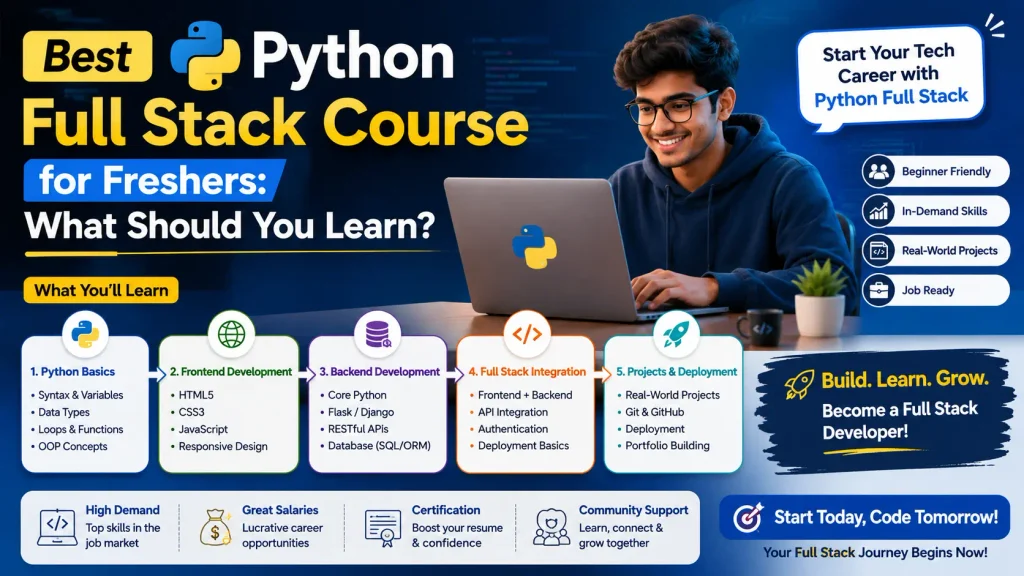
Choosing a course becomes easier when you understand the essential skills. A comprehensive curriculum should gradually take you from programming fundamentals to application development.
First, learn the fundamentals of Python.
Important topics include:
These concepts create the foundation for everything you build later.
Next, learn Object-Oriented Programming (OOP).
You should understand:
OOP helps developers organize applications into reusable and maintainable components.
Therefore, freshers should not rush through this section. Strong Python fundamentals make it easier to learn frameworks and work on larger projects.
After learning Python, move to frontend development.
HTML creates the structure of a web page, while CSS controls its appearance and layout.
You should learn:
These skills help you understand how websites are constructed before you move into JavaScript and frontend frameworks.
Next, learn JavaScript because modern web applications require interactive frontend functionality.
A beginner-friendly curriculum should cover:
Understanding JavaScript also makes it easier to learn React.
A modern Python Full Stack Course can include React to help students develop dynamic user interfaces.
You should learn concepts such as:
React works well with Python-based backends because the frontend and backend can communicate through APIs.
Now comes one of the most important parts of Python full stack development: backend development.
Django provides a structured framework for building web applications, while Flask offers a lightweight approach.
Students should understand:
CloudData Technologies’ existing Python training material includes web development using Flask or Django as part of its progression from fundamentals to practical development.
A developer also needs to understand how applications store and retrieve information.
A Python Full Stack curriculum should introduce databases such as:
Important concepts include:
You should also understand how Python applications communicate with databases.
APIs connect different parts of an application.
For example, a React frontend can send a request to a Python backend through an API. The backend processes the request, communicates with the database, and returns the required information.
Freshers should learn:
This knowledge is particularly valuable when developing real-world applications.
In addition to programming languages and frameworks, you should become comfortable with common development tools.
Git helps developers track changes in their code. GitHub allows them to store and collaborate on projects.
Learn basic commands such as:
You should also learn how to create a professional GitHub portfolio.
Visual Studio Code is widely used for software development. Freshers should learn how to create projects, manage files, install extensions, use terminals, and debug applications.
Tools such as Postman can help you test REST APIs and understand how frontend and backend systems communicate.
Learning concepts is important, but building projects is what turns knowledge into practical ability.
For example, instead of only learning Django theoretically, you could build a complete application using Python, Django, React, and a database.
Good beginner-to-intermediate project ideas include:
Student Management System
Build an application that allows administrators to add, update, search, and delete student information.
Online Shopping Application
Create product pages, user registration, login, shopping carts, orders, and payment-related workflows.
Job Portal
Develop a platform where recruiters can post jobs and candidates can create profiles and apply for opportunities.
Expense Tracker
Build an application that allows users to record expenses and view spending information through dashboards.
Projects like these help freshers demonstrate programming, database, frontend, backend, and API skills.
CloudData Technologies also emphasizes hands-on learning and real-time projects in its Python training approach, along with interview guidance and placement support.
Not every course provides the same learning experience. Before enrolling, compare the curriculum and training approach.
Look for a course that provides:
Practical coding: You should write code regularly rather than only watching lectures.
Complete curriculum: The course should cover Python, frontend development, backend frameworks, databases, APIs, Git, and projects.
Real-time projects: Projects should simulate real development scenarios.
Experienced trainers: Trainers should be able to explain concepts using practical examples.
Interview preparation: Freshers should receive support with technical interviews, coding questions, resumes, and communication.
Flexible learning: Weekday, weekend, online, or fast-track options can make training easier to manage.
Certification: A course completion certificate can add supporting evidence of your training to your resume.
CloudData Technologies currently highlights hands-on training, flexible batches, real-time projects, certification, and placement support in its Python training offering.
Work on real-time projects such as e-commerce websites, employee management systems, portfolio applications, and REST APIs. Practical projects help freshers strengthen their resumes and demonstrate their development skills.
Get guidance on resume preparation, interview skills, coding assessments, and technical interviews. The course is designed to help freshers become job-ready for roles such as Python Developer, Full Stack Developer, Web Developer, and Junior Software Developer.
For freshers in Chennai, CloudData Technologies provides career-oriented software training with a practical focus. Its Python training starts with fundamentals and progresses toward advanced concepts, web development, databases, automation, and projects.
The institute also offers online and offline learning options and focuses on practical exposure. Its broader training approach emphasizes real-time projects, expert guidance, interview preparation, and career support.
Students can therefore use the training to build technical foundations while developing projects that they can showcase during interviews.
The learning time depends on your existing knowledge, practice schedule, and course structure.
A beginner can follow a progressive learning path:
1: Python fundamentals
2: Advanced Python and OOP
3: HTML, CSS, and JavaScript
4: React
5: Django or Flask
6: SQL and databases
7: REST APIs
8: Git, testing, and deployment basics
9: Real-time projects
10: Resume and interview preparation
However, completing a course alone does not make someone job-ready. Consistent coding practice and project development are equally important.
After developing the required skills, freshers can explore several entry-level roles.
Potential positions include:
Furthermore, Python can provide a foundation for learning emerging areas such as AI application development and automation. CloudData Technologies also highlights Python’s relevance to web development, automation, data analysis, and AI-related technologies.
Choosing the best Python Full Stack Course can give freshers a structured path into software development. However, the right course should go beyond basic Python programming.
You should learn Python, OOP, HTML, CSS, JavaScript, React, Django or Flask, SQL, databases, REST APIs, Git, and practical development tools. Most importantly, you should build real-world projects and develop a portfolio that demonstrates your abilities.
If you are a fresher starting from zero, focus on fundamentals first. Then, gradually move into frontend and backend development. Finally, combine everything into complete applications.
With consistent practice, practical projects, and proper guidance, a Python Full Stack Course for Freshers can help you build the technical foundation needed to begin your software development career.
Ready to start your Python Full Stack journey? Explore Python training opportunities at CloudData Technologies and take the next step toward becoming a job-ready developer.
Visit CloudData Technologies to explore available training options, course details, and enrollment information.