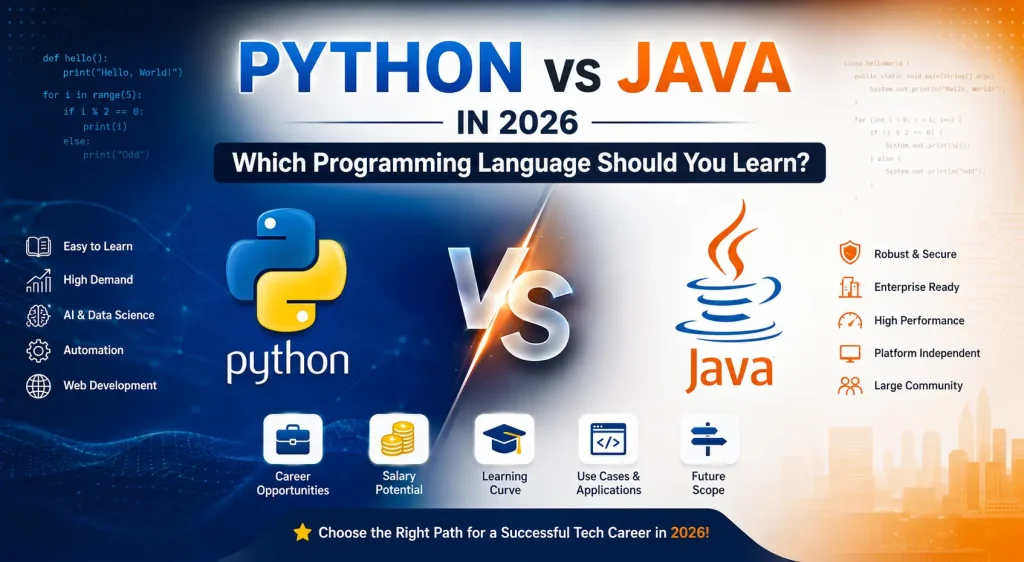
Choosing the right programming language can be a major decision for freshers starting a technology career. Among the many programming languages available today, Python vs Java remains one of the most popular comparisons for students and aspiring developers. Both languages have strong ecosystems, excellent career opportunities, and applications across different industries. However, they serve different purposes and have different learning curves.
In 2026, Python continues to attract beginners because of its simple syntax and wide use in artificial intelligence, machine learning, data science, automation, and web development. Python 3.14 is currently the latest feature-release series, with Python 3.14.6 released in June 2026. Meanwhile, Java continues to play an important role in enterprise applications, backend development, cloud systems, and large-scale software. Oracle lists JDK 26 as the latest Java SE release and JDK 25 as the latest Long-Term Support release.
So, Python vs Java in 2026: which one should a fresher learn? The answer depends on your career goals, interests, and the type of software you want to build.
Python is a high-level, general-purpose programming language known for its readable syntax and developer-friendly approach. Beginners can understand Python code relatively quickly because the language uses fewer lines of code for many common programming tasks.
Python has become especially popular in areas such as:
Python’s ecosystem also includes popular frameworks and libraries such as Django, Flask, FastAPI, NumPy, Pandas, TensorFlow, and PyTorch.
Furthermore, Python continues to evolve. Python 3.14 introduced several important improvements, including officially supported free-threaded Python, template string literals, multiple interpreters in the standard library, and the new compression.zstd module.
Java is a general-purpose, object-oriented programming language that has been widely used for enterprise and backend software development for decades. Its mature ecosystem makes it a popular choice for large applications that require scalability, reliability, and long-term maintenance.
Java is commonly used for:
Java also continues to receive regular updates. In 2026, JDK 26 is the latest Java SE release, while JDK 25 provides the current Long-Term Support release.
Therefore, Java remains a strong option for freshers who want to build a career in enterprise software and backend development.
Understanding the differences between Python and Java can help beginners choose the language that matches their career goals.
| Feature | Python | Java |
|---|---|---|
| Learning curve | Easier for beginners | Moderate |
| Syntax | Simple and concise | More structured and verbose |
| Programming style | Multi-paradigm | Primarily object-oriented |
| Performance | Generally slower | Generally faster |
| AI and ML | Excellent | Limited compared with Python |
| Data science | Excellent | Less commonly preferred |
| Enterprise applications | Strong | Excellent |
| Backend development | Strong | Excellent |
| Automation | Excellent | Good |
| Large-scale applications | Strong | Excellent |
| Beginner friendly | Very high | Moderate |
The comparison shows that neither language is universally better. Instead, each language has specific strengths.
For most freshers, Python offers an easier starting point. Its syntax is relatively simple, allowing students to focus on programming concepts instead of spending too much time understanding complex syntax.
For example, beginners can quickly learn variables, loops, functions, lists, dictionaries, and conditional statements in Python. As a result, students can start building small projects earlier.
Java, on the other hand, introduces concepts such as classes, objects, methods, interfaces, and strong type systems more explicitly. Although this can make Java feel more difficult initially, it can also help students develop a strong foundation in object-oriented programming.
Therefore, if your priority is learning programming quickly, Python may be the better first language. If you want to develop a deeper understanding of structured object-oriented development, Java can be an excellent choice.
Career opportunities are an important factor when comparing Python vs Java.
Python supports a broad range of modern technology roles. Freshers who learn Python can explore career paths such as:
Java also offers strong career opportunities, particularly in enterprise and backend development. Common roles include:
However, the language alone does not guarantee employment. Employers generally look for programming fundamentals, problem-solving skills, databases, Git, APIs, frameworks, projects, and communication skills.
Consequently, freshers should focus on developing practical skills rather than simply completing a programming course.
If your goal is to enter artificial intelligence or machine learning, Python has a significant advantage.
Python provides a large collection of libraries and frameworks for AI and data-related development. Developers commonly use Python with tools such as Pandas, NumPy, Scikit-learn, TensorFlow, and PyTorch.
Moreover, Python’s simple syntax makes it convenient for experimenting with algorithms, processing datasets, creating machine learning models, and developing AI applications.
Java can also be used for machine learning and AI applications. However, Python is generally the more convenient choice for students who specifically want to enter AI, machine learning, data science, or generative AI.
Therefore, for an AI-focused career in 2026, Python is usually the stronger starting point.
Both Python and Java are capable web development technologies.
Python developers commonly use Django, Flask, and FastAPI to create web applications and APIs. FastAPI, in particular, is popular for building modern Python-based APIs and backend services.
Java developers frequently use frameworks such as Spring and Spring Boot for enterprise backend development and microservices.
So, which one should you choose?
If you want a simpler entry into backend development, Python can be a good option. On the other hand, if you are targeting enterprise software, large-scale backend systems, or Java-based organizations, Java and Spring Boot can provide a strong career path.
Performance is another important difference.
Java is generally known for strong runtime performance and is widely used for large-scale applications where efficiency and scalability matter. Its mature ecosystem and JVM also make it suitable for enterprise workloads.
Python prioritizes developer productivity and simplicity. Although it may not match Java in raw execution speed for every workload, Python remains highly effective for automation, AI, data science, scripting, APIs, and many modern applications.
Therefore, beginners should not choose a language based only on performance benchmarks. Instead, consider the type of applications you want to build.
For freshers, choosing between Python and Java should start with a simple question: What career do you want to build?
Choose Python if you are interested in:
Choose Java if you are interested in:
However, you do not necessarily need to learn both languages immediately. Beginners often make the mistake of trying to learn several programming languages at the same time. Instead, focus on one language, understand programming fundamentals, and build real projects.
Both Python and Java can lead to successful technology careers.
Python has a strong position in emerging fields such as AI, machine learning, data science, and automation. Java continues to have strong relevance in enterprise software, backend systems, cloud applications, and large organizations.
As a result, the better language depends on your specialization.
For example, a fresher interested in AI and data science may benefit more from Python. Meanwhile, someone targeting enterprise backend development may find Java more suitable.
Most importantly, employers value practical ability. Learning syntax is only the first step. You should also learn databases, APIs, Git, testing, frameworks, debugging, and software development practices.
If you are completely new to programming and want a language that is easy to start with, Python is a strong choice in 2026.
If you already know programming fundamentals and want to pursue enterprise backend development, Java remains an excellent choice.
For freshers who are unsure about their specialization, Python can provide a flexible starting point because you can later move into web development, automation, data analytics, AI, or machine learning.
Nevertheless, Java should not be considered outdated. Its continued releases and current LTS ecosystem demonstrate that it remains actively maintained and relevant.
Learning Python syntax alone is not enough to become a Python developer. Freshers should follow a structured learning path.
Start with Python fundamentals, including variables, data types, operators, loops, functions, modules, exception handling, and object-oriented programming.
Next, learn:
After learning the fundamentals, build projects that demonstrate your skills. For example, you could create an expense tracker, job portal, e-commerce API, student management system, automation tool, or AI-powered application.
This practical approach can make your resume more valuable than simply listing Python as a skill.
Java learners should also develop skills beyond basic syntax.
Start with Java fundamentals and gradually learn object-oriented programming, collections, exception handling, multithreading, file handling, and modern Java features.
Then move into:
Building projects with Java and Spring Boot can help freshers demonstrate practical backend development skills.
So, Python vs Java: which programming language should you learn in 2026?
There is no single answer for everyone.
Choose Python if you want an easier learning curve and are interested in AI, machine learning, data science, automation, or modern Python development.
Choose Java if your goal is enterprise software, backend development, Spring Boot, microservices, or large-scale application development.
For most freshers who are completely new to programming, Python is an excellent starting point. Its readable syntax and broad application areas make it easier to begin building projects and exploring different technology careers. At the same time, Java remains a valuable skill for enterprise and backend-focused careers.
Ultimately, the best programming language is the one you learn deeply and apply consistently. Instead of asking only “Python vs Java which is better?”, ask “Which technology matches my career goal?” Once you answer that question, choose one language, follow a structured roadmap, build practical projects, and continuously improve your skills.
Is Python better than Java in 2026?
Python is better for many beginners and for careers in AI, machine learning, data science, and automation. Java can be better for enterprise and backend development. Your career goal should determine your choice.
Should freshers learn Python or Java?
Freshers who want an easier introduction to programming can start with Python. Those interested in enterprise applications and Java backend development can choose Java.
Which is easier, Python or Java?
Python is generally easier for beginners because its syntax is concise and readable. Java has a more structured syntax and introduces object-oriented concepts more explicitly.
Is Python good for jobs in 2026?
Yes. Python remains highly relevant across AI, data science, automation, web development, and software engineering.
Is Java still worth learning in 2026?
Yes. Java remains an important technology for enterprise applications, backend systems, cloud software, and large-scale development. Oracle continues to release new Java versions, with JDK 25 serving as the current LTS release in 2026.
Can I learn Python and Java together?
You can eventually learn both, but beginners should generally focus on one language first. Once you understand programming fundamentals, adding the second language becomes easier.