Artificial intelligence is changing the way developers build software. Instead of creating applications that only follow fixed instructions, developers can now build intelligent systems that understand goals, make decisions, use tools, and complete tasks with limited human intervention. This new approach is driving the growth of AI agents and agentic AI.
For freshers who want to enter the technology industry, learning Python with AI agents can be a valuable career direction in 2026. Python already plays an important role in artificial intelligence, machine learning, automation, data science, and application development. By combining Python programming skills with AI agent concepts, beginners can learn how to create smarter and more useful applications.
In this guide, we will explore what AI agents are, why Python is useful for AI agent development, what skills freshers should learn, and how to build practical AI-powered applications.
An AI agent is a software system that can understand a task, decide what actions to take, use available tools, and work toward a specific goal.
Traditional software usually follows a predefined sequence:
Input → Rules → Processing → Output
AI agents can follow a more flexible process:
Goal → Understand → Plan → Use Tools → Take Action → Evaluate → Complete Task
For example, a traditional chatbot may answer a user’s question. An AI agent, however, can understand the request, search relevant information, analyze the results, call another application, and provide a final response.
As a result, AI agents can support applications such as customer service assistants, research assistants, coding assistants, workflow automation systems, data analysis tools, and business support applications.
Python has become a popular language for AI and machine learning because it offers simple syntax, a large developer community, and a broad ecosystem of libraries and frameworks.
When you learn Python with AI agents, you combine programming fundamentals with modern artificial intelligence concepts.
Python can help developers work with:
Therefore, Python provides a practical foundation for beginners who want to move toward AI agent development.
CloudData Technologies also positions Python training around practical learning, moving from programming fundamentals toward areas such as web development, data analysis, automation, and AI-related projects.
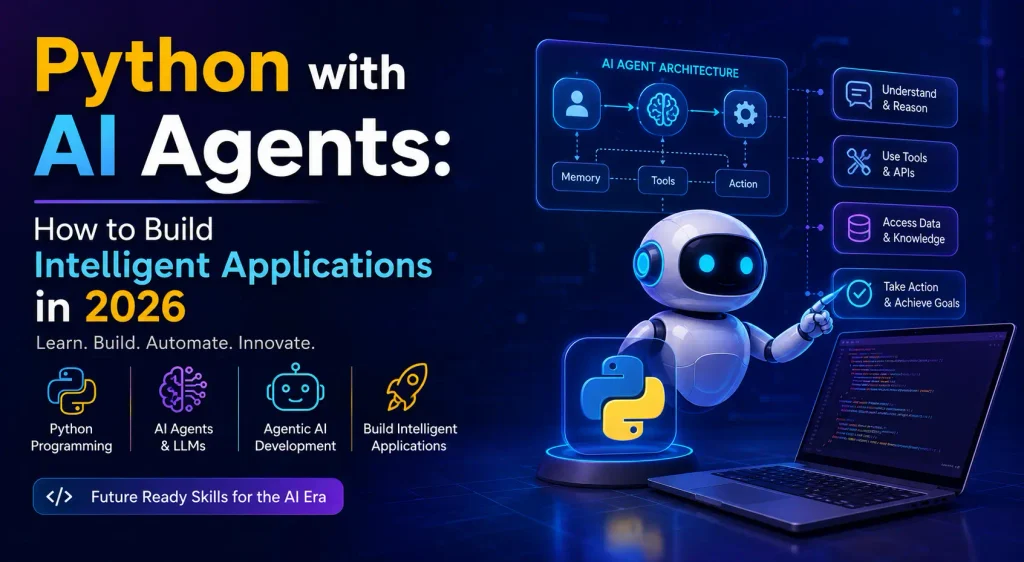
Understanding the basic architecture can make AI agents easier for freshers to learn.
A typical Python AI agent may contain several components.
First, the user provides a goal or question. The application receives this input through a website, chatbot, mobile application, or another interface.
Next, the agent sends the request to an AI model. The model helps the application understand the user’s intention and determine what should happen next.
The agent can break a complex task into smaller steps. Instead of attempting everything at once, it can determine which actions are necessary.
An AI agent may use external tools such as APIs, databases, search systems, calculators, or business applications.
Some agent applications maintain relevant information from previous interactions. This helps the system respond more effectively during a multi-step task.
Finally, the agent performs actions and evaluates the results. If the result does not satisfy the goal, the system can take another
You do not need to become an AI expert before starting. However, you should build your Python foundation first.
Start with:
These concepts help you write clean and reusable programs.
Next, learn classes, objects, inheritance, encapsulation, and other object-oriented programming concepts.
AI applications can contain multiple components. Therefore, object-oriented programming can help you organize larger projects more effectively.
AI agents frequently communicate with external services. For this reason, freshers should understand REST APIs, HTTP requests, JSON data, authentication, and API responses.
Python libraries such as requests can help developers communicate with external services.
Learn how to read, process, filter, and transform data. Basic knowledge of libraries such as Pandas and NumPy can also help when you work with AI and data-driven applications.
AI applications often need to retrieve or store information. Therefore, SQL and basic database concepts can strengthen your AI development skills.
Finally, learn Git and GitHub. They help you manage source code, collaborate with developers, and showcase your projects to potential employers.
Agentic AI refers to AI systems that can take actions toward a goal rather than simply generating a response.
For example, imagine a travel assistant.
A basic AI application may provide suggestions for a trip.
An AI agent could potentially:
This ability to perform multiple steps makes agentic AI different from simple question-and-answer systems.
Consequently, learning Python for agentic AI can help freshers understand how modern intelligent applications are designed.
AI agents can support many industries and use cases.
AI agents can understand customer questions, retrieve relevant information, and assist support teams.
Coding agents can help developers analyze code, generate code suggestions, identify problems, and automate repetitive development tasks.
AI can combine Python data-processing capabilities with AI reasoning to help users explore datasets and generate insights.
Businesses can use intelligent agents to automate repetitive workflows involving documents, emails, reports, and internal systems.
AI agents can help organize information, summarize documents, compare data, and support research workflows.
Intelligent assistants can help users organize tasks, create drafts, summarize information, and manage repetitive activities.
As AI systems become more capable, the focus is shifting from simply generating content toward completing useful multi-step workflows.
Freshers should first understand Python fundamentals before jumping into advanced frameworks. Once the basics are strong, they can explore tools used for AI application development.
Depending on the project, developers may work with:
The exact framework you choose should depend on your application. More importantly, you should understand the concepts behind agents rather than memorizing framework-specific commands.
Start with a simple application. Then gradually introduce tool calling, memory, retrieval, multiple steps, and evaluation.
Freshers can follow a simple learning roadmap.
Build a strong foundation in Python syntax, functions, data structures, modules, and object-oriented programming.
Learn how Python applications communicate with external services.
Understand concepts such as prompts, tokens, context, embeddings, language models, and model responses.
Start with a basic question-answer application. This allows you to understand how an application communicates with an AI model.
Next, connect your application to a calculator, database, API, or another useful tool.
Allow the application to decide which tool it needs and what action it should take.
Test different inputs and identify incorrect responses, unnecessary actions, and unexpected behavior.
Finally, create a complete project that demonstrates your Python, AI, API, database, and problem-solving skills.
Projects can make your resume stronger because they demonstrate practical skills.
Here are some project ideas:
Create an application that analyzes a resume, identifies skills, and suggests improvements.
Build an agent that answers questions using a predefined knowledge base.
Create a system that organizes information and generates structured research summaries.
Build an application that converts natural-language questions into SQL queries and explains the results.
Create an agent that accepts a dataset, analyzes it with Python, and produces useful insights.
Build a beginner-friendly application that explains Python errors and suggests possible solutions.
These projects allow freshers to demonstrate both programming and AI skills.
The combination of Python and AI can open several technology career paths.
Depending on your interests and additional skills, you can explore roles such as:
However, learning a programming language alone does not guarantee a job. Freshers should combine Python with problem-solving, projects, databases, APIs, Git, AI fundamentals, and communication skills.
CloudData Technologies offers Python and Generative AI training with a practical, career-oriented approach, including hands-on projects and guidance for learners. Its Gen AI curriculum includes Python for AI, machine learning basics, LLMs, prompt engineering, and practical AI applications.
The technology industry continues to move toward intelligent automation and AI-powered applications. At the same time, developers need strong programming skills to connect AI models with real software systems.
That is why Python with AI agents is an interesting learning path for freshers.
Instead of learning AI only from a theoretical perspective, you can learn how to build applications that solve real problems.
Moreover, Python gives beginners an accessible entry point. Once you understand the basics, you can gradually progress into APIs, machine learning, LLMs, automation, and agentic AI.
Is Python good for AI agents?
Yes. Python provides a large ecosystem for AI, machine learning, automation, APIs, and application development. These capabilities make it suitable for building AI-powered applications and agents.
Can freshers learn Python AI agents?
Yes. Freshers can learn AI agents step by step. Start with Python programming, then learn APIs and AI fundamentals before moving into agent development.
Do I need machine learning knowledge to build AI agents?
You do not necessarily need advanced machine learning knowledge to begin building LLM-based AI applications. However, understanding basic AI and machine learning concepts will help you develop more effective systems.
What should I learn before AI agent development?
Start with Python programming, data structures, functions, object-oriented programming, APIs, JSON, databases, and Git. Then learn LLM and AI application concepts.
What projects should freshers build?
Freshers can build AI resume assistants, customer support agents, research assistants, AI SQL assistants, data analysis agents, and coding assistants.
Python with AI agents combines programming skills with modern artificial intelligence to create intelligent and goal-oriented applications. For freshers, the best approach is to learn progressively rather than trying to master every AI technology at once.
Start with Python fundamentals. Then learn APIs, databases, Git, AI concepts, and LLMs. After that, build simple AI applications and gradually introduce tools, memory, automation, and agent workflows.
Most importantly, focus on projects. A practical portfolio can demonstrate what you can actually build and how you solve problems.
If you are a fresher planning an AI-focused career in 2026, learning Python for AI agents can be a strong addition to your technology skill set. With consistent practice and real-world projects, you can build the foundation needed to move toward Python development, Generative AI, AI application development, and other emerging technology roles.
Ready to start your Python and AI journey? Explore practical Python and Generative AI learning opportunities with CloudData Technologies and build skills that align with modern AI application development.