The demand for Artificial Intelligence (AI) and Data Science professionals continues to grow rapidly across industries. From healthcare and finance to retail and technology, organizations rely on data-driven insights to make smarter decisions and improve business outcomes. As a result, many beginners are exploring a SQL career in Data Science as a pathway into these exciting fields.
While programming languages such as Python often receive significant attention, SQL remains one of the most important skills for aspiring data scientists and AI professionals. In fact, most companies expect candidates to have strong SQL knowledge because data is typically stored in relational databases. Before building machine learning models or creating predictive analytics solutions, professionals must first retrieve, organize, and analyze data using SQL.
In this guide, you will learn the essential SQL skills required for AI and Data Science careers and understand why mastering SQL can significantly improve your job prospects.
SQL, or Structured Query Language, is the standard language used to manage and retrieve data from databases. Since organizations collect vast amounts of structured data, professionals working in AI and Data Science use SQL daily to access and analyze information.
For example, a data scientist may need to examine customer purchasing behavior before building a recommendation system. Similarly, an AI engineer may need to extract training data from multiple databases before developing machine learning models.
Therefore, SQL serves as the foundation of data analysis and plays a critical role in every stage of the data science workflow.
Because of these advantages, SQL remains one of the most sought-after technical skills in the modern job market.
Before writing SQL queries, beginners must understand how databases work.
Key concepts include:
A strong understanding of these fundamentals helps professionals navigate complex datasets and design efficient queries.
Every aspiring data scientist should know how to retrieve information from databases using SQL queries.
Important commands include:
These commands allow users to filter, sort, and summarize data effectively.
For instance, businesses often use SQL queries to identify top-performing products, analyze customer demographics, and evaluate sales performance.
One of the most important SQL skills for Data Science is understanding joins.
Since information is usually stored across multiple tables, professionals must combine data to perform meaningful analysis.
Common joins include:
Data scientists frequently use joins to connect customer data, transaction records, product information, and operational metrics.
Without this skill, analyzing large datasets becomes difficult.
Aggregate functions help summarize large volumes of data.
Examples include:
These functions allow professionals to calculate important business metrics and identify trends.
For example, an analyst might calculate average customer spending or total monthly revenue using aggregate functions.
As a result, these functions form the foundation of data analysis and reporting.
AI and Data Science projects often require filtering data based on specific conditions.
Essential SQL skills include:
These tools help professionals focus on relevant data and eliminate unnecessary records before analysis.
Consequently, filtering improves data quality and analytical accuracy.
As datasets become more complex, professionals need advanced query techniques.
Subqueries allow users to perform calculations within another query.
For example, a data scientist might identify customers whose spending exceeds the average customer spending level.
Because real-world business problems often involve multiple layers of analysis, subqueries are highly valuable in AI and Data Science careers.
CTEs improve query readability and simplify complex SQL operations.
Benefits include:
Many modern organizations encourage the use of CTEs because they make SQL code cleaner and more understandable.
Therefore, learning CTEs can help beginners develop professional-level SQL skills.
Window functions are among the most powerful SQL features used in advanced analytics.
Popular functions include:
These functions enable professionals to perform sophisticated calculations without changing the structure of the dataset.
As a result, window functions are widely used in business intelligence, predictive analytics, and machine learning workflows.
Data quality directly affects the success of AI and machine learning projects.
Unfortunately, raw data often contains:
SQL provides powerful tools for cleaning and preparing data before analysis.
Since machine learning models depend on accurate information, data cleaning is an essential skill for every aspiring data scientist.
As organizations collect larger datasets, query performance becomes increasingly important.
Professionals should understand:
Optimized queries improve system performance and reduce processing time.
Therefore, companies highly value candidates who can write efficient SQL code.
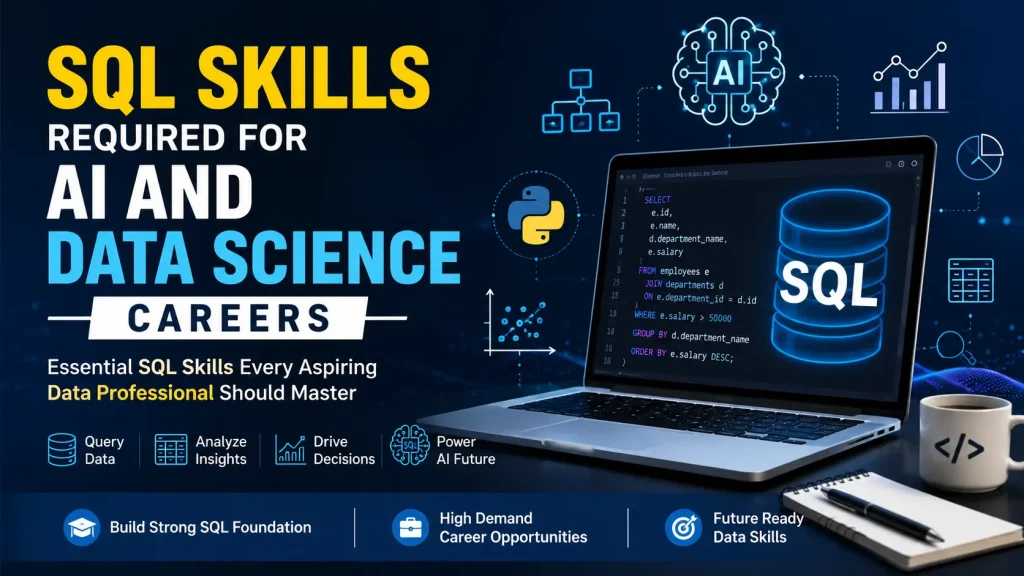
Many beginners assume machine learning relies only on Python. However, SQL plays an equally important role in preparing datasets for machine learning models.
Before training algorithms, professionals must:
SQL handles these tasks efficiently.
Consequently, strong SQL skills can significantly improve machine learning project outcomes.
Learning SQL opens doors to numerous career paths.
Popular roles include:
Because data continues to drive business decisions worldwide, demand for SQL professionals remains exceptionally strong.
This makes a SQL career in Data Science an excellent choice for beginners seeking long-term growth and stability.
If you are new to Data Science, follow these steps:
Step 1: Learn Database Basics
Understand tables, relationships, and database structures.
Step 2: Practice Basic Queries
Master SELECT, WHERE, ORDER BY, and GROUP BY commands.
Step 3: Learn Joins and Subqueries
Develop the ability to work with multiple datasets.
Step 4: Explore Advanced SQL
Study window functions, CTEs, and optimization techniques.
Step 5: Build Real Projects
Work on business datasets and create analytical reports.
Step 6: Combine SQL with Python
Learning SQL and Python together creates a powerful foundation for AI and Data Science careers.
SQL remains one of the most valuable skills for anyone pursuing a career in AI and Data Science. While machine learning frameworks and programming languages continue to evolve, organizations still rely on SQL to access, manage, and analyze data efficiently.
By mastering database fundamentals, SQL queries, joins, aggregate functions, window functions, and data cleaning techniques, beginners can build a strong foundation for a successful SQL career in Data Science. Furthermore, combining SQL expertise with analytics and machine learning skills can unlock exciting opportunities in today’s data-driven world.
Whether you aspire to become a data analyst, data scientist, AI engineer, or machine learning professional, investing time in SQL today can help you achieve your career goals tomorrow.