Choosing the right Salesforce Cloud can significantly impact your business growth, customer relationships, and operational efficiency. Salesforce offers a wide range of cloud-based solutions designed to meet different business needs, from managing sales and customer support to automating marketing and analyzing customer data.
However, with so many Salesforce Cloud products available, beginners and business owners often wonder, “Which Salesforce Cloud is right for my business?” Fortunately, understanding the purpose of each cloud makes the decision much easier.
If you are a fresher planning to build a career in Salesforce, learning the different Salesforce Clouds is equally important. Knowing how businesses use these solutions can help you choose the right learning path and improve your job opportunities.
In this guide, we will explore the major Salesforce Cloud products, their features, benefits, ideal use cases, and how to select the best one for your business.
Salesforce Cloud refers to a collection of cloud-based applications developed by Salesforce to help businesses manage customers, automate business processes, improve communication, and increase productivity.
Unlike traditional CRM software, Salesforce Cloud stores data securely in the cloud. As a result, users can access information anytime and from anywhere using an internet connection.
Moreover, Salesforce continues to integrate Artificial Intelligence, automation, and analytics into its platform, making it one of the most powerful CRM ecosystems available today.
Businesses across industries prefer Salesforce Cloud because it offers:
Consequently, companies can improve customer satisfaction while reducing manual work.
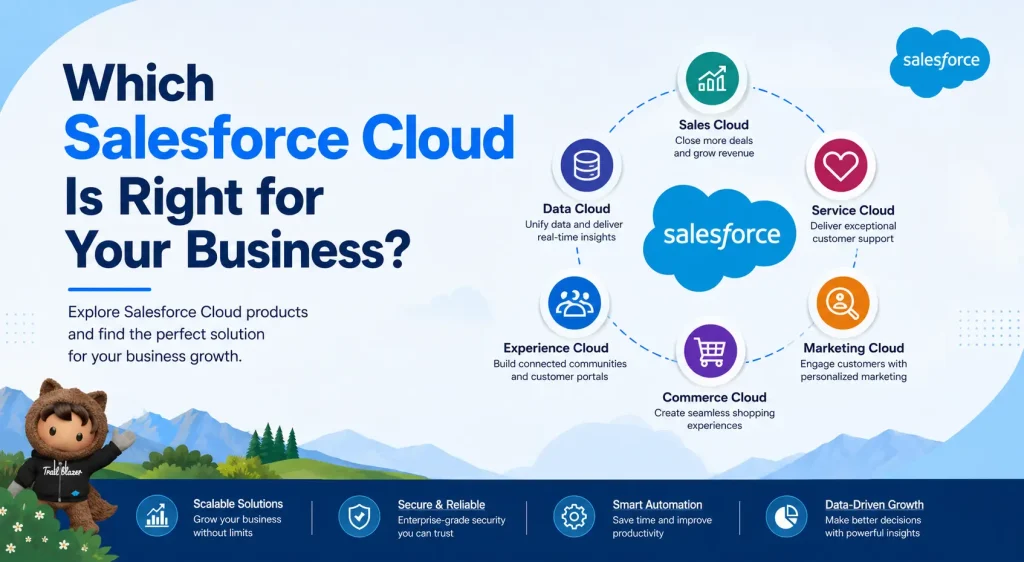
Salesforce offers multiple cloud solutions, each designed for specific business functions.
Sales Cloud helps organizations manage their entire sales process.
It enables sales teams to track leads, manage opportunities, forecast revenue, automate repetitive tasks, and close deals faster.
Best For
Key Features
If your primary goal is increasing sales and managing customer relationships, Sales Cloud is often the best choice.
Service Cloud focuses on delivering exceptional customer support.
It helps customer service teams resolve issues quickly through multiple communication channels such as phone, email, live chat, and social media.
Best For
Key Features
Therefore, businesses looking to improve customer satisfaction should consider Service Cloud.
Marketing Cloud enables organizations to create personalized marketing campaigns.
It helps marketers engage customers through email, SMS, mobile apps, social media, and advertising platforms.
Best For
Key Features
As a result, businesses can deliver highly personalized customer experiences.
Experience Cloud allows businesses to create online communities, customer portals, and partner portals.
Customers can access support resources, track cases, and collaborate with businesses more efficiently.
Best For
Key Features
Furthermore, Experience Cloud improves customer engagement while reducing support costs.
Commerce Cloud helps businesses build powerful online stores.
It provides AI-powered shopping experiences across websites and mobile devices.
Best For
Key Features
Consequently, businesses can improve conversions and customer loyalty.
Data Cloud unifies customer data from multiple systems into a single platform.
Businesses gain a complete customer view for better decision-making and personalization.
Best For
Key Features
Since accurate customer data is essential for modern businesses, Data Cloud has become increasingly popular.
The right Salesforce Cloud depends entirely on your business goals.
| Business Requirement | Recommended Salesforce Cloud |
|---|---|
| Increase Sales | Sales Cloud |
| Improve Customer Support | Service Cloud |
| Run Marketing Campaigns | Marketing Cloud |
| Build Customer Portals | Experience Cloud |
| Sell Products Online | Commerce Cloud |
| Manage Customer Data | Data Cloud |
Therefore, identifying your business priorities is the first step before selecting a Salesforce Cloud.
If you are starting your Salesforce career, understanding these cloud products can give you a competitive advantage.
Most companies expect Salesforce professionals to understand how different cloud solutions work together.
Freshers should begin with:
Later, you can specialize in Marketing Cloud, Data Cloud, or Experience Cloud based on your career goals.
Moreover, earning a Salesforce certification can significantly improve your chances of getting hired.
Learning Salesforce Cloud offers several long-term career advantages.
Some of the biggest benefits include:
As Salesforce adoption continues to grow worldwide, professionals with Salesforce Cloud expertise remain highly valuable.
Before making a decision, consider the following questions:
Answering these questions will help you select the most suitable Salesforce Cloud solution.
Salesforce continues to introduce innovations in Artificial Intelligence, automation, and predictive analytics.
Technologies like Agentforce, Einstein AI, Flow Automation, and Data Cloud are transforming how businesses interact with customers.
Consequently, organizations adopting gain better productivity, improved customer experiences, and faster business growth.
Similarly, professionals who learn this today position themselves for exciting career opportunities in the coming years.
Choosing the right it depends on your organization’s goals, customer needs, and future growth plans. Whether you want to increase sales, enhance customer service, automate marketing, build online communities, manage e-commerce, or unify customer data, Salesforce offers a cloud solution tailored to your needs.
For freshers, understanding the purpose of each is an excellent starting point for building a successful CRM career. Begin with the fundamentals, gain practical experience through projects, and pursue Salesforce certifications to strengthen your skills.
As businesses continue their digital transformation, Salesforce Cloud remains one of the most powerful and in-demand CRM platforms. By selecting the right cloud and investing in the right skills, both organizations and aspiring professionals can unlock long-term success.